

Dental practice bookkeeping is often built to satisfy a CPA every April, not to show whether last month was actually profitable. The books may close and the numbers tie out, while production-collections gaps, EOB write-offs, and hygiene utilization issues stay hidden until year-end.
A healthy production number and a healthy collections number are not the same thing. One of them can be wrong for months before anyone notices.
This is what monthly dental office bookkeeping should catch before it becomes a bigger problem: five specific numbers, reconciled every month instead of once a year.
What Monthly Dental Bookkeeping Actually Covers
| Production vs. collections reconciliation, so a healthy-looking month doesn’t hide a collections shortfall |
| Insurance payment allocation (EOB tracking), separating true write-offs from misapplied adjustments |
| Accounts receivable aging by bucket, especially balances past 60 and 90 days |
| Overhead as a percentage of collections, not a flat dollar figure, covering payroll, supplies, and lab fees |
| Hygiene production tracked separately from doctor production |
| Payroll and doctor compensation, including how owner draws are categorized |
| Bank and merchant account reconciliation tied back to daily deposits, a task made easier with bookkeeping services for dentists built around this exact list |
The challenge isn’t knowing these numbers exist. It’s reconciling them every month instead of finding them at tax time.
Why Dental Office Bookkeeping Has to Track More Than Tax Compliance
Tax-compliance bookkeeping focuses on accurate reporting. Dental office bookkeeping should go further, showing whether production actually turned into expected cash and, if not, where the gap occurred.

Dental practices deal with insurance contracts, payment plans, and write-offs that affect collections. A practice can hit production targets and still fall short on cash, making it essential to track production and collections separately each month.1
When Production Looks Healthy But Collections Fall Behind
Production shows what a dental practice bills. Collections show what it actually receives after insurance adjustments, patient balances, and write-offs. When dental office bookkeeping focuses on production alone, a growing collections gap can easily go unnoticed.

A practice producing $100,000 at a 91% collection rate brings in $91,000. At 98%, it collects $98,000—a $7,000 monthly difference. Tracking both numbers side by side helps catch that gap before it becomes a pattern.
Why Blended Insurance Payments Hide Your Real Collection Rate
Every EOB includes what the insurer paid and what was written off. When they’re recorded as one adjustment, the books can’t distinguish a contractual write-off from a denied payment that may still be recoverable.

Many administrative denials can be recovered if caught in time. Across a large sample of dental claims, the overall denial rate was 8.2%, and nearly 73% of those denials were administrative.2 Tracking insurance payments and adjustments separately each month keeps that revenue visible instead of burying it as a write-off.
What Aging Receivables Actually Cost You Past 60 Days
Not all outstanding balances are equal. A balance 15 days old may still be inside the normal collection cycle, while a 90-day balance is increasingly difficult to collect.

Practices that consistently run over 30 days in accounts receivable often have a payment-posting bottleneck rather than a collections problem.3 Breaking AR into current, 30-, 60-, and 90-plus-day buckets each month makes those issues easier to spot and address.


How Overhead Creep Goes Unnoticed Without Monthly Percentages
Overhead in a dental practice can look normal even when expenses are growing faster than revenue. Payroll, supplies, and lab fees naturally rise with production, making percentage-based tracking essential.
📊 Healthy dental overhead runs 55–65% of collections, with staff payroll around 28%, supplies near 6%, and lab fees near 8%.4

Tracking overhead as a percentage of collections helps catch margin problems early. A 10% increase in lab fees alongside 10% production growth may be healthy; the same increase against flat production is not. A dedicated virtual accountant can monitor these percentages monthly and flag overhead creep before it becomes a year-end problem.
Why Hygiene Production Needs Its Own Line on the Books
Hygiene is often the most consistent, most profitable part of a dental practice, and it’s also the part most likely to get folded into total production without its own line item. That makes it hard to tell whether the hygiene department is performing or just riding along with doctor production.

Tracking hygiene production separately each month makes it possible to catch a slipping recall rate or a scheduling gap while it’s still small, instead of noticing it a year later as a dip in overall revenue with no obvious cause.
What Doctor Compensation and Cash Flow Need From Your Books
Doctor and associate compensation is often tied to production, adjusted production, or collections, and each method can produce a different paycheck. Dental office bookkeeping should track all three separately rather than relying on the payroll system alone.
For S-corp practices, owner pay also requires careful categorization. The IRS requires reasonable compensation to be treated as wages subject to employment taxes, not simply as distributions.5
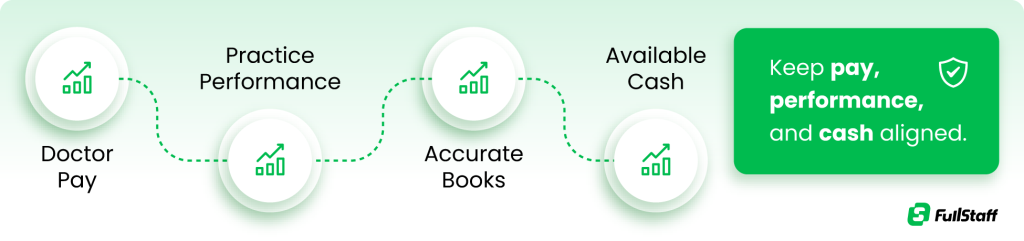
Monthly bank and merchant account reconciliation ties deposits back to collections and helps catch errors across payroll, payments, and reporting.
Conclusion
Dental office bookkeeping should do more than prepare a practice for tax season. Tracking production, collections, EOBs, receivables, overhead, and hygiene production monthly gives owners a clearer picture of financial performance before problems become costly.

Consistent reconciliation also makes doctor compensation and cash flow easier to understand because they’re based on reliable numbers. For practices ready to outsource the process, transparent bookkeeping pricing can make ongoing financial oversight simpler and more predictable.
Frequently Asked Questions (FAQs)
What should a dental bookkeeper track every month?
A dental bookkeeper should reconcile production against collections, allocate insurance payments (EOBs) into write-offs versus disputable denials, age accounts receivable into buckets, track overhead as a percentage of collections, and separate hygiene production from doctor production. Bank and merchant account reconciliation ties all of it back to actual deposits, which confirms the other numbers are accurate rather than just internally consistent.
What’s a healthy collection rate for a dental practice?
The ADA’s KPI framework sets a target collection rate of 98% of adjusted production, meaning a practice keeps nearly all of what it’s contractually entitled to collect. Rates consistently below 95% usually point to a systemic issue in insurance verification, patient payment policy, or claims follow-up rather than a one-month anomaly.
How do you reconcile insurance payments in dental bookkeeping?
Reconciling insurance payments means matching each EOB to the claim it settles, then splitting the difference between billed and paid into two categories: contractual write-offs the practice agreed to under the payer’s fee schedule, and denials that may still be appealable. Entering both as one blended adjustment is the most common way practices lose track of claims that were actually worth fighting for.
What’s a healthy overhead percentage for a dental practice?
A healthy overhead range for most general dental practices is 55–65% of collections, excluding doctor compensation, with staff payroll capped around 28%, supplies near 6%, and lab fees near 8%. Tracking these as percentages rather than flat dollar amounts is what makes it possible to catch overhead creeping ahead of production instead of behind it.
What percentage of collections should go to dental supplies and lab fees?
Dental supplies typically run 5–6% of collections and lab fees 6–8%, with anything meaningfully above those ranges worth investigating. Practices that mill restorations in-house with CAD/CAM often see lab fees drop closer to 2–3% of collections, which shifts the benchmark and should be tracked against the practice’s own baseline rather than a generic industry number.
What’s considered old accounts receivable in a dental practice?
Receivables aged past 60 days start losing collectability, and balances past 90 days are considered old and increasingly unlikely to be collected in full. Best practice is to keep no more than 10% of total AR in the 60-plus bucket and to review 90-plus balances individually each month rather than letting them age into a year-end write-off.
How should hygiene production be tracked separately from doctor production?
Hygiene production should have its own line in monthly reporting, ideally run as a percentage of total practice production, so a slipping hygiene department doesn’t get absorbed into an otherwise healthy overall number. Most practices should see hygiene generating 25–33% of total production; a sustained drop below that range usually points to a scheduling or recall issue rather than a demand problem.
How is dental bookkeeping different from general small business bookkeeping?
General small business bookkeeping tracks revenue, expenses, and cash flow without needing to separate production from collections or manage the insurance layer sitting between the two. Dental bookkeeping has to account for fee schedules, EOB-based insurance reconciliation, production-based compensation models, and hygiene as a distinct revenue center, none of which have a direct equivalent in a typical retail or service business’s books.
How often should a dental practice review its financials?
Financials should be reviewed monthly, with a full reconciliation of bank accounts, production, collections, and AR aging completed within the first two weeks of the following month. Waiting for a quarterly or annual review means a collections gap or overhead creep has had three to twelve months to compound before anyone catches it.
Can AI replace a dental bookkeeper?
AI can automate repetitive parts of dental bookkeeping, like categorizing transactions, flagging overdue balances, and matching bank deposits to production, but it doesn’t replace the judgment needed to interpret an EOB dispute, structure production-based compensation correctly, or explain what a widening collections gap means for the practice. Most dental practices use AI to compress the transactional workload and free their accountant for the analysis and decision support that actually requires a human.
Let FullStaff Handle Your Bookkeeping
Reconciling production against collections, tracking EOBs line by line, and keeping hygiene production visible every month is a lot to ask of a bookkeeper who’s also closing the books for tax season. Dental practice owners usually feel this gap first in accounts receivable, then in a P&L that never quite matches what the bank shows.
Since 2012, FullStaff has connected growing businesses with dedicated virtual accountants and bookkeepers who become part of the team, not a rotating help desk.
- Production and collections reconciliation
- EOB tracking and insurance payment allocation
- Provider-level production reporting
Here’s how the onboarding process works: complete a short kickoff form, meet with our team to outline your practice’s specific reporting needs, and get matched with a dedicated accountant who learns your books instead of starting over every month.
👉 See a sample EOB reconciliation for a 3-doctor practice — Plans start at $200/month, scaling with your practice’s transaction volume and provider count.
References:
- What Is Dental Bookkeeping?
- Administrative and clinical denials by a large dental insurance provider
- A Guide to Dental RCM: Revenue Cycle Management Explained
- Tracking dental practice overhead and what the results mean
- Wage Compensation for S Corporation Officers