

Your Shopify dashboard says sales are up. Your bank deposit says something else. Somewhere between the sale and the settlement, Amazon fees, refunds, and unrecorded COGS are quietly rewriting your numbers before they ever reach your P&L.
Categorizing transactions isn’t the same as understanding your margin. One keeps the IRS satisfied. The other keeps your business solvent.
Below is what separates a bookkeeping setup built for a single-channel store from ecommerce bookkeeping services built for a business running multiple platforms, multiple states, and multiple price points at once, along with what to check if your current provider hasn’t kept pace.
What Ecommerce Bookkeeping Actually Covers
| Reconciles every channel payout (Amazon, Shopify, Walmart, Etsy) against the actual bank deposit, not just the lump sum |
| Tracks COGS and inventory value matched to the period goods were actually sold, not the period they were purchased |
| Breaks out profit by channel and by SKU, so margin isn’t a guess |
| Monitors sales tax exposure as revenue crosses new state nexus thresholds |
| Closes the books on a schedule tight enough to inform pricing and ad-spend decisions |
| Assigns a dedicated professional who already knows marketplace accounting, not a generalist learning on the job |
The challenge isn’t finding someone to enter transactions. It’s finding a service built for how ecommerce actually moves money.
When Multichannel Growth Outpaces Generic Bookkeeping
Selling on more than one channel used to be the exception. It’s now closer to the default. Add a second marketplace, and a bookkeeping setup built around one clean deposit a day starts breaking in ways that don’t show up until month-end.

Retail overall is expected to keep growing too. The National Retail Federation forecasts $5.6 trillion in 2026 retail sales, up 4.4% over 2025.1 For a growing store, that growth usually arrives as new channels, not just more volume on the one you started with.
Why a Single-Channel Setup Breaks First
Generic bookkeeping assumes one revenue stream, one fee structure, and one deposit pattern. Add Amazon’s biweekly payouts on top of Shopify’s daily ones, and a bookkeeper who’s only ever categorized a single feed starts making the same assumption for both, usually the wrong one.
The Real Cost of Inaccurate Settlement Reconciliation
A Shopify payout is mostly straightforward. An Amazon payout isn’t. It bundles gross sales, referral fees, FBA fulfillment charges, ad spend, refunds, and sales tax into a single deposit that shows up every one to two weeks. Recording that deposit as one lump “sales” entry, instead of breaking it into its parts, is the single most common way ecommerce books stop reflecting reality.
| shopify | amazon |
|---|---|
| Sales | Gross Sales |
| Processing Fee | Referral Fees |
| FBA Fees | |
| Ad Spend | |
| Refunds | |
| Sales Tax | |
| *Simple Reconciliation | *Requires Detailed Reconciliation |
Tools built specifically for this exist for a reason. A2X, one of the more established platforms for it, is used by over 13,000 ecommerce businesses specifically to break payouts down by sales, fees, refunds, and taxes before they hit the ledger. That’s the level of detail a payout actually requires. Software can format it, but someone still has to catch when a fee category shifts or a refund pattern changes.
What’s Actually Inside an Amazon or Shopify Payout
Every payout is really several transactions compressed into one bank line. Unbundling it correctly is what makes the difference between a P&L that reflects your business and one that reflects your bank balance.
How Miscategorized COGS Quietly Erodes Your Margin
The most common cost error in ecommerce books isn’t a missing receipt. It’s timing. Recording the cost of inventory when it’s purchased, instead of when it’s sold, overstates expenses in one month and understates them in the next, and if pricing decisions get made off either month, they’re wrong.
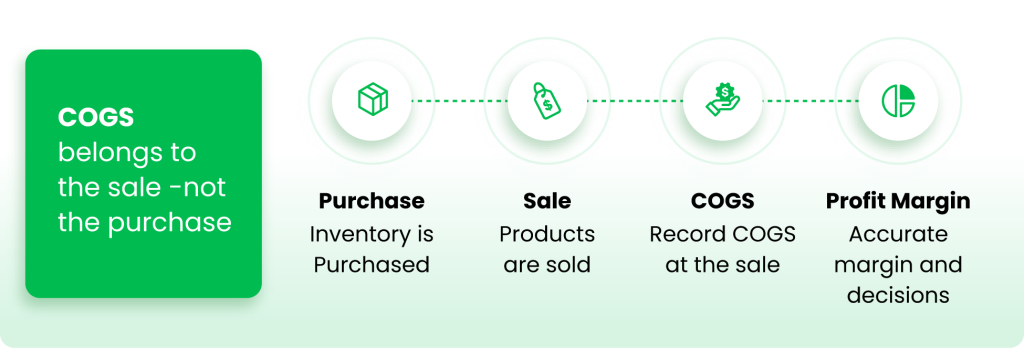
Per-SKU errors compound the problem. A supplier raises a unit cost by a few cents and the change never makes it into the accounting system, or a manufacturer switch happens but the old cost sticks around. Multiply that across a few hundred SKUs and the gap between “what the P&L says” and “what’s actually happening to margin” gets wide fast.
The IRS’s baseline recordkeeping standard requires tracking gross receipts, inventory, and expenses accurately enough to support the numbers on a return.2 That’s the compliance floor. It has nothing to do with knowing which SKU is actually profitable, which is a different, and higher, bar.


Why Categorization-Only Bookkeeping Leaves You Exposed on Sales Tax
Economic nexus is triggered by revenue in a state, not a physical location in it. Most states set the bar around $100,000 in annual sales. States have also been simplifying (and in some cases tightening) these rules: Illinois eliminated its 200-transaction threshold entirely as of January 1, 2026, leaving revenue as the only trigger.3 A seller who was compliant in December can cross a new threshold in January without noticing.
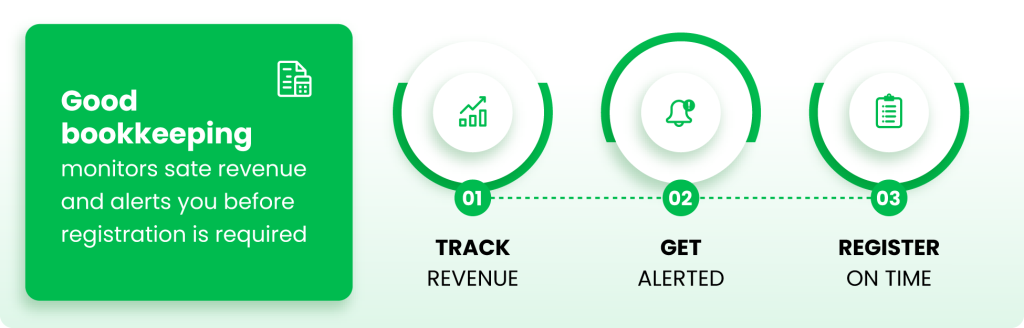
Bookkeeping that only categorizes transactions doesn’t track this. It records the sales tax collected, but it doesn’t watch where you’re approaching a registration requirement in a state you haven’t registered in yet. That’s the layer generic categorization skips, and it’s exactly where ecommerce bookkeeping services need to be doing more than data entry.
What Ecommerce Bookkeeping Services Should Actually Deliver
Real ecommerce bookkeeping produces numbers a business can act on, not just numbers that reconcile. That means a monthly close that lands early enough to inform the next month’s decisions, channel-level and SKU-level P&L instead of one blended number, and a professional who can explain what changed and why, not just confirm that the categories match.
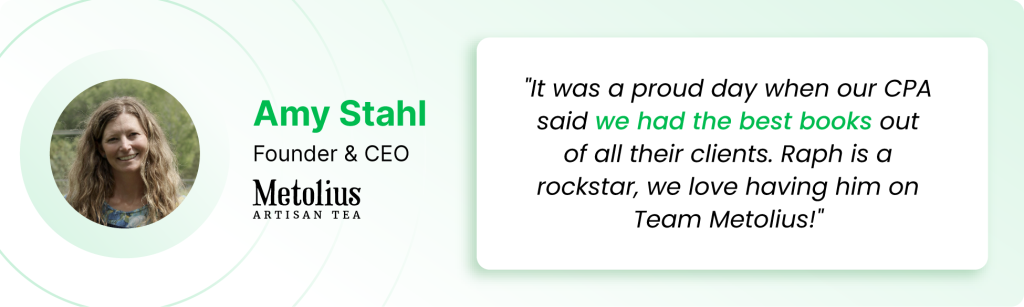
Metolius Tea, a tea importer, manufacturer, wholesaler, and retailer, began closing its books by the 10th of each month after bringing on a senior FullStaff accountant. Product-level margin reporting now supports faster, more informed pricing decisions.
📊 72% of retail executives say they’re shifting product mix toward higher-margin items to protect profitability amid rising costs — Deloitte’s 2026 Retail Outlook.4
That kind of decision is only possible with channel-level and SKU-level margin visibility in the first place. The SBA frames financial understanding as foundational to growth planning for exactly this reason: it’s what a loan application, a pricing decision, or a new-channel bet all depend on.5 It’s also the reasoning behind how FullStaff structures its pricing around the reporting a business actually needs, not a flat monthly rate regardless of complexity.
Signs Your Bookkeeping Setup Isn’t Built for Ecommerce Anymore
A few patterns tend to show up before an owner consciously decides their ecommerce bookkeeping services aren’t keeping up with the business:
| Monthly reports arrive more than two to three weeks after month-end |
| Channel-level or SKU-level profitability isn’t available without asking for it |
| The same reconciliation questions keep coming back unresolved |
| Sales tax registration status across states isn’t something anyone is actively tracking |
| The bookkeeper doesn’t know the difference between a Shopify payout and an Amazon settlement without it being explained |
| Switching providers feels risky because no one’s confirmed how the onboarding process would actually work |
Nearly 45% of small businesses employ neither an accountant nor a bookkeeper at all, according to Clutch.6 Even among those that do, the bigger risk is often relying on bookkeeping that worked at $500K in revenue but was never reassessed as the business grew to $3M.
Conclusion
Ecommerce bookkeeping services become essential once you’re selling across multiple channels, states, and price points. The three areas to audit are settlement reconciliation, accurate COGS tracking, and whether your provider can scale with your business instead of simply processing transactions.

Getting those three right is what turns bookkeeping from a compliance task into a decision-making tool, and it’s worth a closer look before the gap between your dashboard and your bank account gets any wider.
Frequently Asked Questions (FAQs)
What does ecommerce bookkeeping actually include?
Ecommerce bookkeeping covers reconciling payouts from every sales channel to the bank, tracking COGS and inventory value accurately, categorizing platform fees and refunds correctly, monitoring sales tax exposure across states, and producing a monthly close with channel-level reporting. It goes beyond categorizing a bank feed, since the payout complexity of marketplaces like Amazon requires breaking a single deposit into its component parts before anything can be trusted.
How much does a monthly bookkeeping service for ecommerce typically cost?
Pricing generally scales with transaction volume, number of channels, and inventory complexity rather than revenue alone. A single-channel store with straightforward SKUs costs less to reconcile than a multi-channel seller with hundreds of SKUs and fluctuating supplier costs, since the reconciliation and COGS work scales with complexity, not just sales.
How is bookkeeping for ecommerce different from bookkeeping for a regular small business?
A typical small business has a handful of predictable deposits each month. An ecommerce business has payouts that bundle sales, fees, refunds, and taxes across multiple platforms, each with its own settlement schedule and reporting format. The reconciliation work and the inventory/COGS tracking are both meaningfully more involved than standard small business bookkeeping.
How often should Amazon or Shopify settlements be reconciled?
Amazon settlements should be reconciled on the platform’s own payout cycle, typically every one to two weeks, since each payout bundles several transaction types that are easier to unwind close to when they happen. Shopify payouts, which arrive daily and are simpler, are usually reconciled on a weekly or monthly cadence depending on transaction volume.
What are the signs my ecommerce bookkeeping isn’t keeping up with my business?
Common signs include monthly reports arriving weeks after month-end, no visibility into which channel or SKU is actually profitable, unresolved reconciliation discrepancies that recur month after month, and no active tracking of sales tax nexus exposure as revenue grows into new states.
Do I need a bookkeeper who specializes in ecommerce businesses?
Not strictly, but it helps a lot. A bookkeeper unfamiliar with marketplace-specific payout structures is more likely to record a bundled deposit as a single lump sum instead of breaking it into sales, fees, refunds, and tax, which is exactly the kind of error that distorts margin visibility over time.
How does bookkeeping for ecommerce businesses handle multi-state sales tax?
It should actively monitor revenue against each state’s economic nexus threshold (commonly around $100,000 in annual sales) and flag when a new registration requirement is approaching, rather than only recording the sales tax already collected. Since these thresholds are changing state by state, this needs to be an ongoing check, not a one-time setup task.
What happens to my books if my provider shuts down or I switch providers?
This depends entirely on where your data lives. If your books are kept in a platform you own access to, like QuickBooks or Xero, your historical records stay accessible regardless of who was doing the bookkeeping. If a provider used proprietary software you don’t have direct access to, recovering full historical data can be far more difficult, which is itself a reason to prioritize providers who work inside standard accounting platforms.
How do I switch providers without losing historical financial data?
Confirm your books live in a platform you have direct login access to, request a full export of transaction-level detail before making any change, and have the new provider review at least the trailing 12 months for consistency before taking over the close. A clean handoff is far easier when nothing about your financial history was ever locked inside a system you didn’t control.
Can AI replace ecommerce bookkeepers?
AI can automate a meaningful share of the repetitive work (categorization, payout breakdowns, basic reconciliation), but it doesn’t replace the judgment needed to catch a shifted fee structure, question a margin that doesn’t look right, or interpret what a number actually means for a pricing decision. Most growing ecommerce businesses use AI to compress the transactional workload and free up their accountant for the analysis that actually requires a person.
Let FullStaff Handle Your Bookkeeping
Multichannel selling means your books have to account for Amazon settlements, Shopify payouts, inventory that moves faster than your spreadsheet can track it, and sales tax exposure that shifts every time you cross a new threshold. See a sample multi-channel P&L we build monthly for a Shopify and Amazon seller doing $3 million a year.
Since 2012, FullStaff has provided dedicated, US GAAP-trained accounting professionals to growing businesses that have outgrown generic bookkeeping: not a rotating pool, but one team member who learns your channels, your SKUs, and your numbers.
- Settlement reconciliation across Amazon, Shopify, Walmart, and Etsy
- Channel-level and SKU-level margin tracking
- Inventory accounting matched to when goods actually sell
Here’s how it works: complete a short kickoff form, meet with our team to walk through your channels and current setup, and get matched with a dedicated accounting professional who takes it from there.
👉 Talk to FullStaff about ecommerce bookkeeping — Plans start at $200/month, scaling with transaction volume and channel count.
References:
- National Retail Federation — NRF Forecasts 4.4% Annual Retail Sales Growth with New Economic Model
- IRS — Publication 583, Starting a Business and Keeping Records
- Numeral — Economic Nexus: State-by-State Handbook for 2026
- Deloitte — 2026 Retail Industry Outlook
- U.S. Small Business Administration — Understand Your Finances and Grow Your Business
- Clutch — Why Small Businesses Lack Accounting Resources