
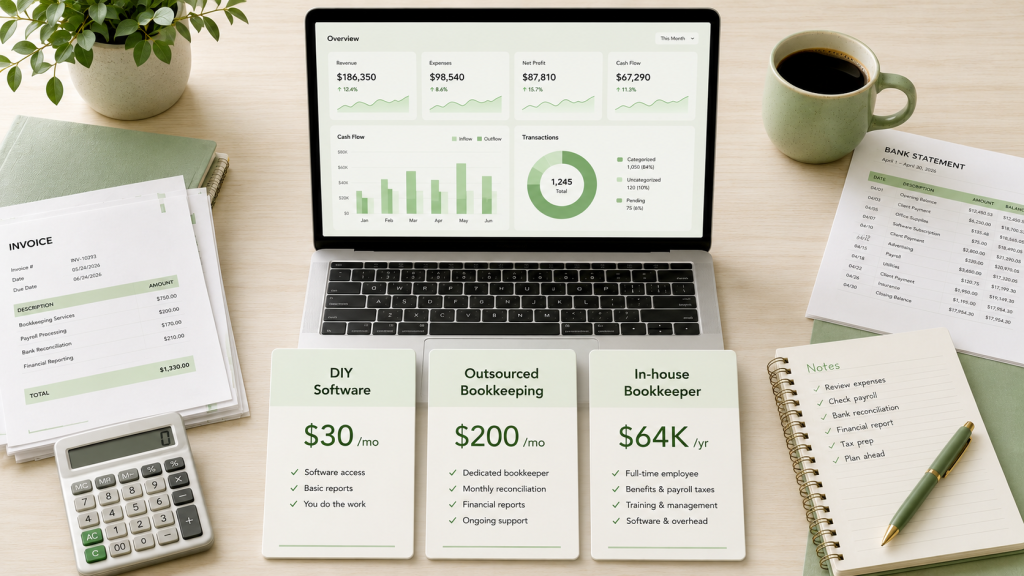
Ask three providers to quote the same set of books and you can get numbers from $200 a month to more than $2,000, with no clear explanation of the gap. For an owner already juggling cash flow, a monthly close that slips into the following month, and an AR aging report nobody has reviewed since March, that spread reads like guesswork. It isn’t.
The spread is information. Price follows the complexity of your books. Score that complexity first, and the quotes start making sense.
This guide breaks down the real cost of bookkeeping services for small business in 2026: what each model charges, the in-house math owners tend to underestimate, why prices are climbing, and how to match a budget to your stage instead of chasing the lowest number.
What Bookkeeping Services Actually Cost in 2026
| Flat-fee online bookkeeping services typically run $200 to $700 per month, with premium tiers at $1,000 and up |
| Freelance bookkeepers charge roughly $25 to $80 per hour depending on experience and location |
| An in-house bookkeeper costs about $64,000 a year once benefits are added to the median salary, before software and training |
| Full-service arrangements for complex businesses reach $2,500 or more per month |
| DIY is free on paper and expensive in owner hours, error risk, and late financial visibility |
| Five drivers set your price: transaction volume, number of accounts, payroll headcount, inventory complexity, and the current state of your books |
The challenge is matching the model to your stage, not finding the lowest number.
Why Two Quotes for the Same Business Can Be $1,000 Apart
Bookkeeping is priced based on workload, and workload hides in details that don’t show up in a revenue figure. Two businesses each generating $800K a year can require vastly different amounts of accounting work. One sells consulting through a single bank account. The other has 14 employees, two credit cards, a line of credit, and inventory across three sales channels.
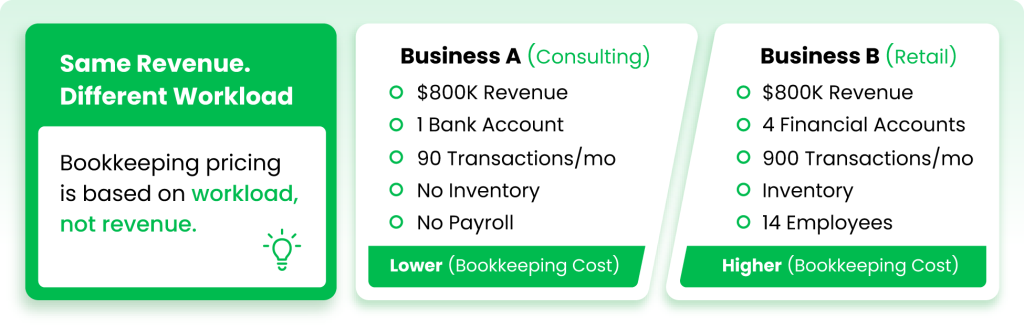
Five factors drive most bookkeeping quotes. Transaction volume comes first, since reconciling 900 monthly transactions takes far more time than reconciling 90. The number of bank, credit card, and loan accounts also matters because each account requires its own reconciliation.
Payroll and contractor headcount add tax filings and 1099-NEC reporting. Inventory or cost of goods sold creates additional accounting work, while the condition of your books can increase costs if months of uncategorized transactions need to be cleaned up before regular bookkeeping begins.
This is why requesting a quote before assessing your own complexity wastes everyone’s time. When you know your monthly transaction count, account list, and headcount, you can evaluate the cost of bookkeeping services for small business the way providers do: as a workload estimate, not just a sticker price.
What the Cost of Bookkeeping Services for Small Business Looks Like by Model
The market has settled into five models, and they aren’t interchangeable. Each buys a different close cadence, a different depth of review, and a different amount of judgment applied to your numbers.
📊 Small businesses should expect to pay around $300 or more per month for bookkeeping, with flat-fee packages ranging from roughly $200 to $700 and premium tiers passing $1,000.1
| Bookkeeping Model | Typical Cost |
|---|---|
| DIY Software | $0-$100/mo |
| Freelance Bookkeeper | $25-$80/hr |
| Online Bookkeeping Service | $300-$1,500/mo |
| In-house Bookkeeper | ~$64k/year |
| Dedicated Outsourced Professional | $200-$1,000/mo |
DIY software
Accounting software subscriptions run $0 to about $100 per month. The dollar cost is the whole appeal. The actual cost is your evenings, and it compounds as volume grows: categorization, reconciliations, and a close that happens whenever you get to it. Workable for a solo operator with light volume. Increasingly costly past that.
Freelance bookkeeper
Freelancers charge roughly $25 to $80 per hour. A business with a few hours of monthly work might spend $200 to $500. The trade-off is capacity and continuity: one person, their availability, and no coverage when they take on a bigger client or leave.
Online bookkeeping services for small business
Flat-fee subscriptions have largely replaced hourly billing in this segment. Typical packages run $300 to $1,500 per month depending on tier.2 Basic tiers cover categorization and reconciliations; higher tiers add accrual accounting, inventory, and dedicated review. Predictable pricing is the draw. The limit is standardization, since packages define what’s included and your edge cases may not be.
In-house hire
Based on average salary alone, a hired bookkeeper runs roughly $3,500 per month before benefits, software, and overhead. The full math gets its own section below, because this is where owners most often under budget.
Dedicated outsourced professional
The middle path: a specific person who works your books on bookkeeping services built for small businesses, without the employment overhead. Pricing typically lands between $200 and $1,000 per month depending on scope, and it scales with the business instead of stepping up in salary-sized increments.
PhotoUp, a real estate photo editing company with 200-plus employees and an international entity structure, was paying five figures a year to a legacy accounting firm that still couldn’t produce timely consolidated statements. One dedicated senior accountant took over a single entity’s books, absorbed every subsidiary within a few months, and now delivers US and global consolidated financials monthly at a fraction of the prior bill.
The In-House Math Owners Underestimate
The salary is the floor, not the cost. That distinction gets missed in almost every “should I just hire someone” conversation.
📊 The average annual wage for bookkeeping, accounting, and auditing clerks was $53,560, or $25.75 per hour, in May 2025.3
Benefits sit on top of that number, and they are not a rounding error.
📊 Benefit costs account for 29.9% of total employer compensation in private industry, according to the U.S. Bureau of Labor Statistics.4
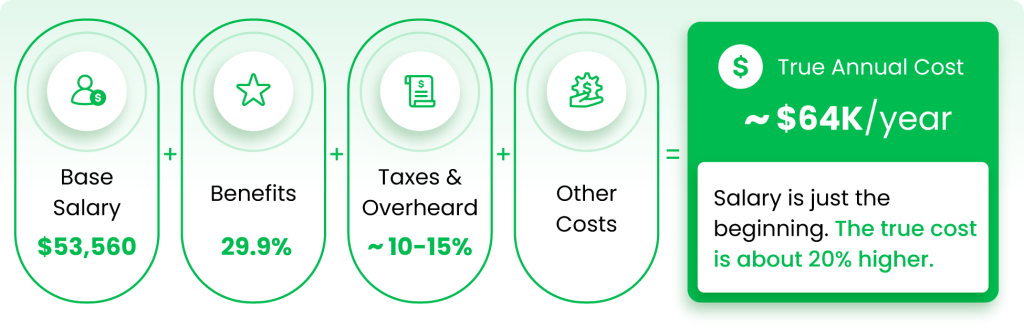
Apply that benefit load to the average salary and the real figure approaches $69,000 to $70,000 a year before anyone opens a ledger. The SBA’s long-standing rule of thumb points in the same direction: an employee’s true cost typically runs 1.25 to 1.4 times base salary once taxes and overhead are counted.5 Then come the costs that never make the comparison spreadsheet: software seats, training, recruiting time, and vacation coverage.
There is also the quiet operational risk of a single point of failure. When your only bookkeeper resigns in March, your close, your payables, and your institutional knowledge resign with them.
None of this argues against hiring dedicated accounting help when volume justifies it. A business generating enough daily transaction work to fill 40 hours a week needs a full-time person somewhere. The argument is narrower: compare the fully loaded number, not the salary, against the alternatives.


What “Free” DIY Bookkeeping Costs in Hours and Decisions
Doing your own books has a price. It’s just denominated in hours and stale information instead of dollars.
📊 40% of small business owners say bookkeeping and taxes are the worst part of owning a business, and 40% report spending more than 80 hours a year on tax preparation.6
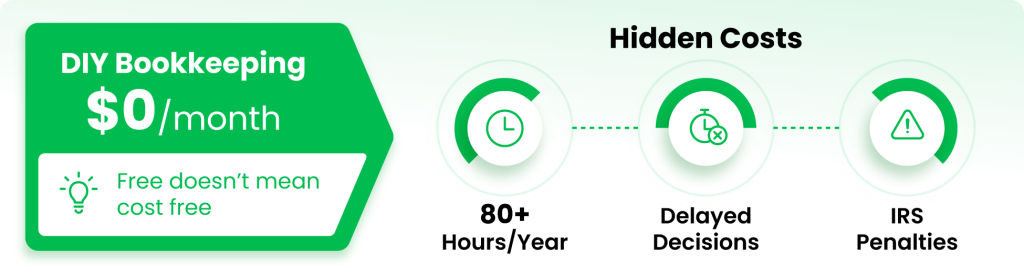
The hours are the visible cost. Businesses with 10 to 99 employees spend an average of 25 hours a week on manual data entry and reconciling data across apps.7 At that point, bookkeeping becomes a part-time job on top of running the business.
The hidden cost is decision quality. Books that close weeks late lead to outdated pricing, hiring, and cash flow decisions. Compliance mistakes are expensive, too. The IRS failure-to-deposit penalty ranges from 2% to 15% of unpaid payroll taxes, depending on how late the payment is.8 Even one missed deadline can cost more than a month of professional bookkeeping.
Why Bookkeeping Prices Are Rising and What It Means for Your Budget
The supply side of the market is tightening, putting upward pressure on the cost of bookkeeping services for small business.
📊 Schools awarded 55,152 accounting bachelor’s and master’s degrees in the 2023–2024 academic year, down 6.6% from the prior year, according to the Journal of Accountancy.9

For small businesses, the most sustainable options are often flat-fee services or dedicated offshore professionals who follow US GAAP standards at a lower cost. Certified bookkeepers also earn 10% to 24% more than their uncertified peers, reflecting the value of experience and credentials.10
How to Match Your Bookkeeping Budget to Your Business Stage
The right bookkeeping budget should support where your business is headed, not where it has been.
Businesses earning under $100K can often manage with DIY software or a freelance bookkeeper for $100 to $400 per month. Between $100K and $1M, growing complexity makes $200 to $1,000 per month a common range for flat-fee or dedicated bookkeeping services. Beyond $1M, businesses typically need accrual accounting and more detailed reporting, with budgets starting around $1,000 to $2,500+ per month.
Rather than revenue alone, watch for signs you’ve outgrown your current setup. Common upgrade triggers include:
- Your first payroll run
- Your first inventory count
- A lender requesting financial statements you can’t produce
- Your bookkeeper leaving unexpectedly
Before signing with a provider, ask these five questions:
| What is included in the monthly price, and what triggers extra fees? |
| Who will manage my books, and what happens if they leave? |
| When will I receive my monthly financials? |
| How is cleanup priced if my books need work? |
| Which accounting software do you use, and who owns the file if we part ways? |
A reputable bookkeeping provider should answer all five clearly before you sign.
Conclusion
The cost of bookkeeping services for small business can range from a low-cost software subscription to a fully loaded in-house hire. The right choice depends on your transaction volume, business complexity, and growth stage, not just your budget.

Before comparing quotes, assess your monthly workload, account count, and staffing needs. As your business grows, use operational milestones, not just revenue, to determine when it’s time to upgrade your bookkeeping solution.
Ultimately, good bookkeeping delivers more than accurate records. It provides timely financial insights that help you make better business decisions. If you’re evaluating providers, request a sample monthly close package and a quote based on your actual workload rather than a one-size-fits-all pricing tier.
Frequently Asked Questions (FAQs)
How much does a bookkeeper cost per month for a small business?
Typical small businesses pay around $300 per month, with flat-fee online services ranging from roughly $200 to $700 and premium tiers exceeding $1,000. The final number tracks transaction volume, number of accounts, payroll headcount, inventory complexity, and whether your books need cleanup before maintenance begins.
How much do bookkeepers charge per hour in 2026?
Freelance bookkeepers charge roughly $25 to $80 per hour, with most experienced independents in the $40 to $60 range. Employed bookkeepers earn a median of $23.66 per hour according to the Bureau of Labor Statistics, but a freelancer’s rate covers their own taxes, software, and unbillable time, which is why it runs higher than the wage.
Is it cheaper to outsource bookkeeping or hire in-house?
For most businesses under a few million in revenue, outsourcing costs less: $2,400 to $18,000 per year for a flat-fee or dedicated service versus roughly $64,000 fully loaded for a median in-house hire. In-house wins only when daily transaction volume genuinely fills a 40-hour week, which usually happens well past the point owners assume it does.
What is the difference between a bookkeeper and a CPA, and which one do I need?
A bookkeeper records transactions, reconciles accounts, and produces your monthly close; a CPA interprets those records for tax strategy, filings, and advisory work at a higher hourly rate. Most small businesses need both, but at different cadences: bookkeeping is a monthly function, while CPA work concentrates around tax season and major decisions, and clean monthly books reduce what you pay the CPA to sort out.
How much should a small business budget for bookkeeping as a percentage of revenue?
A workable planning range is 1% to 2% of revenue for bookkeeping and basic accounting combined at revenues under $1M, declining as a percentage as you scale. Treat it as a starting estimate rather than a rule, because complexity drives cost more than revenue does; a $500K business with inventory and payroll can legitimately cost more to keep than a $900K consultancy.
What does an online bookkeeping service include for the monthly fee?
Standard packages of online bookkeeping services for small business include transaction categorization, bank and credit card reconciliation, and monthly financial statements, usually on cash basis at entry tiers. Accrual accounting, inventory tracking, payables management, and dedicated review typically sit in higher tiers or cost extra, so confirm which tier matches your complexity before comparing prices.
How much does catch-up or cleanup bookkeeping cost?
Cleanup is usually priced per month of backlog after the provider reviews the state of your books, so the honest answer is a quote, not a rate card. Cost scales with the same drivers as ongoing work: transaction volume, accounts, and how tangled the existing records are. Getting cleanup scoped and finished matters more than its price, because every provider’s ongoing fee assumes current books.
Can I do my own bookkeeping to save money?
Yes, and at low volume it can be the right call if you reconcile every month without fail. The savings erode as volume grows: SCORE found 40% of owners call bookkeeping and taxes the worst part of ownership, and the hours diverted from revenue work, plus the risk of stale numbers and payroll tax penalties, routinely exceed the fee you avoided paying.
Can AI replace a bookkeeper?
AI now handles a meaningful share of the transactional layer, including categorization, matching, and first-pass reconciliation, but it does not replace human judgment on accruals, error investigation, compliance questions, or what the numbers mean for a decision. The practical effect is that AI compresses the routine work inside a bookkeeping service while the professional applies judgment on top of it, which is why AI has changed bookkeeping pricing more than it has changed the need for a bookkeeper.
Let FullStaff Handle Your Bookkeeping
If your close keeps sliding, your AR aging hasn’t been reviewed in months, and you’re pricing decisions off numbers from two quarters ago, the fix is capacity, not another software subscription. Request a sample monthly close package and a quote built on your actual transaction volume.
Since 2012, FullStaff has placed dedicated, degreed accounting professionals with growing US businesses, working to US GAAP standards as a consistent member of your team rather than a rotating resource.
- Bank and credit card reconciliation, every month, on schedule
- A monthly close you can rely on, delivered with your P&L
- Financial statements clean enough for your CPA, your bank, and your decisions
Here’s how it works: complete a short kickoff form, meet with our team to define scope, and get matched with a dedicated professional who learns your business and stays with it.
👉 Get started with FullStaff — Plans start at $200/month and scale with your transaction volume.
References:
- NerdWallet — Bookkeeping Prices for Small Business: What to Expect in 2026
- QuickBooks — How Much Does a Bookkeeper Cost in 2026
- National employment and wage data from the Occupational Employment and Wage Statistics
- U.S. Bureau of Labor Statistics — Employer Costs for Employee Compensation, December 2025
- SBA — How Much Does an Employee Cost You?
- SCORE — The Burden of Small Business Accounting, Taxes and Payroll (via PR Newswire)
- Intuit QuickBooks — Business Solutions Survey 2024
- IRS — Failure to Deposit Penalty
- Journal of Accountancy — The Accounting Graduate Pipeline: Where Do Things Stand?
- Forbes Advisor — How Much Do Bookkeepers Make? A Salary Breakdown