

Many agents hire the first bookkeeping provider that seems reliable. Months later, they discover commission records don’t match brokerage statements, expenses were categorized incorrectly, or tax questions are harder to answer than they should be.
Not every bookkeeping service understands real estate. The difference shows up fast, in how they answer seven specific questions.
Ask them before you sign, not after your first tax season with them goes sideways. Below are the seven questions worth asking any bookkeeping service for real estate agents, and what a real answer sounds like versus a generic one.
What to Look for in a Real Estate Bookkeeping Service
| Direct experience with commission-based income, not just small business bookkeeping in general |
| Records commissions at the gross amount, with splits, referral fees, and transaction fees itemized separately |
| Manages 1099-NEC obligations in both directions, the one you receive and the ones you issue |
| Helps you set aside and pay quarterly estimated taxes proactively, not just report on them after the fact |
| Reconciles bank accounts, credit cards, and the commission ledger against closing statements every month |
| Categorizes real estate-specific expenses correctly, including staging, MLS dues, marketing, and mileage |
| Prices clearly, with a model that makes sense whether you’re a solo agent or part of a team |
None of these questions require a finance background to ask. They just require asking them before the relationship starts.
Do They Actually Specialize in Bookkeeping for Real Estate Agents?
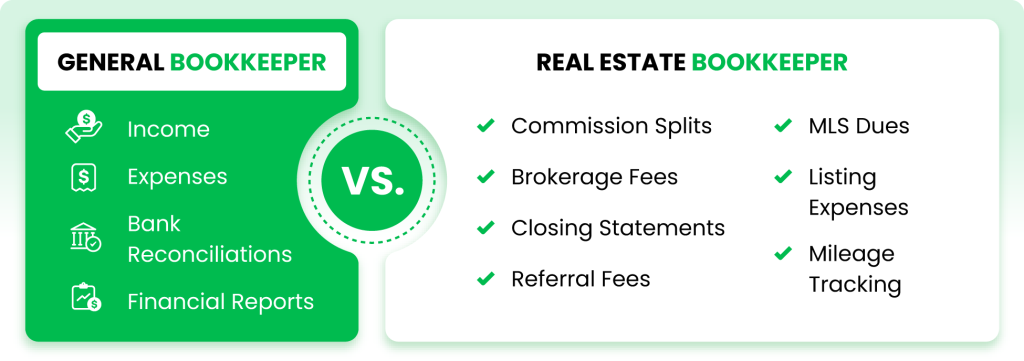
A lot of providers advertise “bookkeeping for real estate agents” as one line on a services page that otherwise lists twelve other industries. That’s not automatically disqualifying, but test it directly. Ask how many real estate clients they currently manage, and ask them to describe, unprompted, how they’d record a closing.
If the answer is simply, “We categorize your income and expenses,” you’re probably talking to a general bookkeeper. A bookkeeping service for real estate agents should know how to handle commission splits, brokerage fees, and irregular commission deposits to give you an accurate picture of your revenue.
📊 86% of REALTORS® are independent contractors at their own firms, which means the bookkeeping and tax obligations of running a business fall entirely on the agent, not an employer.1
This matters because self-employment tax alone runs 15.3% on top of income tax, and a provider without real estate experience is less likely to flag it early.2 A specialist should bring this up in the first conversation, unprompted.
How Do They Record Commission Income — Gross or Net?
This is the single most common real estate bookkeeping mistake, so ask about it directly. A $9,000 gross commission can become a $5,600 deposit after the broker split, a referral fee, and a transaction fee. Providers who book the $5,600 and move on are erasing information you need.
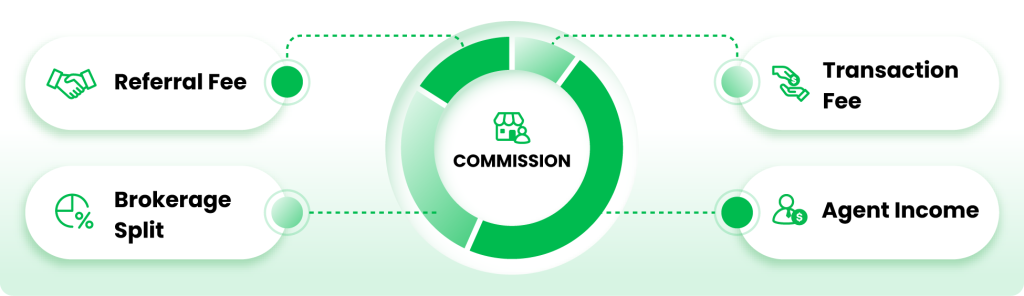
Schedule C asks for gross receipts, not the net number that landed in your account, so booking net from the start creates a mismatch that eventually has to get untangled by hand.3 The fix is a commission ledger: one row per closing, with sale price, gross commission, split percentage, fees, referral payouts, and net received all itemized.
Ask a prospective provider to walk you through exactly what fields their commission ledger tracks. If they can’t answer specifically, they’re probably still working from net deposits.
Can They Handle 1099-NEC for the Contractors You Pay?
Agents sit on both sides of the 1099-NEC. Your brokerage issues one to you. You likely owe them to the photographer, the stager, and the transaction coordinator you paid as contractors throughout the year.

Ask how the provider tracks payments toward that threshold throughout the year, not just in January when forms are due. Ask whether they collect a W-9 from every vendor at the time of first payment, since chasing one down in January from a stager who’s moved on is a common and avoidable scramble.
How Do They Keep You Ahead of Quarterly Estimated Taxes?
Nobody withholds taxes from a commission check. The full amount lands in the account looking like spendable money, which is exactly the assumption that gets agents in trouble in their first year or two of self-employment.
Independent contractors expecting to owe $1,000 or more for the year are required to make quarterly payments using Form 1040-ES, and underpaying triggers a penalty even if the full balance gets paid at filing.4


Ask a prospective provider whether they calculate and remind you of these deadlines proactively, or whether quarterly taxes are something you’re expected to track yourself and just bring up at year-end.
The IRS charges an underpayment penalty on top of the tax owed when estimated payments fall short, so a provider who waits until April to mention this has already cost you money.5 A bookkeeping service worth hiring treats this as a running conversation, not a once-a-year line item.
What Does Their Monthly Reconciliation Actually Include?
“We categorize your transactions” is not the same thing as reconciliation. Ask what specifically gets checked each month, and how discrepancies get resolved.
A real monthly close means your bank statement, credit card statement, and commission ledger are matched against actual closing statements, with every discrepancy resolved. It should also include mileage and vehicle expense tracking, one of the largest deductions many real estate agents claim.

Ask whether mileage gets reconciled monthly against a contemporaneous log, or reconstructed once a year from memory. The second approach rarely survives a closer look.
Do They Know How to Categorize Real Estate-Specific Expenses?
Staging invoices, MLS dues, listing photography, lockbox fees, and client closing gifts are the categories a generalist bookkeeper miscategorizes or, worse, misses entirely because nothing about them looks unusual on a bank statement.

Ask a candidate provider to name five expense categories specific to real estate agents without prompting. If staging, MLS dues, and mileage aren’t on that list within the first few seconds, they haven’t done this work before. Every missed category is a deduction you paid for and didn’t get credit for.
What Does a Bookkeeping Service for Real Estate Agents Actually Cost, and How Does It Scale?
Pricing conversations get vague fast, so push for specifics: what’s included at the base tier, what triggers a higher tier, and whether pricing is flat or tied to transaction volume.
This matters more if you work in a team. Team-based agents need split accounting across multiple people, not just one commission stream, and that’s a meaningfully different scope of work than solo bookkeeping.

📊 21% of REALTORS® work as part of a team, and team-based specialists reported a median of 32 transaction sides and $17.5 million in sales volume in 2025, compared to nine sides and $2.7 million individually.1
Ask directly whether their pricing model accounts for that difference, and whether it scales predictably as your volume grows or drops in a slow season. A bookkeeping service for real estate agents that can’t explain its own pricing clearly probably can’t explain your books clearly either.
Choosing the Right Fit
Choosing a bookkeeping service for real estate agents comes down to how a provider answers these seven questions, not how polished their homepage looks. Specialization, gross-commission accounting, 1099 handling in both directions, proactive quarterly tax guidance, real monthly reconciliation, correct expense categorization, and transparent scalable pricing. That’s the checklist.

Ask each of the seven directly, in the first conversation, before any contract gets signed. A provider that answers specifically and without hesitation has done this work before. One that answers in generalities is asking you to find out the hard way, at tax time.
Frequently Asked Questions (FAQs)
How much does bookkeeping cost for real estate agents?
Pricing varies with transaction volume and whether you’re a solo agent or part of a team, so ask any provider for a specific number tied to your situation rather than a general range. What matters more than the sticker price is what’s included at that price: full reconciliation and commission-ledger tracking, not just basic categorization.
What’s the difference between a bookkeeper and a CPA for real estate agents?
A bookkeeper handles the ongoing recordkeeping: categorizing transactions, reconciling accounts, and maintaining the commission ledger. A CPA typically prepares and files your tax return and advises on tax strategy. The IRS maintains a directory of credentialed tax preparers if you’re vetting a CPA separately from your bookkeeping provider. Many agents use both, with the bookkeeper’s clean monthly records making the CPA’s tax-season work faster and cheaper.
Do I need a bookkeeping service if I already use QuickBooks Self-Employed?
Software captures transactions; it doesn’t reconcile them, catch a missed 1099 obligation, or flag that a closing didn’t post correctly. QuickBooks Self-Employed is a reasonable starting point for a brand-new agent with a handful of transactions, but most agents outgrow DIY software once volume increases or the books fall more than a quarter behind.
Should I hire a local bookkeeper or a virtual outsourced service?
Local providers offer in-person meetings, which some agents prefer for building trust early on. Virtual services typically offer more real estate-specific specialization for the price, since they aren’t limited to bookkeepers within driving distance. Either can work well as long as the specialization and reconciliation questions above get clear answers.
What information does a bookkeeping service need to get started?
Expect to provide bank and credit card statements, your commission structure and split agreement with your brokerage, prior-year tax returns if you’re switching providers mid-relationship, and access to whatever accounting software you’re currently using. A provider who asks detailed questions about your split structure upfront is signaling real estate familiarity.
Can a bookkeeping service handle 1099-NEC for my contractors?
Yes, and this should be a standard part of the service, not an add-on. Ask specifically whether they collect W-9 forms from your vendors at the time of first payment and track cumulative payments toward the reporting threshold throughout the year, rather than scrambling to compile everything in January.
How often should my books be reconciled?
Monthly, at minimum. Reconciliation catches errors such as a duplicate charge, a closing that never posted, or a bank feed gap while the details are still fresh and recoverable, rather than letting twelve months of small errors compound into a messy year-end cleanup project.
Do real estate teams need different bookkeeping than solo agents?
Yes. Team-based bookkeeping has to track splits across multiple agents, not just one commission stream, and often involves reconciling a team lead’s override against each member’s individual production. Ask a provider directly whether they’ve managed team accounts before, since the complexity is meaningfully different from solo agent bookkeeping.
What happens if I switch bookkeeping services mid-year?
A competent provider will ask for your books to date, reconcile everything since your last confirmed clean month, and flag any gaps before taking over ongoing work. Switching mid-year is common and manageable as long as the new provider does a proper catch-up reconciliation rather than just picking up where the software left off.
Can AI replace a bookkeeper for real estate agents?
AI now handles a meaningful share of the transactional layer, including categorizing expenses, matching bank feeds, and flagging anomalies, and does it faster than manual entry. It doesn’t replace judgment on the parts that carry real risk: gross-versus-net commission treatment, 1099 classification calls, and catching the error the automation itself introduced. The practical setup for most agents is AI-assisted tools paired with an experienced bookkeeper who reviews and closes the month.
Let FullStaff Handle Your Bookkeeping
You now have seven questions to ask other providers. Here’s how FullStaff answers them: real estate specialization, gross-commission ledgers, 1099-NEC support in both directions, proactive quarterly tax guidance, and monthly reconciliation that actually reconciles.
Since 2012, FullStaff has matched growing businesses with dedicated, degree-qualified accountants who work to US GAAP standards. You get a consistent team member, not a rotating resource.
For real estate agents, that includes:
- Commission ledger recording and reconciliation
- Trust-account recordkeeping and monthly reconciliation
- Bank and credit card reconciliation
- 1099-NEC preparation support
- Agent split reconciliation
- Catch-up bookkeeping
Here’s how it works: complete a short kickoff form, meet with our team to define what your books need, and get matched with a dedicated accounting professional who learns your business and keeps the close on schedule.
👉 Get started with FullStaff — Plans start at $200/month and scale with your transaction volume.
References:
- National Association of REALTORS® — 2026 Member Profile News Release
- IRS — Self-Employment Tax (Social Security and Medicare Taxes)
- IRS — About Schedule C (Form 1040)
- IRS — About Form 1040-ES, Estimated Tax for Individuals
- IRS — Underpayment of Estimated Tax by Individuals Penalty