

Dental practices often end up with two sets of numbers. Production lives in the practice management system, while collections sit in QuickBooks. Without reconciling the two, collection gaps can go unnoticed until cash flow suffers.
That gap has a cost. Production looks healthy while collections slip, EOBs remain unposted, and cash flow issues build in the background.
Bookkeeping services for dentists reconcile production with collections, giving practices a clear picture of what they actually keep. With 55.3% of dentists citing insurance issues as one of their biggest challenges, ahead of staffing and overhead,1 accurate financial reconciliation is more important than ever.
What Dental Bookkeeping Services Actually Cover
| Monthly reconciliation of production, adjustments, and collections between your practice management software and your accounting file |
| EOB tracking and insurance payment allocation, so write-offs and contractual adjustments land in the right categories |
| A dental-specific chart of accounts that separates supplies, lab fees, and payroll into their own lines |
| Provider-level production reporting, with doctor production and hygiene production tracked separately |
| Overhead reported as a percentage of collections, measured against dental benchmarks |
| A month-end close on a fixed date, with financial statements the owner can act on |
The challenge is consistency, not complexity.
Why Dental Practice Finances Feel Harder Than They Should
A dental practice runs on two record systems that measure different things. The practice management system tracks production, adjustments, and patient balances, while the accounting system records cash, expenses, and payroll.
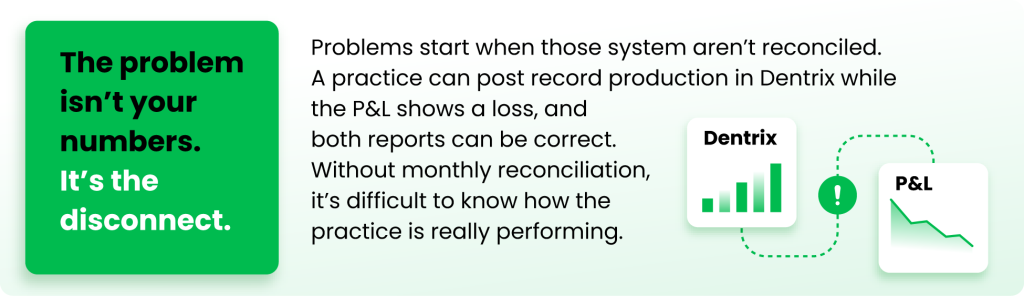
Problems start when those systems aren’t reconciled. A practice can post record production in Dentrix while the P&L shows a loss, and both reports can be correct. Without monthly reconciliation, it’s difficult to know how the practice is really performing.
The IRS notes that good records help monitor business performance and prepare accurate financial statements, not just support a tax return.2 Yet many dental practices keep books mainly for tax filing, leaving owners to manage a growing business by checking the bank balance.
What Bookkeeping Services for Dentists Actually Include
A generic bookkeeper categorizes bank transactions. A dental bookkeeper starts from your production reports and works toward the bank, which changes what the service includes.
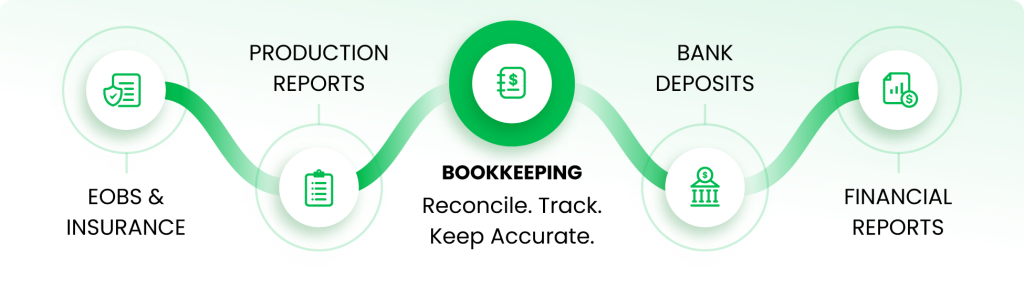
Production, adjustments, and collections reconciled monthly
Each month, gross production is reconciled to adjusted production, net collections, and bank deposits. When the numbers don’t match, discrepancies are investigated before the books close. This process helps uncover missed insurance payments, unposted EOBs, and misapplied patient credits while they’re still easy to fix.
EOB tracking and insurance payment allocation
Every EOB includes three key figures: the amount billed, the amount allowed, and the write-off. Posting them as a single deposit hides contractual adjustments and distorts your collection rate. Most denied claims are also clerical, not clinical, making them easier to identify and resolve before they impact cash flow.
📊 A peer-reviewed study of a large dental insurer found 8.2% of claims were denied — and 72.88% of those denials were administrative, not clinical.3
Provider-level reporting and a dental chart of accounts
A two-doctor practice with three hygienists needs to know who produces what. Provider-level reporting splits doctor production from hygiene production, which feeds associate compensation, hygiene department targets, and scheduling decisions. Under it all sits a chart of accounts built for dentistry, one that doesn’t bury lab fees inside “cost of goods sold.”


The Production–Collections Gap Is Where Revenue Quietly Leaks
Adjusted production is what you expect to collect after write-offs. Net collections are what arrived. The ratio between them is the single most revealing number in dentist bookkeeping, and most practices can’t produce it on demand.
Industry averages show why. The widely used target is to collect 98% of adjusted production, yet the average office runs well below it. On $1 million of adjusted production, each point of slippage is $10,000 that was earned, written into the schedule, and never banked.
📊 The average dental office collects 91% of the revenue it’s owed, and carries 18% of accounts receivable more than 90 days past due.4
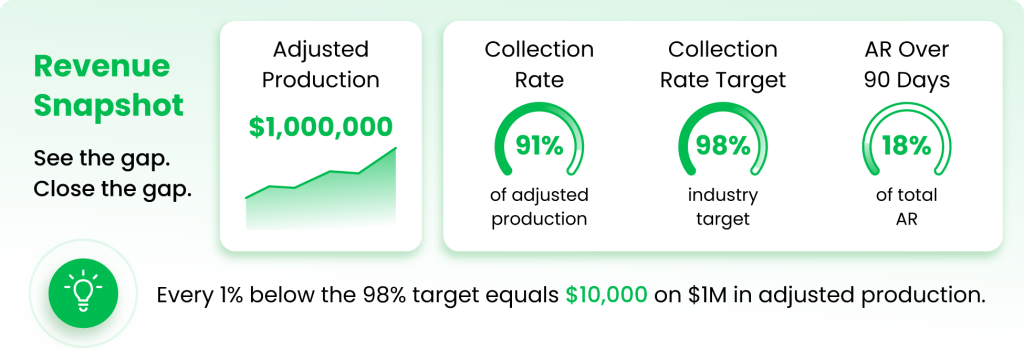
The leak rarely announces itself. It shows up as insurance aging nobody works, secondary claims that never get filed, and patient balances that quietly pass the 90-day mark, where their value starts eroding fast. Monthly bookkeeping services for dentists put this on one page: adjusted production, collections, the ratio, and the aging that explains the difference.
A Dental Chart of Accounts Turns Your P&L Into a Management Tool
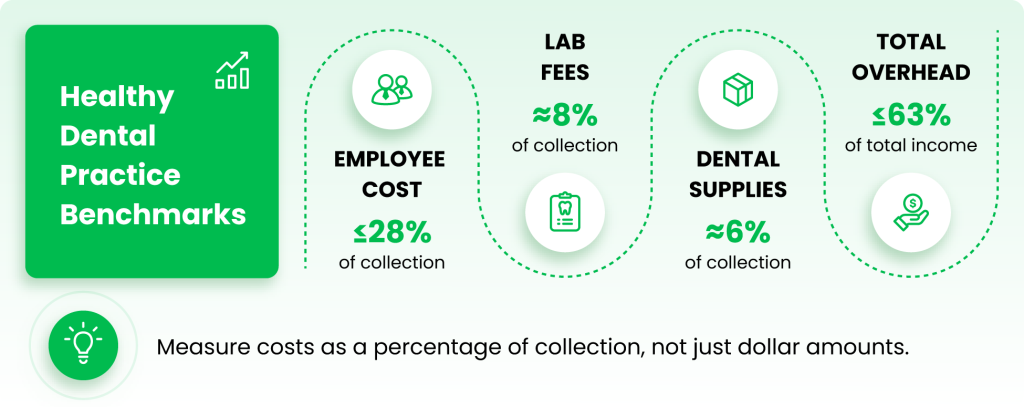
Overhead is most useful when measured as a percentage of collections. A $38,000 payroll isn’t inherently good or bad—it depends on the practice’s collections. Tracking expenses this way reveals cost trends that raw dollar amounts can hide.
That starts with expense categories that reflect how a dental practice actually operates. Dental CPA benchmarks place supplies at about 6% of collections, lab fees at 8%, and total employee costs at no more than 28%.5 If those costs are grouped into a single expense line, meaningful benchmarking becomes impossible.
📊 The ADA’s KPI guidance sets a target of collecting 98% of adjusted production and keeping overhead at 63% or less of total income.6
A bookkeeping service earns its fee here in an unglamorous way: coding every transaction to the right line, every month, so the percentages stay comparable. The benchmark is only useful if January was categorized the same way as June.
Clean Monthly Books Are a Working Defense Against Embezzlement
Dental practices handle payments from multiple sources, including cash, checks, cards, and insurance deposits. When one person records payments, adjusts balances, and reconciles accounts, errors or fraud can go unnoticed.
An independent bookkeeper adds an important layer of oversight. By reconciling production, collections, and deposits each month, unusual adjustments are flagged as part of the normal review process. Separating these responsibilities strengthens internal controls without disrupting daily operations.
What Simpler Finances Look Like Month to Month
“Simplify” is a vague promise. In practice, it means closing the books on a set schedule and receiving three key reports: a P&L with overhead percentages, a production-to-collections reconciliation, and an AR aging summary. Reviewing them takes minutes because the work has already been done.
Without that process, payments get posted between patients, transactions are categorized after hours, and the CPA sorts everything out at tax time. Most practice owners never intended to manage the books themselves.

Hiring in-house has become more difficult. Accounting graduates fell to a two-decade low in the 2023–24 academic year,7 even as demand for accountants remains high. Bookkeeping services for dentists offer a practical alternative, giving practices access to experienced specialists without the cost or delays of hiring full-time staff.
Conclusion
Bookkeeping services for dentists help practices connect production, collections, and cash flow, turning financial data into meaningful insights. Monthly reconciliations, benchmark-based reporting, and independent oversight give owners a clearer view of practice performance and help catch issues before they grow.
Want to see what that looks like? Request a sample month-end reporting package from FullStaff, including a P&L, production-to-collections reconciliation, and AR aging report, to see how a dental practice’s financials come together.
Frequently Asked Questions (FAQs)
What is dental bookkeeping?
Dental bookkeeping is the monthly process of recording and reconciling a practice’s financial activity across both its practice management system and its accounting file. It covers production and collections reconciliation, EOB and insurance payment allocation, payroll, and a dental-specific chart of accounts, producing financial statements that reflect how a practice actually operates rather than just what moved through the bank account.
What’s the difference between dentist bookkeeping and regular bookkeeping?
Regular bookkeeping starts and ends with the bank account: categorizing transactions and reconciling statements. Dentist bookkeeping adds the clinical revenue cycle: gross production, contractual adjustments, write-offs, and insurance payments are tracked and tied to deposits, so the practice can measure its collection rate and spot revenue leaks that a bank-only view never reveals.
How much does bookkeeping for dental practices cost?
Outsourced dental bookkeeping typically runs a few hundred to a couple thousand dollars per month depending on transaction volume, number of providers, and how much cleanup the books need at the start. That compares to roughly $45,000–$60,000 in salary plus benefits for an in-house bookkeeper. FullStaff publishes flat-rate bookkeeping pricing starting at $200 per month.
Can my CPA handle bookkeeping for my dental practice?
Most CPAs are built for tax strategy and filing, not monthly transaction work, and many prefer receiving clean books over doing the bookkeeping themselves. The common arrangement is a bookkeeper or bookkeeping service maintaining monthly records and reconciliations, with the CPA reviewing quarterly and handling tax planning. That split usually costs less than paying CPA rates for bookkeeping-level work.
What software do dental bookkeepers work with?
Most dental bookkeeping runs on QuickBooks Online or a comparable general ledger, fed by reports from practice management systems like Dentrix, Open Dental, or Eaglesoft. The bookkeeper doesn’t replace the practice management system. They pull its production, adjustment, and collections reports each month and reconcile those figures against the accounting file and bank deposits.
How often should production and collections be reconciled?
Monthly, at minimum, as part of a fixed month-end close. Reconciling monthly means a missed insurance payment or posting error is caught within weeks, while the claim is still workable. Practices with heavy insurance volume often review collections and aging weekly, but the formal production-to-collections-to-deposit reconciliation belongs in every monthly close.
What collection rate should a dental practice target?
The standard target is 98% of adjusted production, meaning production after contractual write-offs and adjustments. Averages across the industry run meaningfully lower, which is why the number needs to be measured rather than assumed. A practice consistently below 95% usually has a systemic issue in insurance follow-up, patient billing, or posting accuracy worth investigating.
What’s a healthy overhead percentage for a dental practice?
Healthy overhead for a general practice runs roughly 60–65% of collections, excluding owner compensation, and the ADA’s KPI guidance flags anything above 63% as worth examining. The percentage matters more than the dollar figure, and so does the breakdown: staff costs, supplies, lab fees, and facility costs each have their own benchmark ranges that a dental chart of accounts makes visible.
Can AI replace a dental bookkeeper?
AI handles the volume layer of bookkeeping well: categorizing transactions, matching payments, flagging anomalies. Good bookkeeping services already use it for that work. It does not replace human judgment on EOB interpretation, adjustment coding, benchmark analysis, or the questions a reconciliation raises. The practical model is AI compressing the repetitive work while an experienced bookkeeper handles interpretation, review, and the conversation about what the numbers mean.
Let FullStaff Handle Your Bookkeeping
You didn’t buy a practice to spend Sunday nights matching EOBs to deposits. Your front office has patients to take care of. FullStaff gives your practice a dedicated accounting professional who already understands production, collections, and the difference between a write-off and an adjustment.
Since 2012, FullStaff has provided university-educated, US GAAP–trained accounting professionals to American businesses: a dedicated team member, not a rotating resource.
For dental practices, that includes:
- Production and collections reconciliation
- EOB tracking and insurance payment allocation
- Provider-level production reporting
- Monthly close with dental-benchmark financial statements
Here’s how it works: complete a short kickoff form, meet with us to walk through your practice’s setup, and get matched with a dedicated accounting professional who learns your systems.
References:
- Dental Practice Overhead: Cost Breakdown, Benchmarks, and Insights
- IRS — Why Should I Keep Records?
- Administrative and Clinical Denials by a Large Dental Insurance Provider
- Dental Collections Statistics
- Tracking Dental Practice Overhead and What the Results Mean (Allen M. Schiff, CPA, CFE)
- Key Performance Indicators (Guidelines for Practice Success)
- Accounting Firms Report Strong Hiring Outlook, 2025 Trends Report