

A successful real estate business can still have messy finances. Commission checks come in after every closing, the broker takes a split, and whatever reaches your bank account often feels like income. Then the 1099-NEC arrives, showing your gross earnings—not what you actually kept.
The gap is predictable. No employer withholds your taxes, no payroll system tracks your deductions, and every closing comes with a tax bill that no one automatically sets aside.
The median REALTOR® grossed $58,100 from real estate activities and spent a median of $8,010 on business expenses.1 Irregular commission income and recurring costs make it easy to lose track of cash flow. This article explains how bookkeeping services for real estate help agents and brokers stay organized, maximize deductions, and spend less time managing their finances.
What Real Estate Bookkeeping Services Actually Cover
For an agent or broker, a real-estate-specific bookkeeping service typically handles:
| Recording every commission in a proper commission ledger — gross commission, broker split, cap status, referral fees — so income is tracked, not guessed |
| Categorizing expenses to Schedule C categories so deductions survive until tax season |
| Reconciling business bank and credit card accounts every month |
| Calculating quarterly estimated tax set-asides from actual net income, not the bank balance |
| Keeping trust-account records and agent-split reconciliations current at the brokerage level |
| Producing 1099-ready records and monthly profit and loss statements you can read in five minutes |
None of this is complicated. The challenge is consistency between closings, not complexity.
Why Commission Income Is Where Agent Books Break First
The IRS treats licensed real estate agents as statutory nonemployees, meaning they are self-employed for federal tax purposes when their pay is based on sales rather than hours.2 That means no tax withholding, no W-2, and no employer covering part of your Social Security and Medicare taxes.
Commission income is also unpredictable. Two closings one month and none the next can make your bank balance look healthier than your business actually is. Without proper records, it’s difficult to separate gross commissions, tax obligations, business expenses, and personal spending.
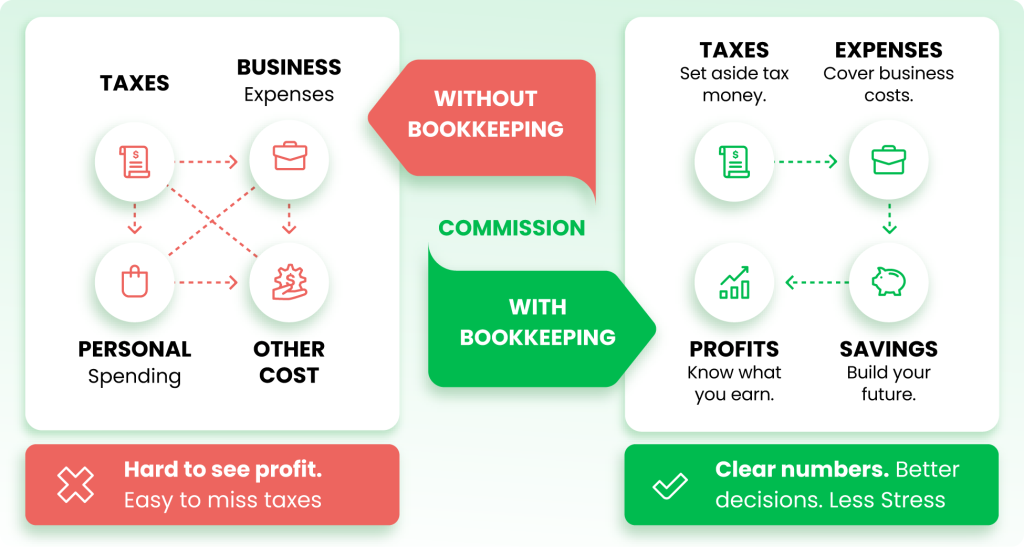
The solution is a reliable bookkeeping system. A dedicated business account, commission tracking, and monthly financial reports provide a clear view of profitability, making it easier to plan for taxes, monitor cash flow, and make informed business decisions.
The Tax Bill Nobody Withheld
Self-employment tax is 15.3%, including 12.4% for Social Security and 2.9% for Medicare, and is calculated on net self-employment earnings using Schedule SE.3 If you expect to owe at least $1,000 for the year, the IRS requires estimated quarterly tax payments and may charge an underpayment penalty if you miss them, even if you pay the full balance by April.
A practical habit is to set aside a fixed percentage of every net commission, typically 25% to 35%, into a separate tax account as soon as the payment clears. Because commission income fluctuates, the IRS also allows annualized income reporting, which can reduce or eliminate underpayment penalties in uneven earning years.4 Accurate bookkeeping is what makes that option possible.
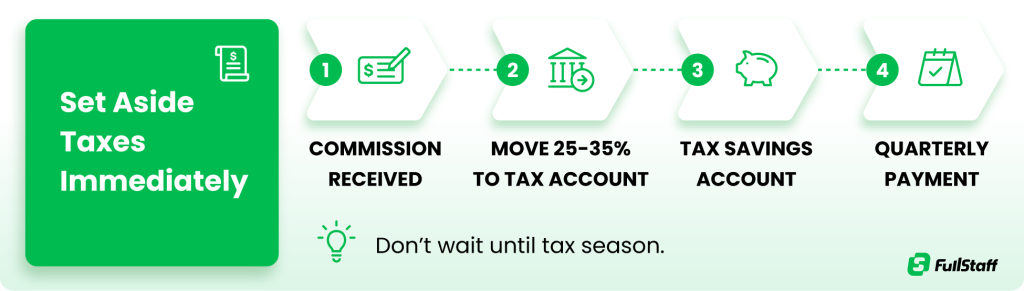
This is where bookkeeping services for real estate provide real value. Organized monthly records make quarterly tax estimates more accurate and give your CPA reliable financial data instead of piecing everything together at tax time.
Where Deductions Leak When Tracking Is an Afterthought
Real estate agents have ongoing expenses, from vehicle costs and marketing to MLS dues, E&O insurance, staging, and continuing education. Every undocumented expense is a missed deduction, and median annual business expenses reach $8,010.


Mileage is one of the biggest deductions. For 2026, the IRS standard mileage rate for business use is 72.5 cents per mile, up 2.5 cents from 2025.5 To claim it, you need a contemporaneous log with the date, miles, destination, and business purpose.
At that rate, 12,000 business miles equals an $8,700 deduction. Good bookkeeping also keeps business and personal expenses separate, helping you capture more deductions and maintain clean records.
For Brokers, Messy Books Become a License Problem
For brokers, bookkeeping is about more than taxes. Client funds, including earnest money, must stay separate from operating funds, and trust accounts must be reconciled regularly to meet state requirements.6
A DRE audit can suspend a broker’s license if it finds more than $10,000 in commingled or converted trust funds pending a formal hearing.7 As transaction volume grows, so do trust account reconciliations, commission splits, and agent payouts.
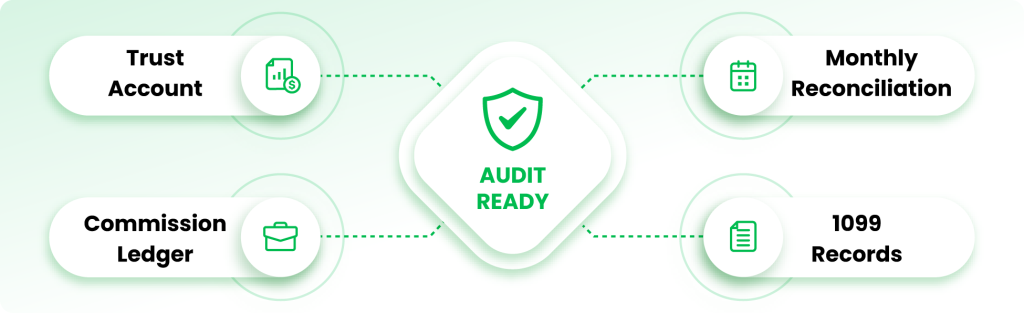
Monthly bookkeeping keeps trust accounts balanced, commission records accurate, and 1099-NEC reporting organized. It also makes audits far less stressful by ensuring the necessary documentation is already in place.
What Bookkeeping Services for Real Estate Actually Handle
A real estate bookkeeper does more than record transactions. They track commissions by deal, reconcile bank and credit card accounts, categorize expenses, maintain trust account records, and close the books each month so your financial reports stay accurate. If your books are behind, catch-up bookkeeping helps restore accurate records before monthly bookkeeping resumes.
When evaluating a provider, look for real estate experience. They should confidently answer questions such as:
| How many real estate agents or brokerages do you serve? |
| How do you track commission splits, team splits, caps, and referral fees? |
| Can you manage trust account recordkeeping and monthly reconciliations? |
| Do you prepare 1099-NEC records for agent payments? |
| When do you deliver the monthly close, and what reports are included? |
Weak answers about commission splits or trust accounting are a red flag. These areas are unique to real estate, so working with someone who understands your transaction flow is far more valuable than hiring a general bookkeeper.
The Hours-vs-Cost Math for Agents Weighing It
The real comparison is not the monthly fee versus zero. It’s the cost of doing the books yourself, missed deductions, and the risk of inaccurate quarterly tax payments.
📊 40% of small business owners spend more than 80 hours a year on tax preparation, and the same share say bookkeeping and taxes are the hardest part of running a business.8
For real estate agents, those hours are often better spent prospecting, showing homes, and closing deals. That’s why bookkeeping services for real estate are an investment in productivity, not just another business expense. Saving even a few hours each week can easily offset the monthly fee while improving tax accuracy and capturing more deductions.

Conclusion
Bookkeeping services for real estate help eliminate common financial problems, from inaccurate commission tracking and missed deductions to unreliable tax estimates and disorganized records. Start by separating your business finances, tracking every commission, and setting aside a fixed percentage of each payment for taxes.
If you’d rather spend your time growing your business than managing the books, ask for a sample monthly commission ledger and profit and loss statement. Reviewing actual reports is one of the quickest ways to evaluate whether a bookkeeping service fits your business.
Frequently Asked Questions (FAQs)
Do real estate agents need a bookkeeper?
Not legally, but most agents benefit once they close more than a handful of deals a year. As a self-employed professional you’re responsible for tracking commission income, categorizing deductible expenses, and paying quarterly estimated taxes, and errors in any of those cost money in penalties or lost deductions. A bookkeeper becomes worthwhile the moment the hours you spend on the books exceed what the service costs, which for most active agents happens early.
How much does bookkeeping cost for a real estate agent?
Most individual agents pay a few hundred dollars a month, with the price driven by transaction volume, number of accounts, and whether the books need catch-up work first. Brokerages pay more because trust accounting, agent-split reconciliation, and 1099 preparation add scope. Compare the quote against your own hourly value and the deductions you’re currently failing to capture, not against zero.
What can real estate agents write off on their taxes?
Common Schedule C deductions include business mileage, marketing and advertising, MLS and association dues, E&O insurance, staging and photography, continuing education, client meals within IRS limits, software subscriptions, and a qualifying home office. Mileage is usually the largest single deduction and requires a contemporaneous log with date, miles, destination, and business purpose to survive scrutiny. Clean categorization during the year is what makes these deductions usable at filing time.
How do real estate agents pay quarterly taxes?
Agents who expect to owe $1,000 or more in federal tax for the year make estimated payments four times a year using Form 1040-ES, covering both income tax and self-employment tax. Payments can be made online through an IRS account, and agents with uneven commission income can use the annualized income method on Form 2210 to match payments to when the money actually arrived. Missing a quarter triggers an underpayment penalty even if the full balance is paid by the filing deadline.
Do real estate agents need a separate business bank account?
Yes, as a practical matter. A sole proprietor isn’t legally required to have one, but running commissions and business expenses through a dedicated account is what makes clean bookkeeping possible: every deposit is income, every debit is a candidate deduction. Mixing business and personal spending in one account is the single most common reason agent books take hours instead of minutes to reconcile.
What is commingling in real estate?
Commingling is mixing client trust funds — earnest money, security deposits, rents held for others — with a broker’s personal or business operating funds. State real estate law treats it as a serious violation: it’s grounds for license suspension or revocation, and regulators audit trust accounts for it specifically. Brokers avoid it by keeping a dedicated trust account, reconciling it monthly, and never using client funds to cover operating expenses, even briefly.
Will I still get a 1099-NEC from my brokerage in 2026?
Only if your brokerage pays you $2,000 or more in the calendar year. The reporting threshold rises from $600 to $2,000 for payments made in 2026, with annual inflation adjustments after that. The change affects paperwork, not taxes: every dollar of commission income remains taxable and must be reported on your return whether or not a form arrives. Your own commission ledger, not the 1099, should be your record of what you earned.
Should a real estate agent use cash or accrual accounting?
Cash basis suits almost all individual agents: you record commission income when the check arrives and expenses when you pay them, which matches how the money actually moves. Accrual accounting, which records income when earned rather than received, mainly makes sense for larger brokerages that need to track pending commissions across many transactions. Whichever you choose, apply it consistently — switching methods requires IRS approval.
Should a real estate agent form an LLC or S corp?
An LLC provides liability separation but doesn’t change your taxes by default — a single-member LLC still files Schedule C. An S corp election can reduce self-employment tax for agents with consistently strong net income, because part of earnings can be taken as distributions rather than salary, but it adds payroll, a reasonable-salary requirement, and compliance costs. The break-even point varies, so run the numbers with a CPA before restructuring; clean books make that analysis possible.
Can AI replace a bookkeeper for real estate agents?
AI now handles much of the repetitive layer — transaction categorization, receipt capture, bank feed matching — and it does that well. It does not replace human judgment on the parts that carry risk: whether a split was recorded correctly against your cap, whether a trust-account discrepancy signals a compliance problem, or how to structure quarterly payments in an uneven year. Most agents get the best result from a bookkeeper who uses AI tools for volume and applies experience to the exceptions.
Let FullStaff Handle Your Bookkeeping
You close the deals, chase the listings, and drive the miles — the commission ledger, the quarterly set-asides, and the January 1099 scramble shouldn’t be what your evenings are for. Since 2012, FullStaff has provided dedicated, degreed accountants who keep books accurate to US GAAP standards, working as a consistent member of your team rather than a rotating resource.
For real estate professionals, that includes:
- Commission ledger recording and reconciliation
- Trust-account recordkeeping and monthly reconciliation
- Bank and credit card reconciliation
- 1099-NEC preparation support
- Agent split reconciliation
- Catch-up bookkeeping
Here’s how it works: complete a short kickoff form, meet with our team to walk through your setup, and get matched with a dedicated accounting professional who learns your business and stays with it.
References:
- Agent Income – NAR
- Licensed real estate agents – Real estate tax tips, Internal Revenue Service
- Self-employment tax (Social Security and Medicare taxes)
- Estimated taxes, Internal Revenue Service
- IRS sets 2026 business standard mileage rate at 72.5 cents per mile, up 2.5 cents
- Trust Funds: A Guide for Real Estate Brokers and Salespersons (RE 13), California Department of Real Estate
- Penalties for Misuse of Trust Funds
- The Burden of Small Business Accounting, Taxes and Payroll