

Shopify says you sold $84,000 last month. Your bank shows only $71,300 in deposits. Both figures are correct. The difference comes from processing fees, refunds, and platform reserves deducted before payouts reach your account.
That gap is where your margin hides. A bank deposit combines sales, fees, and refunds into one number, making it hard to see what you actually earned.
Bookkeeping for ecommerce separates sales, fees, and refunds into distinct records so every dollar is accounted for. Done right, it reveals true margins, accurate COGS, and the real cost of returns. Here’s how to track each piece and keep your financial reports accurate.
What Tracking Sales, Fees, and Refunds Actually Looks Like
| Record gross sales from each channel’s settlement or payout report, never from the bank deposit |
| Book each fee type (referral, fulfillment, processing, subscriptions, storage) to its own expense account |
| Track refunds in a contra-revenue account so returns stay visible instead of quietly shrinking sales |
| Record chargebacks and chargeback fees separately from ordinary refunds |
| Reconcile every settlement and payout against the bank, every period, without exceptions |
| Treat collected sales tax as a liability, not revenue |
| Close monthly with channel-level margin, COGS, and inventory adjustments |
The challenge is consistency, not complexity.
Why the Bank Deposit Never Matches the Sales Report
Every platform pays differently. Amazon, Stripe, and Shopify Payments each follow their own payout schedules, settlement timelines, fee structures, and reserve policies. As a result, the amount deposited into your bank account rarely matches your sales report exactly.
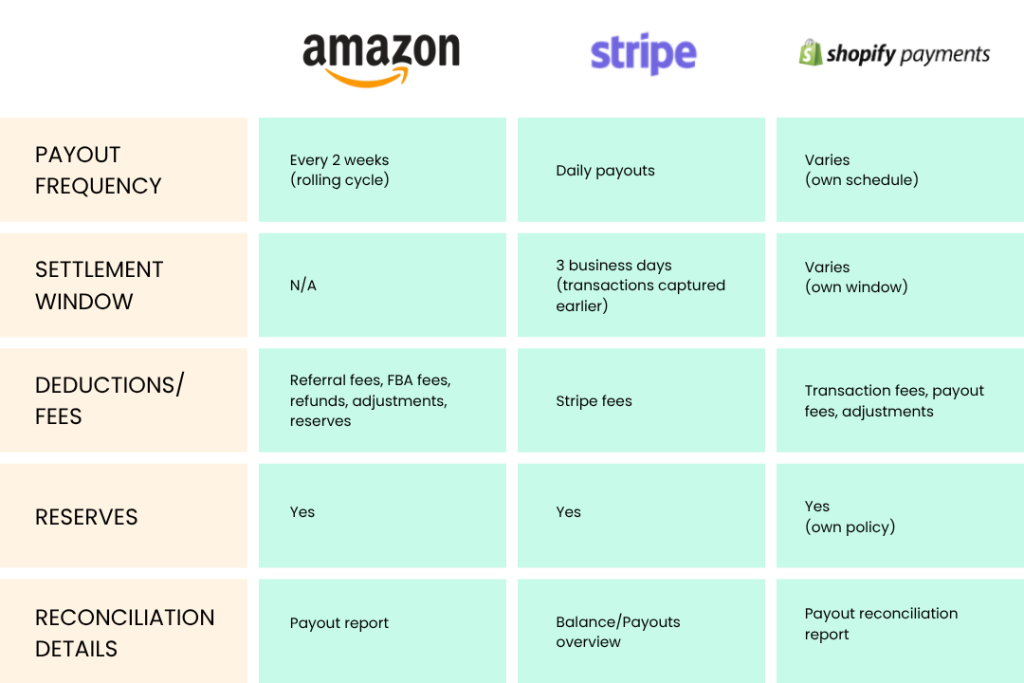
The difference comes down to two things: timing and deductions. A sale made in one period may be paid out in the next, while processing fees, refunds, reserves, and other adjustments are deducted before the money reaches your account.
📊 Average credit card processing fees in 2026 run about 2% to 3% per transaction, with typical effective rates between 1.6% and 3.1%.1
None of this is an error. It’s simply how payment infrastructure works. Good bookkeeping reconciles every payout back to the underlying sales, fees, refunds, and adjustments, so your records explain exactly why the deposit differs from the sales report.
Recording Net Deposits Understates Both Revenue and Fees
The most common shortcut in ecommerce books is booking the bank deposit as sales. It feels efficient. It’s also wrong in both directions at once: revenue is understated by the amount of the fees, and the fees themselves disappear entirely, so no report will ever show what it costs you to sell on each channel.
The distortion compounds. Understated revenue can put you on the wrong side of a sales tax registration threshold without anyone noticing. Vanished fees make a channel look more profitable than it is, which is exactly the information you need when deciding where to push ad spend.
What gross recording looks like
Proper bookkeeping for ecommerce starts with the settlement report, not the bank feed.
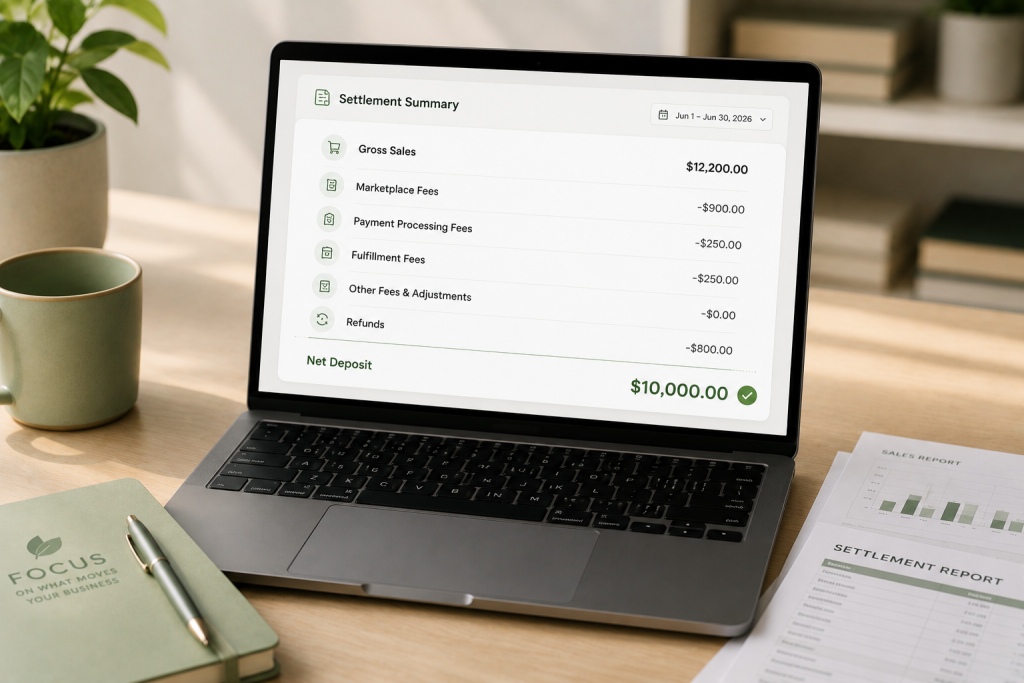
Book gross sales as revenue. Book each fee category as its own expense. Book refunds to a contra-revenue account. The sum of those entries equals the deposit, and the deposit becomes a check on your work instead of your source of truth.
A $10,000 deposit might represent $12,200 in gross sales, $1,400 in marketplace and payment fees, and $800 in refunds. Three financial streams—one bank deposit.
Every Channel Charges Differently, and Your Books Should Show It
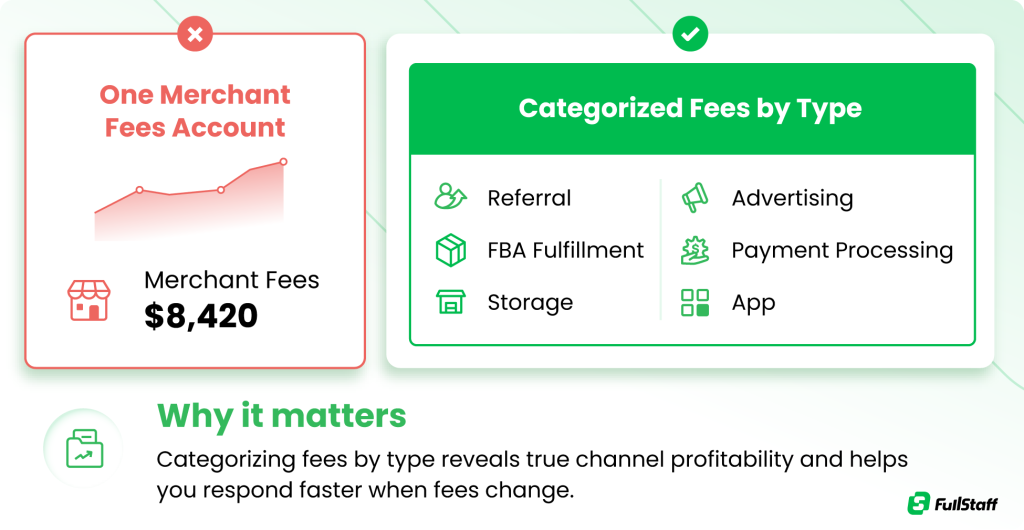
“Merchant fees” as a single expense line is where channel profitability goes to die. Amazon alone charges referral fees, FBA fulfillment fees, storage fees that spike in Q4, and advertising costs, and each behaves differently. Referral fees scale with price. Fulfillment fees scale with size and weight. Storage scales with how long inventory sits.
Shopify’s stack is different: subscription fees, payment processing, app charges, and transaction fees if you use an outside processor. Lumping both platforms into one account means you can’t answer the only question that matters: what does it cost to sell a unit on each channel?
📊 Amazon’s 2026 update raises FBA fees by an average of $0.08 per unit sold, less than 0.5% of an average item’s selling price, effective January 15, 2026.2
Fee structures change over time. Tracking fee categories separately makes it easy to see which costs increased and when they began affecting profitability. With one “Merchant Fees” account, those changes often go unnoticed until tax season.


Refunds Are Not Negative Sales
Netting refunds against revenue is tidy and destructive. The sales number shrinks, the refund disappears, and the pattern that would have told you something about product quality, sizing, or fulfillment damage is gone. A store with $100K in sales and $5K in refunds is a different business from a store with $95K in sales and none, but netted books make them identical.
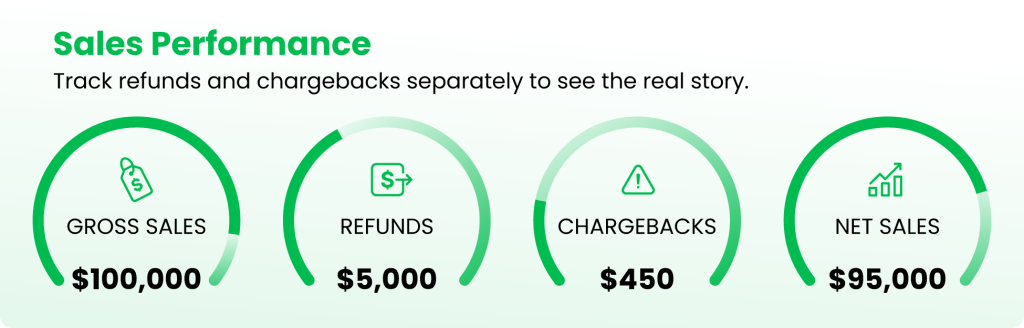
The fix is a contra-revenue account: refunds and returns recorded as their own line, visible on the P&L right under gross sales. Restockable returns also need an inventory adjustment, or COGS drifts away from reality a little more each month.
📊 An estimated 19.3% of online sales were returned in 2025, against a $849.9 billion total returns figure across retail, and 9% of all returns were fraudulent.3
Chargebacks deserve their own category, separate from refunds. A chargeback carries a dispute fee, usually $15 to $20, and a pattern of them threatens your processor relationship. Blend them into refunds and you lose the early warning.
Settlement Reconciliation Is Where Bookkeeping for Ecommerce Earns Its Keep
Recording transactions is data entry. Reconciliation is the control that proves the data is complete. For an ecommerce business, that means matching three things every period: what the platform says it owes you, what your books say happened, and what the bank says arrived.
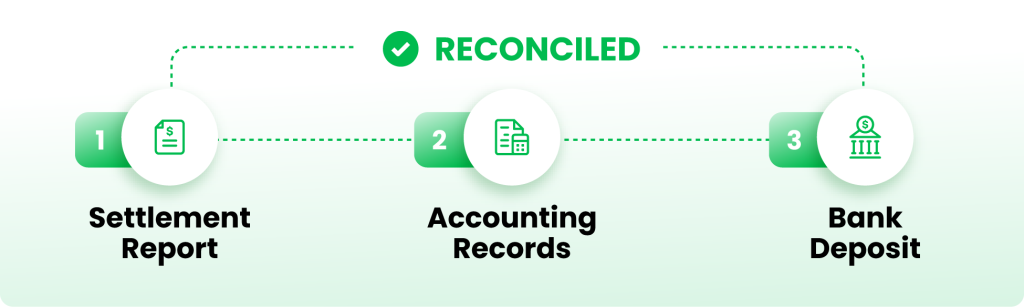
The reconciliation workflow
The settlement or payout report is the starting point for reconciliation. Match it against your accounting records and bank deposits for each settlement period to confirm every sale, fee, refund, and payout is accounted for. Connector tools like A2X automate much of this process by posting settlement summaries to the correct accounts, reducing manual work and improving accuracy.4
The sales tax wrinkle
Sales tax collected from customers is not revenue—it’s a liability until it’s remitted. Marketplace facilitator laws mean Amazon collects and remits tax for marketplace orders, but sales through your own website remain your responsibility. Tracking sales by channel also helps you know when you’ve reached a state’s economic nexus threshold.
What a Clean Monthly Close Looks Like for an Ecommerce Business
A monthly close turns bookkeeping into reliable financial reporting. Settlements are reconciled, refunds categorized, inventory and COGS updated, and sales tax liabilities recorded. The result is an accurate P&L with reliable channel-level profitability. Businesses with inventory generally must follow IRS inventory accounting rules unless they qualify for a small business exception.
Metolius Artisan Tea reached this point after growing into a seven-figure business. With a dedicated senior accountant managing the monthly close, the company now closes its books by the 10th of every month and relies on product-level margin reports to guide decisions.

📊 82% of small businesses that fail cite cash flow problems as a contributing factor — SCORE 5
The goal isn’t who performs the monthly close—it’s that it happens consistently. Whether you handle it yourself, assign it to an in-house bookkeeper, or outsource it, a disciplined monthly close keeps your books accurate and your decisions informed.
Conclusion

Bookkeeping for ecommerce comes down to three habits: record gross sales correctly, categorize fees, and track refunds separately. Reconciliation ensures every number is accurate.
The key is consistency. A disciplined monthly close keeps your books reliable, gives you confidence in your financial reports, and helps you make better decisions about pricing, inventory, and profitability. Whether you manage it yourself or work with a bookkeeping professional, staying consistent month after month is what keeps your business financially healthy.
Frequently Asked Questions (FAQs)
What is ecommerce bookkeeping?
Ecommerce bookkeeping is the practice of recording and reconciling the financial activity of an online store, including gross sales, platform and processing fees, refunds, chargebacks, sales tax, inventory, and COGS across every sales channel. It differs from standard small-business bookkeeping because revenue arrives through settlements and payouts that bundle fees and refunds into a single deposit, so accurate books require working from settlement reports rather than bank feeds.
Should I record gross sales or the net deposit from my payment processor?
Record gross sales. The net deposit is gross sales minus fees, refunds, and reserves, and booking it as revenue understates sales while hiding fees completely. Record the gross figure from the settlement report as revenue, book fees and refunds as their own lines, and use the bank deposit as a check that everything ties.
How do you record refunds in ecommerce bookkeeping?
Record refunds in a contra-revenue account that sits under gross sales on the P&L, rather than netting them against revenue. This keeps your return rate visible as a trend, and restockable returns should also trigger an inventory adjustment so COGS stays accurate. Chargebacks and their dispute fees belong in a separate account from ordinary refunds.
How often should Amazon settlements be reconciled?
Reconcile at least once per settlement period, which for most sellers means every two weeks, and Amazon’s own guidance recommends daily matching for high-volume accounts. Reconciled each period, the work takes roughly 20 to 30 minutes; left until quarter-end, unmatched refunds, reserves, and adjustments pile up into a much larger job.
What fees should ecommerce sellers track separately?
At minimum: payment processing fees, marketplace referral fees, fulfillment fees (FBA or 3PL), storage fees, platform subscription and app fees, advertising costs, and chargeback fees. Each behaves differently as your volume and product mix change, so separate accounts are what let you see which channel and which cost is moving your margin.
Do ecommerce businesses need accrual accounting?
Generally yes, once inventory is significant. IRS rules require an accrual method for purchases and sales when inventory is necessary to account for income, although qualifying small businesses under the gross receipts threshold can elect simpler treatment. Beyond compliance, accrual books match COGS to the sales they generated, which is the only way channel-margin reporting means anything.
Is sales tax collected from customers counted as revenue?
No. Collected sales tax is a liability you hold until you remit it to the state, and it should be booked to a sales tax payable account, never to revenue. Marketplace facilitator laws shift collection to platforms like Amazon for marketplace orders, but sales through your own site remain your responsibility once you cross a state’s nexus threshold.
How much does a monthly bookkeeping service for ecommerce cost?
Most ecommerce sellers pay somewhere between a few hundred and a few thousand dollars per month, depending on transaction volume, channel count, and whether inventory accounting is included. Dedicated-accountant models typically start around $200 per month and scale with complexity, and you can compare approaches against virtual accountant pricing to see where your volume lands.
Can AI replace an ecommerce bookkeeper?
AI handles the volume layer well: transaction categorization, settlement imports, and reconciliation matching. It does not replace human judgment on inventory accounting, sales tax exposure, margin interpretation, or the monthly close review that catches what automation miscategorized. Most growing stores get the best result using AI tools to compress data entry while an experienced accountant owns accuracy and interpretation.
Let FullStaff Handle Your Bookkeeping
Multi-channel selling means every month ends with settlements to reconcile, fees to categorize, and refunds to chase across platforms. If that work keeps sliding to 9 p.m., the problem is capacity, not competence.
Since 2012, FullStaff has placed dedicated, degree-qualified accountants with growing businesses, working to US GAAP standards as a consistent member of your team rather than a rotating resource. For ecommerce businesses, that includes:
- Settlement reconciliation across Amazon, Shopify, and other channels
- Channel-level margin tracking and monthly P&L reporting
- Inventory accounting and COGS tracking
- Sales tax liability tracking and monthly close by a fixed date
Here’s how it works: complete a short kickoff form, meet with our team about your channels and volume, and get matched with a dedicated accounting professional who learns your business and stays with it.
References:
- Shopify — The Average Credit Card Processing Fees for 2026
- Amazon Selling Partner Services — Update to U.S. Referral and Fulfillment by Amazon fees for 2026
- National Retail Federation — Consumers Expected to Return Nearly $850 Billion in Merchandise in 2025
- A2X — Ecommerce Accounting Guide for Business Owners
- SCORE — The #1 Reason Small Businesses Fail