

Many ecommerce businesses look profitable on paper but struggle to explain where the money actually goes. Shopify payouts and Amazon settlements already include fees, refunds, chargebacks, and sales tax, so they don’t show your true revenue. Without proper reconciliation and accurate COGS tracking, your financial reports can paint the wrong picture.
The result is unclear profitability. Sales may be growing, but it’s difficult to know which products or sales channels are actually generating profit.
As ecommerce continues to grow, accurate bookkeeping for ecommerce businesses is more important than ever. Ecommerce accounted for 16.9% of total US retail sales in the first quarter of 2026 and grew 9.8% year over year, compared to 3.9% for retail overall.1 This article covers five bookkeeping essentials that help you keep accurate financial records and know when it’s time to outsource the work.
What Bookkeeping for Ecommerce Businesses Actually Covers
Done properly, ecommerce bookkeeping handles a short list of jobs that generic books skip:
| Breaking every payout into gross sales, fees, refunds, and sales tax before anything posts as revenue |
| Tracking inventory on an accrual basis so COGS reflects what actually sold |
| Reporting margin by channel, not just blended margin across the whole business |
| Recording returns as contra-revenue instead of letting them vanish into deposits |
| Monitoring sales tax exposure as revenue crosses state nexus thresholds |
| Closing the books on a fixed monthly schedule so the numbers arrive while they are still useful |
None of these steps is complicated on its own. The challenge is doing all of them, every month, without falling behind.
A Payout Is Not Revenue
Amazon seller payouts combine gross sales, referral fees, fulfillment and storage fees, advertising costs, refunds, reimbursements, and sales tax into a single deposit.2 Recording that deposit as revenue hides those individual transactions, making sales, expenses, and tax liabilities harder to track accurately.
Shopify follows a different payout schedule. In the US, Shopify Payments typically settles within three business days, with Friday through Sunday payments grouped into one payout.3 When a payout spans two accounting periods, revenue can easily be recorded in the wrong month without proper reconciliation.
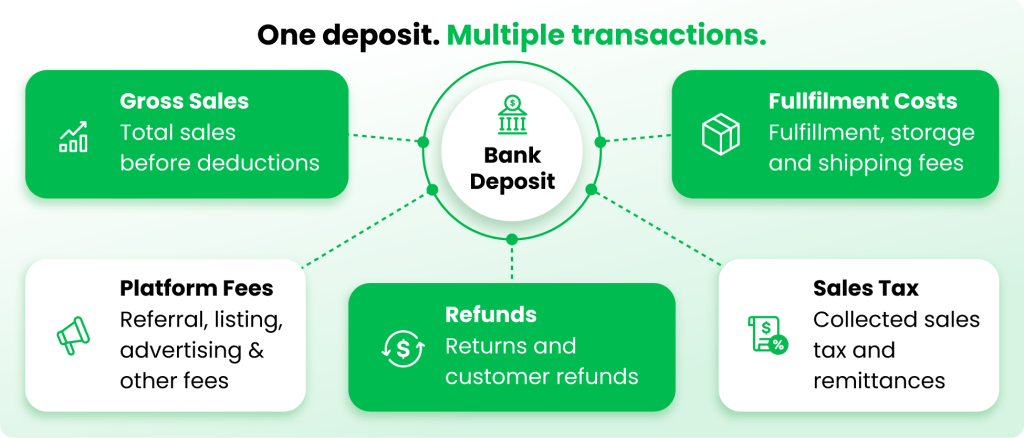
That’s why settlement reconciliation is the foundation of ecommerce bookkeeping. Automation tools like A2X can break settlements into the correct accounts, but they still require proper setup, ongoing review, and exception handling to keep your books accurate.
Inventory and COGS Set the Rules
Inventory affects more than operations. It also influences how your business accounts for purchases and sales. While qualifying small businesses have some flexibility, the IRS generally requires businesses where inventory is an income-producing factor to use an accrual method.4 Accrual accounting also provides a more accurate view of profitability by matching inventory costs to the sales they generate.
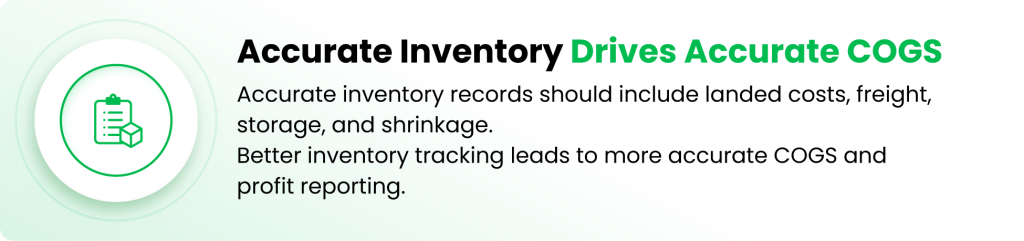
When inventory records are inaccurate, COGS becomes unreliable, and so do your gross margins. That makes it harder to price products, plan purchases, and measure the true profitability of your ecommerce business. According to SCORE, 43% of small businesses either don’t track inventory or still rely on manual processes.5
Fees Decide Your Channel-Level Margin
The same product can generate very different profits depending on where it’s sold. Amazon referral fees are typically 15% in most categories, though they range from about 5% to 45% depending on the product.6 Add FBA fulfillment and storage fees, and selling costs can quickly add up. Shopify, on the other hand, has lower payment processing fees, but merchants cover their own fulfillment and customer acquisition costs.
When these fees are grouped together, or left netted inside payouts, it’s impossible to see which sales channels are actually profitable. You may be selling the same product, but earning very different margins on Amazon versus your own website.
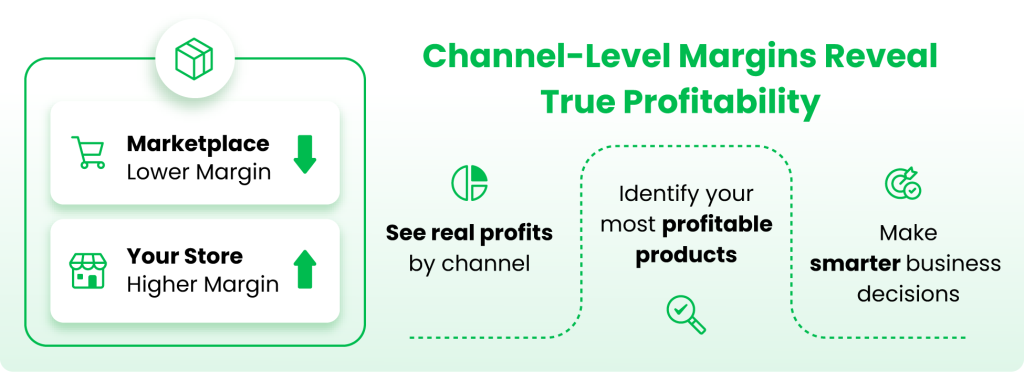
That’s why bookkeeping for ecommerce businesses should include channel-level profitability reports. Breaking out revenue and fees by sales channel helps you identify your most profitable products, allocate marketing spend more effectively, and make better inventory decisions.


Returns Are a Line Item, Not a Surprise
Returns aren’t an exception in ecommerce, they’re part of doing business.
📊 The National Retail Federation estimates that 19.3% of online sales were returned in 2025, compared to 15.8% for retail overall.7
When refunds are treated as occasional negative deposits, financial reports become distorted. Revenue may be overstated in one month, while refunds appear in another. Returned inventory can also be miscounted or undervalued if it isn’t properly recorded.
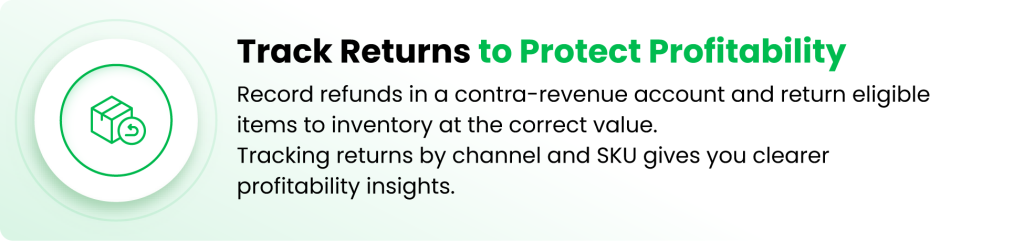
When returns are tracked correctly, they become a valuable business metric rather than a financial surprise.
Sales Tax Nexus Follows Your Customers
Since the Supreme Court’s 2018 decision in South Dakota v. Wayfair, physical presence no longer limits where you owe sales tax. States can require remote sellers to register and collect once sales into the state cross an economic nexus threshold, and no two states define that threshold quite the same way.8
Marketplaces complicate the picture in a way that trips up multichannel sellers. Amazon collects and remits tax on marketplace orders in most states under facilitator laws, but those same marketplace sales can still count toward your nexus thresholds. Meanwhile your Shopify orders are usually your own obligation entirely. A seller can be fully compliant on one channel and quietly exposed on the other.
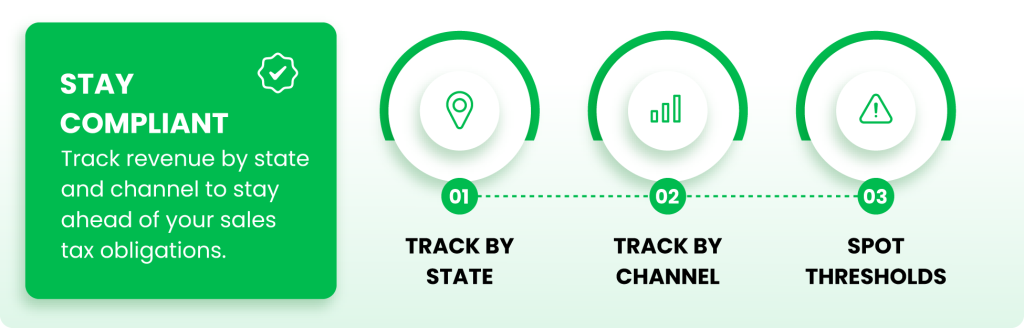
Clean books are the early-warning system here. When revenue is recorded gross by state and by channel, you can see a threshold approaching before you cross it. When everything sits in netted deposits, the first notice you get may come from a state revenue department.
When a Monthly Bookkeeping Service for Ecommerce Makes Sense
Many ecommerce businesses manage their own books until the workload becomes too complex. Warning signs include settlements that no longer match deposits, inventory issues that delay tax filings, or growing sales with shrinking cash flow. Business survival data also shows that retail businesses have less room for error than many other industries.9
📊 The JPMorgan Chase Institute found the median small business holds just 27 cash buffer days, while retail businesses hold only 19.10
With so little cash on hand, accurate financial reporting becomes essential. A monthly bookkeeping service for ecommerce keeps settlements reconciled, inventory and COGS updated, channel margins reported, and monthly closes completed on schedule.

Metolius Artisan Tea reached this point as it scaled to seven-figure revenue. Inventory, production, and multichannel fulfillment had outgrown a part-time bookkeeper. After partnering with FullStaff, the company closed its books by the 10th of every month and gained reliable product-margin reports. Their CPA even described them as having the best books of any client at the firm.
Ultimately, bookkeeping for ecommerce businesses is more than a back-office task. Done well, it gives business owners timely, accurate financial insights to make better decisions with confidence.
Frequently Asked Questions (FAQs)
What is ecommerce bookkeeping?
Ecommerce bookkeeping is the recording and reconciliation of an online store’s finances, built around the mechanics specific to selling online: payout and settlement reconciliation, inventory and COGS tracking, marketplace fee accounting, returns processing, and multi-state sales tax. It differs from generic bookkeeping mainly in how revenue arrives, as netted payouts from platforms rather than direct customer payments.
How is bookkeeping for an online store different from regular bookkeeping?
The core difference is that platforms pay you a net amount. Amazon and Shopify deduct fees, refunds, and adjustments before the deposit hits your bank, so accurate books require decomposing every payout back into gross components. Add inventory accounting, channel-level margin tracking, and economic nexus monitoring, and the workload looks very different from a service business with a dozen invoices a month.
Do I need accrual accounting for my ecommerce store?
If inventory is an income-producing factor in your business, the IRS generally requires an accrual method for purchases and sales, although qualifying small business taxpayers under the gross receipts threshold have simpler options. Beyond compliance, accrual is the only method that matches COGS to the period a product is sold in, which is what makes monthly margin numbers meaningful.
How do I record Shopify payouts correctly?
Record the components, not the deposit. Each payout should be split into gross sales, discounts, refunds, processing fees, and sales tax collected, with each amount posted to its own account and the net tied to the bank deposit. In the US, Shopify Payments settles in about three business days and groups weekend transactions into one payout, so month-end payouts often need to be split across periods.
What percentage of online sales get returned?
Retailers estimated that 19.3% of online sales were returned in 2025, according to the National Retail Federation, compared with 15.8% for retail sales overall. Rates run higher in apparel and footwear, where customers order multiple sizes intending to return some, so a store’s own rate by category matters more than the average.
When do I need to collect sales tax in other states?
Once your sales into a state cross its economic nexus threshold, commonly around $100,000 in annual sales, though every state sets its own rules. Marketplace facilitator laws mean Amazon typically collects on marketplace orders for you, but direct-channel sales through your own site remain your responsibility, and marketplace sales can still count toward the thresholds.
How much does ecommerce bookkeeping cost?
Dedicated support typically starts around $200 per month for a store with straightforward volume and scales with transaction count, channels, and inventory complexity. The comparison that matters is against the alternative: the hours an owner spends reconciling settlements, plus the cost of decisions made on unreliable margin numbers.
How often should ecommerce books be reconciled?
Settlements should be reconciled as they arrive, weekly at minimum for active stores, with a full close every month on a fixed date. Amazon settles roughly every two weeks and Shopify pays out on a daily, weekly, or monthly schedule, so a monthly-only reconciliation leaves too much time for errors to compound across hundreds of transactions.
Can AI replace an ecommerce bookkeeper?
AI and automation already handle the volume work well: pulling settlement data, categorizing routine transactions, and flagging mismatches. What they do not handle is judgment, such as deciding how to treat a damaged return, whether a state threshold has been crossed, or why a channel’s margin dropped four points. The practical setup is automation for the repetitive load and a human professional for interpretation, accuracy, and compliance.
Let FullStaff Handle Your Bookkeeping
If reading this felt like a description of your last month, that is the point where bookkeeping for ecommerce businesses is worth handing off. You built a store that sells; keeping the settlements, COGS, and state thresholds straight should not be your night job.
Since 2012, FullStaff has provided dedicated accounting professionals to US businesses, each with an accounting degree, trained on US GAAP standards, and assigned to your business as a consistent team member rather than a rotating resource. For ecommerce operators, that means:
- Settlement reconciliation across Amazon, Shopify, and other channels
- Channel-level margin tracking and monthly reporting
- Inventory accounting with accurate, accrual-based COGS
- Sales tax tracking as your revenue grows across states
- A monthly close that lands on schedule, every month
Here’s how it works: complete a short kickoff form, meet with our team to walk through your channels and tools, and get matched with a dedicated bookkeeping professional who learns your business and stays with it.
References:
- US Census Bureau, Quarterly Retail E-Commerce Sales, 1st Quarter 2026
- A2X, How to Reconcile Your Amazon Seller Statement
- Shopify Help Center, Understanding Shopify Payments Payout Timing
- IRS Publication 538, Accounting Periods and Methods
- SCORE, The #1 Reason Small Businesses Fail
- Amazon, Standard Selling Fees
- National Retail Federation, 2025 Retail Returns Landscape
- Avalara, Economic Nexus and South Dakota v. Wayfair, Inc.
- US Bureau of Labor Statistics, Entrepreneurship and the US Economy
- JPMorgan Chase Institute, Cash Is King: Flows, Balances, and Buffer Days