

A dental practice can hit its production goals every month and still come up short at collections. Insurance write-offs, patient balances, and EOB adjustments all move through the books differently than they do in a typical small business, and generic bookkeeping doesn’t always catch where the gap opens.
General books answer tax questions. Dental books need to answer whether the practice is actually collecting what it produces.
Choosing the right dental bookkeeping services means looking past reviews and software checklists to the specific mechanics of dental revenue, and knowing which questions actually separate a generalist from a provider who understands your practice.
What Dental Bookkeeping Actually Does
| Reconciles insurance payments, EOBs, and patient collections against what was actually produced |
| Tracks production and collections separately, by provider and by hygienist |
| Closes the books on a set monthly schedule, synced to your practice management software |
| Handles payroll, vendor payments, and overhead tracking without turning into a second job for your office manager |
| Produces reports a dentist, and a CPA at tax time, can actually read and use |
The real challenge is fit: finding a provider who already understands dental revenue, not just a lower price or more reviews.
Why Generic Bookkeeping Advice Doesn’t Fit a Dental Practice
Most bookkeeping advice online is written for a generic small business, not bookkeeping for dental practices specifically. That advice tells you to check reviews, compare software, and collect a few quotes. None of it is wrong, but none of it touches what actually makes dental accounting different: revenue that arrives in pieces, months apart, from multiple payers, at rates negotiated per plan.

A retail business books a sale and gets paid the same day. A dental practice bills a procedure, waits on an insurance adjudication, posts a write-off, then collects a patient balance that might trickle in over weeks. Bookkeeping that doesn’t track each of those pieces separately will still balance. It just won’t tell you anything useful.
That’s why bookkeeping built specifically for dental practices treats insurance-driven revenue as the starting point, not an afterthought bolted onto a generic template.
What a Production-Collections Gap Reveals About Your Current Books
Production is what your practice billed for the work performed. Collections is what actually came in the door. The gap between them is where most dental practices quietly lose visibility, not because anyone did anything wrong, but because generic bookkeeping doesn’t isolate insurance adjustments from real losses.
A production report can say a month looked strong. A collections report can tell a different story once insurance write-offs, claim denials, and slow-paying patient balances are subtracted out. If your bookkeeping doesn’t show you both numbers side by side, you won’t know which one to trust.
📊 The average dental office collects roughly 91% of what it bills, and close to 18% of accounts receivable sits more than 90 days past due 1 — a gap that’s easy to miss without production and collections tracked separately.
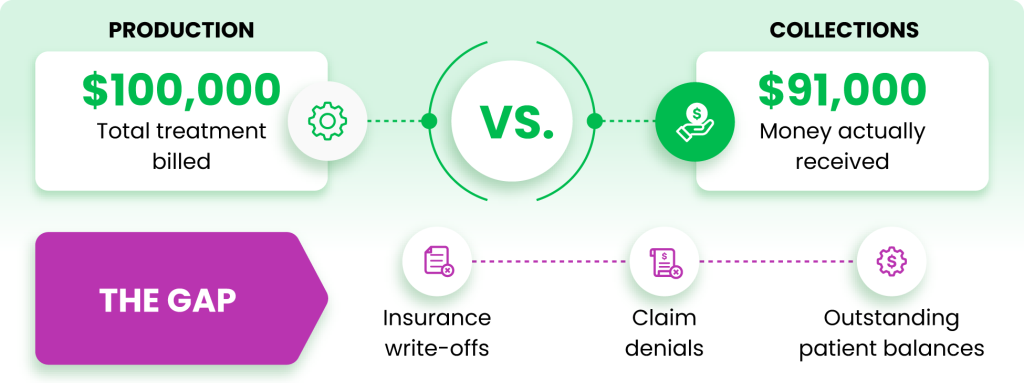
This is one of the first things to check when evaluating dental bookkeeping services: whether production and collections are reconciled every month, not just reviewed at tax time when there’s nothing left to do about it.
How EOB and Insurance Reconciliation Separates Real Dental Bookkeeping Services From Generalists
An Explanation of Benefits tells you what an insurer paid, what it adjusted, and what’s left for the patient to owe. Posting that correctly, and catching it when it’s wrong, is one of the more technical parts of dentist bookkeeping, and it’s where generalist bookkeepers tend to fall short.
Coordination of benefits, which determines which plan pays first when a patient has dual coverage, follows documented rules.2 Applying them consistently, month after month, across a full patient roster is where errors compound quietly.


Ask a prospective provider how they handle secondary claims, denied claims, and write-off timing. If the answer is vague, that’s useful information on its own. A bookkeeper worth paying for should be able to walk through their reconciliation process in specific terms.
What Rising Overhead and Staffing Pressure Mean for the Timing of This Decision
Insurance issues, staffing shortages, and rising overhead costs are dentists’ top three cited challenges heading into 2026 3 — and all three make the case for bookkeeping that’s accurate enough to act on quickly.
Staffing is part of why this decision keeps getting harder to put off. Hygienist and front-desk recruiting has stayed difficult for several years running,4 which means many practices are stretching an already-thin front office to also manage the books, usually not well and not for long.

None of this calls for panic. It does mean that waiting for a slow month to get around to fixing the books usually costs more than handling it now.
The Questions That Actually Reveal Whether a Provider Understands Your Practice
Most vetting checklists ask about reviews, pricing, and software compatibility. Those matter, but they don’t tell you whether a provider actually understands dental revenue. A short, direct set of questions will tell you more in ten minutes than a stack of testimonials.
| How do you reconcile EOBs against what was billed and what was collected? |
| Do you track production and collections separately, by provider and by hygienist? |
| How do you handle secondary insurance claims and coordination of benefits? |
| What does your monthly close actually include, and by what date does it close? |
| Can you work inside Dentrix, Open Dental, Eaglesoft, or whatever we’re already using? |
A provider who answers these specifically, without needing you to explain dental terms first, has probably done this before. For practices that keep hitting the same wall with generalist providers, the more direct route is hiring a dedicated virtual accountant who already works with dental clients.
What In-House vs. Outsourced Dental Bookkeeping Actually Costs
The median pay for a bookkeeping, accounting, or auditing clerk is $49,210 a year, and the U.S. Bureau of Labor Statistics projects that role to shrink 6% by 2034 even as accountant and auditor positions keep growing.5

Outsourced bookkeeping for dental practices is usually priced as a flat monthly rate that already accounts for those costs.
The real comparison isn’t just about cost. It’s about which option keeps your books accurate and up to date without creating extra work. Before choosing dental bookkeeping services, compare outsourced pricing with the true cost of managing bookkeeping in-house.
Conclusion
Dental bookkeeping services are worth evaluating on dental-specific criteria, not the generic checklist that works for any small business. The practices that get the most out of a bookkeeping partner ask about EOB reconciliation and production-versus-collections tracking before signing anything.

Generic vetting questions about reviews and software will tell you whether a provider is competent. Dental-specific questions will tell you whether they understand your practice. Dentist bookkeeping done well starts with the questions above, not a template built for a different kind of business.
Start there, ask directly, and pay attention to how specific the answers are. Part of that evaluation should also include how the onboarding process works with any provider you’re considering, since a rushed start is usually a sign of what’s ahead. A provider who understands your practice will have real answers ready.
Frequently Asked Questions (FAQs)
How much does bookkeeping for dentists cost?
Outsourced options typically run a flat monthly rate rather than an hourly fee, with pricing scaling based on transaction volume, provider count, and how much insurance reconciliation the practice generates. Pricing varies by provider, but most plans are set to compete with, or beat, the fully loaded cost of a single in-house hire once payroll taxes and benefits are factored in.
What should a dental bookkeeping service include?
At minimum, monthly reconciliation of insurance payments and EOBs, separate tracking of production and collections, a scheduled monthly close, and reporting a dentist or CPA can act on without translation. Anything less tends to leave gaps that surface at tax time instead of when they’re still fixable.
How is bookkeeping for dental practices different from general small business bookkeeping?
The core difference is the timing and structure of revenue. A dental practice bills a procedure, waits on insurance adjudication, posts adjustments and write-offs, then collects a patient balance, often across several weeks. General small-business bookkeeping usually doesn’t need to track production separately from collections, since most of it isn’t insurance-driven.
What should I ask before hiring bookkeeping services for dentists?
Ask how they reconcile EOBs, whether they track production and collections separately, whether they’ve signed BAAs with dental clients before, how they handle secondary insurance claims, and what their monthly close actually includes. Specific answers are the signal to look for; vague ones usually mean the provider hasn’t done this before.
Can my front-desk or office manager just handle bookkeeping instead of outsourcing?
They can, but it usually means bookkeeping happens in the gaps between other duties, which is exactly how reconciliation errors and late closes tend to start. It’s a reasonable short-term option for a very small practice, but it rarely holds up once patient volume or provider count grows.
How often should insurance payments be reconciled?
Monthly at minimum, and ideally as EOBs come in rather than in a batch at month-end. Waiting longer makes it harder to catch coordination-of-benefits errors or missed secondary claims before filing deadlines close the window to fix them.
What’s considered a healthy overhead percentage for a dental practice?
General dental practices commonly run overhead from the mid-60s to mid-70s percent of collections, though this varies by practice type and market. The number matters less on its own than whether it’s trending up or down, and whether the practice can see that trend clearly in its books.
Can AI replace a dental bookkeeper?
AI can speed up repetitive tasks like data entry, categorization, and flagging mismatched EOBs, but it doesn’t replace the judgment needed to interpret coordination-of-benefits rules, catch an unusual write-off, or explain a number to a dentist in plain terms. Most practices get the most value from AI handling volume while an experienced professional handles the interpretation.
How long should a dental practice keep its financial records?
The IRS generally recommends keeping tax-related records for at least three years, with employment tax records kept for at least four years. Many practices keep a longer buffer, since how long a specific document should be kept depends on the expense, event, or action it supports.
Let FullStaff Handle Your Bookkeeping
Between EOB reconciliation and a monthly close your CPA can actually use, dental bookkeeping asks for more specialty knowledge than a generic service usually brings.
Since 2012, FullStaff has staffed dedicated virtual accountants and bookkeepers for practices and growing businesses across the U.S., matching each client with a professional who already understands their industry.
- Monthly reconciliation of insurance payments, EOBs, and patient collections
- Production and collections reporting by provider and by hygienist
- Month-end close synced to Dentrix, Open Dental, Eaglesoft, or your existing practice management software
- Payroll, vendor tracking, and reporting your CPA can use at tax time
Here’s how it works: complete a short kickoff form, meet your dedicated accountant, and get started with reporting built around your practice.
👉 See a sample EOB reconciliation and monthly close package for a single-doctor practice. Plans start at $200/month, scaling with transaction volume and provider count.
References:
- 2740 Consulting: Dental Collections Statistics
- ADA: Guidance on Coordination of Benefits
- ADA Health Policy Institute: The State of the U.S. Dental Economy, Q4 2025 Update
- ADA: Dental Hygienist Shortage
- U.S. Bureau of Labor Statistics: Bookkeeping, Accounting, and Auditing Clerks