

Construction jobs can look profitable on paper while draining cash flow. That happens when expenses are tracked by category instead of by project, making it difficult to see what each job actually costs.
Construction bookkeeping is different. Revenue comes in stages, costs must stay tied to each job, and retainage delays part of every payment.
Slow payments make the challenge even bigger, costing the U.S. construction industry an estimated $299 billion in 2025.1 This guide explains what bookkeeping and accounting for small construction company operations should include, from job costing and WIP reporting to retainage, progress billing, accounting methods, and when outsourcing makes sense.
What Bookkeeping and Accounting Means for a Small Construction Company
| Every cost (labor, materials, subs, equipment) is coded to a specific job, not just a general expense category |
| A WIP schedule compares billings to costs on every open project, reviewed monthly |
| Retainage is tracked as its own receivable, separate from standard accounts receivable |
| Progress billing ties directly to pay applications, AIA G702/G703 on most commercial work |
| The tax accounting method matches your contract length and revenue size, and gets revisited as you grow |
| Books close by mid-month, so bidding and staffing decisions run on last month’s real numbers |
The challenge is consistency, not complexity.
Why Books Built for a Retail Shop Break on a Job Site
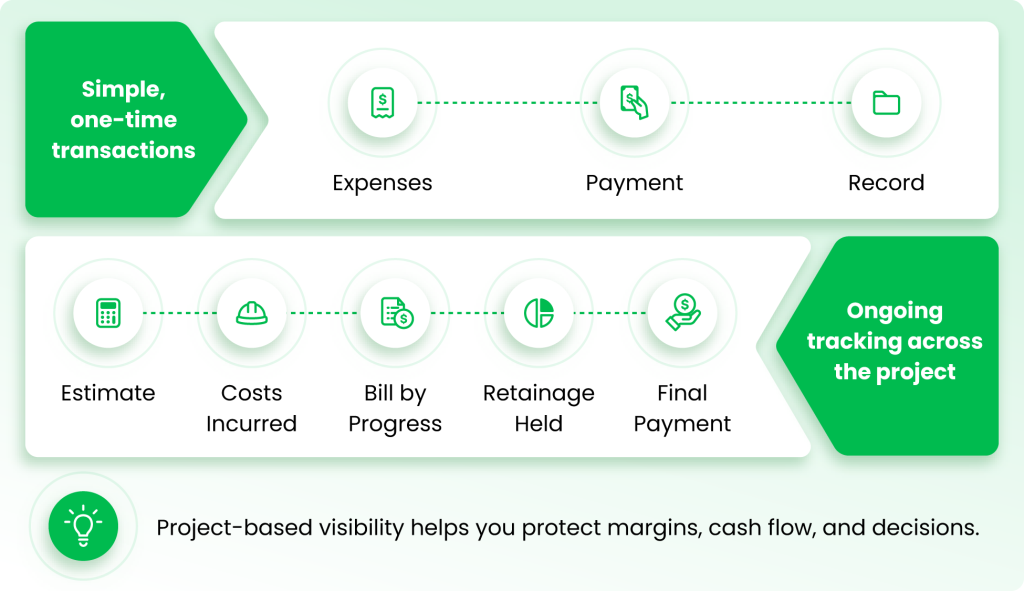
Standard small-business bookkeeping assumes a simple cycle: sell, get paid, record the transaction, and repeat. Construction doesn’t work that way. Revenue arrives over months, billing happens in stages, and costs must be tracked by project, not just by expense type.
That’s why construction companies need more than a standard chart of accounts. Cost codes tie labor, materials, and subcontractor expenses to specific jobs, making it possible to measure the true profitability of every project.
📊 Roughly one in five construction businesses closes in its first year, more than half are gone within five, and cash flow issues account for 82% of contractor failures.2
Construction Job Costing Separates Busy From Profitable
Construction job costing means every dollar of cost carries two labels: what it was for and which job it belongs to. This is where bookkeeping and accounting for small construction company operations either earns its keep or fails quietly.
What a working cost-code structure looks like
A practical job-costing system doesn’t need hundreds of codes. Most small contractors only need categories for field labor (including payroll taxes, workers’ comp, and benefits), materials, subcontractors, equipment, and overhead.3 Using fully burdened labor costs instead of base wages helps protect job margins.
Change orders belong here too. Unbilled change-order work is one of the most common leaks in bookkeeping for contractors, because the field agrees to the work weeks before the office bills for it.


Catching overruns while the job can still absorb them
The point of construction job costing is timing. A framing overrun caught at 30% completion can be managed: re-sequence crews, price the change order, tighten the remaining phases. The same overrun discovered at closeout is just a smaller check. Job-cost history also feeds the next bid, which is how estimates improve.
When the WIP Report and the Bank Balance Disagree
A work-in-progress (WIP) schedule compares costs, revenue earned, and billings on each active job. Its purpose is simple: show whether you’re billing ahead of or behind the work completed.
Overbilling improves short-term cash flow but isn’t profit—it’s payment for work you still have to finish. Underbilling does the opposite, leaving you to finance the project with your own cash.
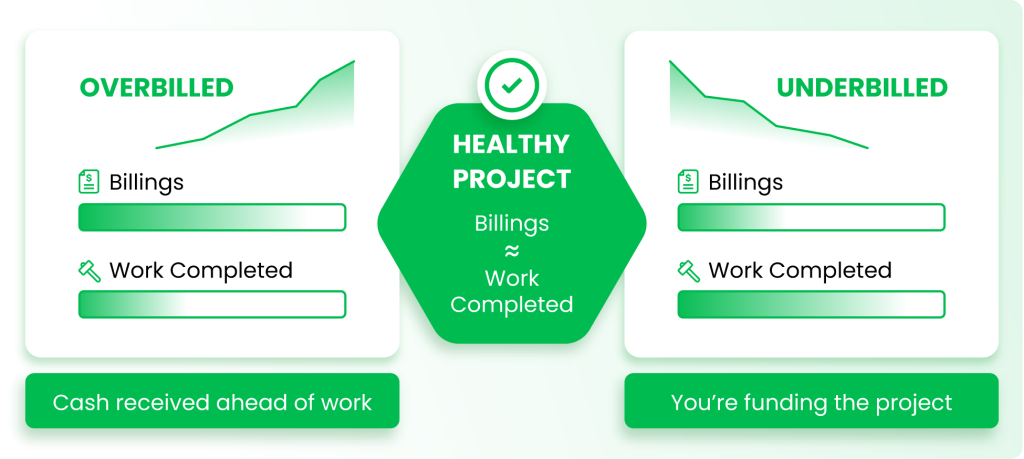
A WIP schedule also helps spot profit fade early. If projected margins keep shrinking, it’s a warning to investigate before delayed billings and slow payments create bigger cash flow problems
📊 General contractors believed subcontractors were paid about 30 days after a pay application; subs actually waited 56 days on average.4
Retainage and Slow Payments Keep Earned Revenue Out of Reach
Retainage holds back 5% to 10% of each progress payment until a project is substantially or fully complete. On a $600,000 job with 10% retainage, that’s $60,000 in earned revenue you can’t access.
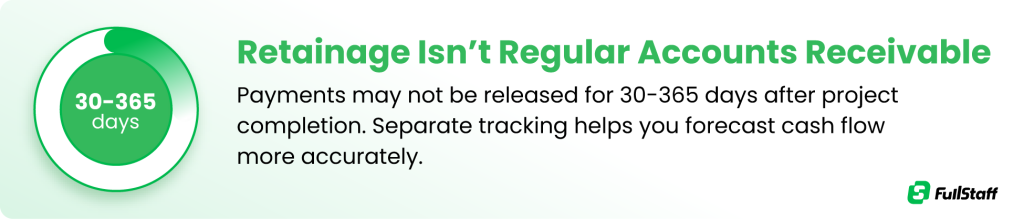
Strong progress billing is just as important. Late pay applications delay payments even further, putting additional pressure on cash flow throughout the project.
The Accounting Method Decision Most Small Contractors Get Wrong
Construction contractors can choose from several accounting methods, including cash basis, accrual, the completed contract method (CCM), and the percentage of completion method (PCM). Choosing the right method is an important part of bookkeeping and accounting for small construction company operations because it affects when income and taxes are recognized.
Eligibility depends on IRS rules. Contractors with average annual gross receipts below $32 million whose projects are expected to finish within two years may qualify for CCM or other simplified methods.5 Larger contractors generally must use PCM.
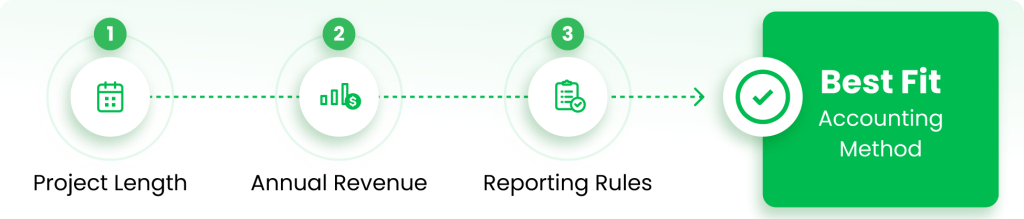
Tax rules, financing requirements, and recent legislation can all influence the best choice. Since banks and bonding companies often require PCM-based financial statements, review your accounting method with a construction-focused CPA each year.
What Bookkeeping and Accounting for Small Construction Company Owners Should Hand Off First
Most owners run the books themselves at the start, and it works until it doesn’t. You’re capable of doing it. The question is whether coding invoices at 9 p.m. is the best use of the person who also estimates the jobs and wins the work.
Owner-does-the-books, software alone, or dedicated support
Construction accounting software is a valuable tool, but it can’t handle everything. It won’t assign costs to jobs, reconcile retainage, or maintain a WIP schedule without the right process.⁷ That’s why bookkeeping and accounting for small construction company operations often requires someone who understands construction workflows—not just bookkeeping.
The signals it’s time
If your monthly close keeps slipping, your WIP schedule is unreliable, retainage hasn’t been reconciled, or you’re pricing bids from memory instead of job-cost data, it’s probably time to upgrade your process. In many cases, outsourcing costs less than the profit lost from inaccurate books.
Conclusion
Bookkeeping and accounting for small construction company operations comes down to three essentials: accurate job costing, regular WIP reviews, and separate retainage tracking. Together, they help you protect margins, spot profit fade early, and keep earned revenue from slipping through the cracks.
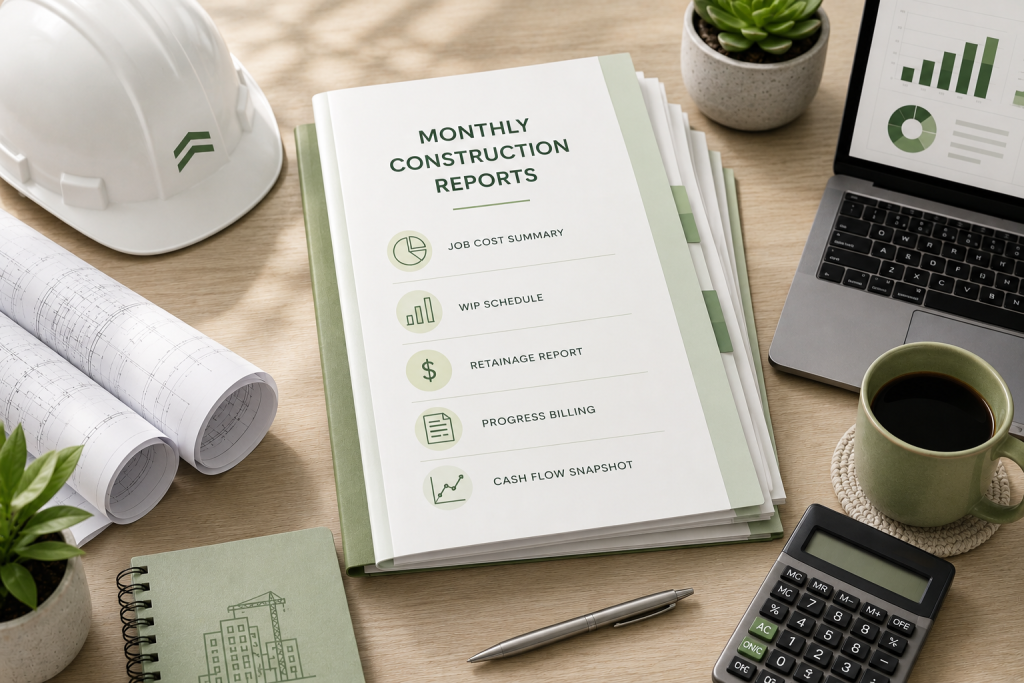
You don’t have to manage it yourself, you need a system and someone who understands construction accounting. If you’re ready to improve your financial visibility before your next project, take a look at a sample monthly job-cost and WIP reporting package below.
Frequently Asked Questions (FAQs)
What is the difference between construction bookkeeping and regular bookkeeping?
Construction bookkeeping tracks every transaction at the project level, while regular bookkeeping tracks by expense category. That means job costing, work-in-progress schedules, retainage receivables, and progress billing tied to pay applications, none of which exist in a standard small-business ledger.
What is job costing in construction?
Job costing is the practice of assigning every cost (labor with burden, materials, subcontractors, equipment, and allocated overhead) to the specific job that incurred it. It shows the actual profit on each project rather than a blended company total, which is what lets a contractor catch overruns mid-project, bill change orders accurately, and price future bids from real history instead of estimates.
What is a WIP report and why does it matter?
A work-in-progress (WIP) report compares billings to costs and earned revenue on every open job, showing whether each project is overbilled or underbilled. It matters because it’s the earliest warning system a contractor has: profit fade, billing gaps, and cash-flow problems all appear on the WIP schedule weeks or months before they show up in the bank account.
Which accounting method should a small construction company use?
Most small contractors that meet the IRS gross receipts test (average annual gross receipts under roughly $32 million) and expect contracts to finish within two years can choose among cash, accrual, and the completed contract method, while larger contractors must use percentage of completion. The right choice depends on contract length, entity type, and AMT exposure, so it’s a decision to make with a construction-savvy tax professional and revisit as revenue grows.
How is retainage recorded in construction bookkeeping?
Retainage is recorded as retainage receivable, a separate asset account from standard accounts receivable, because the funds are earned but not collectible until release conditions like substantial completion and final lien waivers are met. A contractor withholding retainage from subs records the mirror image as retainage payable.
How much does bookkeeping cost for a small construction company?
Outsourced construction bookkeeping typically runs a few hundred to a couple thousand dollars per month depending on transaction volume, number of active jobs, and whether WIP and job-cost reporting are included. That’s usually well below the cost of a part-time in-house bookkeeper once wages and benefits are counted.
What is the best accounting software for a small construction business?
There is no single best option: QuickBooks with a job-costing setup covers many small contractors, while construction-specific platforms like Foundation, Sage 100 Contractor, or Buildertrend add native WIP, certified payroll, and pay-application handling. The software matters less than the workflow around it, because no platform codes costs to jobs or reconciles retainage without a person running the process consistently.
When should a contractor hire a bookkeeper?
The reliable signals are a monthly close that slips past mid-month, a WIP schedule that lives in an untrusted spreadsheet, unreconciled retainage, or bids priced from memory rather than job-cost history. Any two of those together mean the books have outgrown the owner-does-it model, and contractor bookkeeping handed off at that stage costs less than the pricing errors it prevents.
Can AI replace a construction bookkeeper?
AI can automate the repetitive layer of construction bookkeeping, including transaction categorization, receipt capture, and parts of reconciliation, but it doesn’t replace human judgment on job costing, WIP accuracy, retainage release, or tax method decisions. Most contractors get the best result using AI to compress data entry while an experienced accountant reviews the output and handles the interpretation.
Let FullStaff Handle Your Bookkeeping
You already run the crews and the bids. The job costing, WIP schedules, and retainage tracking described above shouldn’t also land on your desk at 9 p.m. If you’d like to see what you’d actually receive, ask us for a sample monthly job-cost and WIP reporting package for a small GC or sub.
Since 2012, FullStaff has provided dedicated accounting professionals, trained to US GAAP standards, to small businesses that need reliable books without the cost of a full-time hire.
For construction companies, that includes:
- Job-cost tracking by cost code, including labor burden and overhead allocation
- Monthly WIP and over/under-billing schedules
- Retainage receivable tracking and reconciliation
- Progress billing and accounts receivable management
- A monthly close delivered by mid-month, every month
Here’s how it works: complete a short kickoff form, meet with our team to walk through your jobs and systems, and get matched with a dedicated accounting professional who learns your business and stays with it.
References:
- 2025 Construction Payments Report
- Contractor Survival Rates: Why 50% Fail & How to Beat the Odds (2026)
- Foundation Software — Construction Accounting 101: A Basic Guide for Contractors
- Cash flow problems continue to plague subcontractors: report
- Completed Contract vs. Percentage of Completion: Which Method Saves Contractors More?