

A job can hit its bid numbers, finish on schedule, and still close with less cash than the estimate promised. The gap usually isn’t in the field. It lives in books with no job costing, no WIP schedule, retainage buried in accounts receivable, and progress billings that don’t tie to your AIA G702 pay applications.
Generic books answer tax questions. Construction books answer whether each job made money.
Whether to hand your books to a specialist is a decision you can make on evidence. Below are the signs your setup has hit its ceiling, what construction bookkeeping services actually take on, and how to vet a provider before you commit.
What Outsourced Construction Bookkeeping Actually Looks Like
| A dedicated bookkeeper who already knows construction, coding every transaction to your jobs and cost codes |
| Job-cost reports that arrive while the job is still open, not after closeout |
| WIP schedules and retainage tracked as their own line items instead of disappearing into receivables |
| Progress-billing support that ties invoices to your schedule of values |
| Certified payroll records prepared and reconciled for prevailing-wage work |
| A monthly close that produces both a company P&L and job-level profitability |
The challenge isn’t finding someone who can categorize transactions. It’s finding someone who knows what retainage is.
Why General-Purpose Books Break on Construction Work
A standard small-business P&L assumes revenue and expenses fall into the same month and roll into one bucket. Construction rarely works that way. Costs often arrive before payments, revenue spans multiple accounting periods, and profitability has to be tracked by individual jobs, not just across the business.

Long-term contracts add another layer of complexity. Many contractors account for them using the percentage-of-completion method, recognizing revenue as work progresses instead of when cash is received.1 A generic bookkeeping approach can easily miss these requirements, creating problems during tax filing or surety reviews.
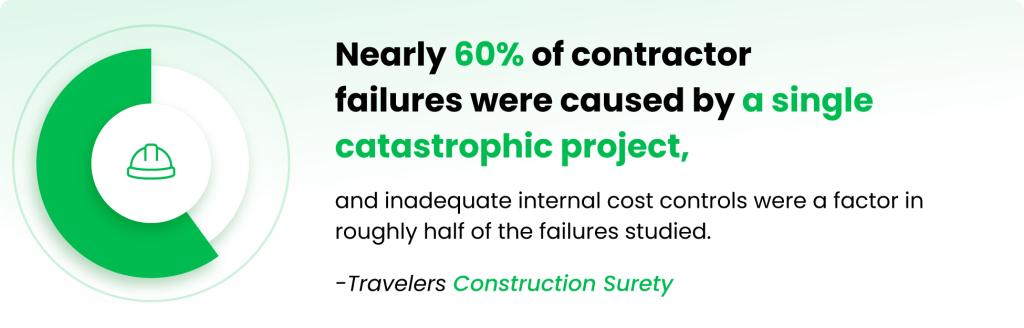
Generic books also fail to capture construction-specific details like retainage and job overhead. Retainage can overstate available cash, while unallocated overhead makes projects appear more profitable than they really are. It’s one reason only 14.1% of the 69,296 U.S. construction establishments that opened in the year ending March 2001 were still operating 24 years later.2
The Signs Your Books Have Outgrown Your Setup
The trigger for outsourcing isn’t company size. It’s the moment your books stop answering job-level questions. Bookkeeping for construction companies fails quietly, so it helps to name the signs one at a time.
Job-cost reports arrive after the job closes
If you learn a project’s true margin at closeout, the report is a historical document, not a management tool. By then, the labor overrun that ate your margin happened in week six, and nobody flagged it because cost coding ran four weeks behind. Estimating suffers too, since your next bid gets priced on stale actuals.
The WIP report and the bank balance disagree
A WIP schedule compares recognized revenue against billings, using contract value, approved change orders, costs to date, and estimated cost to complete.3 When it says a project is profitable while your cash position says otherwise, one of them is wrong, and it’s usually the WIP. Sureties and lenders read that document closely. Over-billings treated as profit and under-billings nobody investigates both erode bonding capacity.
Billing admin is eating owner hours
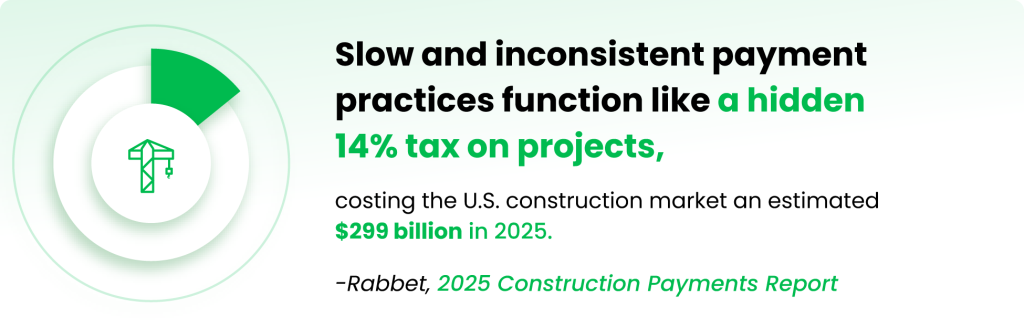
General contractors report spending 65 hours a month managing payments to subs and vendors. If a meaningful share of those hours are yours, the business is paying its most expensive person to chase pay apps and lien waivers.
If any of these describe your last quarter, the books have already outgrown the setup. The only question is what replaces it.
What Construction Bookkeeping Services Actually Take Off Your Plate
A construction-literate bookkeeping team takes over the transactional layer and returns it as decision-ready reporting. That means every invoice, receipt, and payroll run is coded to a job and cost code, so construction job costing reflects reality instead of a monthly guess. It means WIP schedules maintained monthly, retainage receivable tracked to each contract, and progress billings reconciled against the schedule of values.


Prevailing-wage work adds a compliance layer. Contractors on federal and federally assisted projects must submit certified payroll weekly under the Davis-Bacon and Related Acts.4 A provider who handles bookkeeping for contractors should treat that as routine work, not a special request.
The output that matters is what this makes possible: bids priced on current cost data, draw requests supported by clean documentation, and financial statements a bonding agent can read without a follow-up call. Specialized construction bookkeeping support exists precisely because these deliverables don’t come out of a generic monthly close.
The Hiring Math No Longer Favors In-House by Default
Suppose you decide to keep everything internal and hire a construction-experienced bookkeeper. The market is working against you.
Median pay for bookkeeping, accounting, and auditing clerks was $49,210 in May 2024 before benefits, taxes, software, and training, and the occupation is projected to decline 6% through 2034 even as roughly 170,000 openings need filling each year.5

None of this argues for replacing a good in-house person. If you already have one, they’re valuable. Outsourced construction bookkeeping services work well alongside internal staff by handling transaction coding and reconciliations so your in-house team can focus on billing, collections, and field coordination.
The comparison that matters is the total cost of building the function yourself against the cost of renting a finished one.
How to Vet a Provider Before You Hand Over the Books
The market includes generalist firms that list construction as one of a dozen industries. A short vetting conversation separates them from specialists quickly, because construction fluency is hard to fake. Ask each candidate provider these questions:
| Can you show me a sample WIP schedule you produce for a contractor my size? |
| How do you track retainage, and where does it appear on my statements? |
| How do you handle over- and under-billings when the WIP surfaces them? |
| Which platforms do you work in daily? QuickBooks, Sage, Foundation, Buildertrend? |
| Who owns the month-end close, and what date do you commit to? |
| How will you work with my CPA at year-end and with my bonding agent at renewal? |
Weak answers tend to cluster in the same areas: no WIP sample, retainage lumped into AR, and a close date of “usually mid-month.” Strong construction bookkeeping services back their claims with documents, clear pricing, and a defined onboarding process.
Conclusion
Construction bookkeeping services make sense when the evidence says your books have stopped keeping up: job-cost reports that trail the work, a WIP you don’t trust, and owner evenings spent on pay apps. Size isn’t the trigger. Visibility is.

Three takeaways. First, judge your current setup by whether it answers job-level questions while jobs are open. Second, count the full cost in-house, including your own hours, before assuming it’s cheaper. Third, vet providers by their documents; a sample WIP schedule tells you more than any sales deck.
If you want a concrete starting point, ask us to walk you through a sample WIP schedule and job-cost report we produce monthly for contractors.
Frequently Asked Questions (FAQs)
What does a construction bookkeeper do?
A construction bookkeeper records and codes every transaction to specific jobs and cost codes, maintains WIP and retainage schedules, reconciles bank and credit card accounts, supports progress billing against the schedule of values, and produces monthly job-level profitability reports alongside standard financial statements. The job differs from general bookkeeping because revenue and costs must be tracked per project across accounting periods, not just per month.
When should a construction company outsource its bookkeeping?
A construction company should consider outsourcing when its books stop answering job-level questions: job-cost reports arrive after projects close, the WIP schedule doesn’t reconcile with cash, month-end close slips past mid-month, or the owner is spending several hours a week on billing admin. These signs matter more than revenue size, because they show the bookkeeping function has fallen behind the operational needs of the business.
How much does it cost to outsource construction bookkeeping?
Outsourced bookkeeping for contractors typically runs from a few hundred dollars a month for a small operation with one or two active jobs to a few thousand for firms needing full job costing, WIP reporting, and payroll support. That compares with a median salary of about $49,210 plus benefits and software for one in-house bookkeeping clerk. Pricing usually scales with transaction volume and the number of active jobs rather than headcount.
What is job costing in construction bookkeeping?
Job costing is the practice of assigning every cost (labor, materials, subcontractors, equipment, and allocated overhead) to a specific project and cost code so you can see each job’s actual profitability. It’s the foundation of construction accounting because company-level financials can look healthy while individual jobs lose money, and job costing is what surfaces the difference early enough to act.
What is a WIP report and why does it matter?
A work-in-progress (WIP) report compares the revenue you’ve earned on each open job, based on percentage of completion, against what you’ve billed, showing whether each project is over-billed or under-billed and whether its margin is holding. It matters because sureties and lenders treat the WIP as a primary measure of contractor health, and because it’s the earliest reliable warning of profit fade on a job.
How is bookkeeping and accounting for a small construction company different from other small businesses?
Bookkeeping and accounting for a small construction company differs because revenue and costs span months on each contract, which typically requires accrual-based or percentage-of-completion accounting rather than the simple cash-basis books many small businesses use.¹⁰ Add retainage, progress billing, certified payroll, and job-level cost tracking, and construction books carry several structures a typical small-business bookkeeper never encounters.
Can QuickBooks alone handle contractor bookkeeping?
QuickBooks can handle contractor bookkeeping for smaller firms if it’s configured with job-level tracking, construction-specific cost codes, and disciplined data entry, though many contractors add construction tools or move to industry platforms as job count grows. The software is rarely the constraint; the constraint is whether the person running it knows how to structure jobs, retainage, and WIP reporting inside it.
What is retainage and how should it show up in my books?
Retainage is the portion of each progress payment, typically 5–10%, withheld until a project milestone or completion to guarantee performance.⁷ It should appear in your books as a separate retainage receivable tied to each contract, not blended into standard accounts receivable, because it isn’t collectible on normal terms and treating it as ordinary AR overstates your near-term cash position.
Can AI replace a construction bookkeeper?
AI can automate the repetitive layer of construction bookkeeping, including transaction categorization, receipt matching, and bank reconciliation, but it can’t replace human judgment on cost-code assignment, WIP adjustments, change-order treatment, or the estimates behind percentage-of-completion revenue. Contractors get the best results using AI to compress data entry while an experienced bookkeeper or accountant owns the interpretation, compliance, and reporting that sureties and CPAs rely on.
Let FullStaff Handle Your Bookkeeping
Running a construction business means your margin lives or dies in the details: cost codes, retainage, pay apps, and a WIP schedule that has to be right. Keeping all of that current takes dedicated hands, not spare evenings.
Since 2012, FullStaff has provided experienced, degree-qualified accounting professionals who work as dedicated members of your team, following US GAAP standards.
- Job-cost tracking and project reporting
- WIP and retainage tracking
- Certified payroll
- Bank and credit card reconciliation with a consistent monthly close
Here’s how it works: complete a short kickoff form, meet with our team to define the workflows you need covered, and get matched with a dedicated accounting professional who learns your business and stays with it.
References:
- IRS — About Form 8697, Look-Back Method for Completed Long-Term Contracts
- ConstructConnect — 6 Reasons Why Construction Companies Fail
- Intuit — Construction Project Accounting: Job Costing, WIP, and Cash Flow
- U.S. Department of Labor — Davis-Bacon Certified Payroll Form WH-347
- U.S. Bureau of Labor Statistics — Bookkeeping, Accounting, and Auditing Clerks, Occupational Outlook Handbook