

The bookkeeping setup that worked at $500K in revenue usually stops working well before $2M. Transaction volume multiplies, the monthly close slips from the 10th to the 25th, and AR aging gets reviewed whenever someone remembers to pull the report. Meanwhile, the owner is still the one categorizing expenses on a Sunday night.
Revenue grows. The books don’t keep up. That gap costs more than most owners realize.
The usual answer is to push through it, or to hire someone. Both options have real costs that rarely get counted. This article walks through the benefits of outsourcing bookkeeping in operational terms: what actually changes in how you run the business, what it costs compared to hiring, and what outsourcing can’t fix.
What Outsourced Bookkeeping Actually Changes
| Your books close on a fixed monthly schedule instead of whenever there’s time. |
| Bank and credit card reconciliation stays current, so your cash position is a fact, not an estimate. |
| AR aging gets reviewed monthly and acted on, not discovered at tax time. |
| The hours you spend on categorization and cleanup go back into revenue work. |
| Your P&L becomes something a lender, CPA, or buyer can rely on without a cleanup project first. |
| Capacity scales with transaction volume, without a hiring decision each time. |
The challenge isn’t finding these benefits. It’s getting them without giving up visibility into your own numbers.
When You Become the Bottleneck on Your Own Books
Most owners don’t decide to fall behind on their books. It happens in increments. A second bank account gets added and reconciliation doubles. A few customers start paying on terms and suddenly there’s an AR aging report nobody owns. Payroll grows from four people to eleven.
Each increment is small. The cumulative effect is that financial work expands to fill evenings, and the close date drifts later each month. By the time the P&L is ready, it describes a month you’ve mostly forgotten.
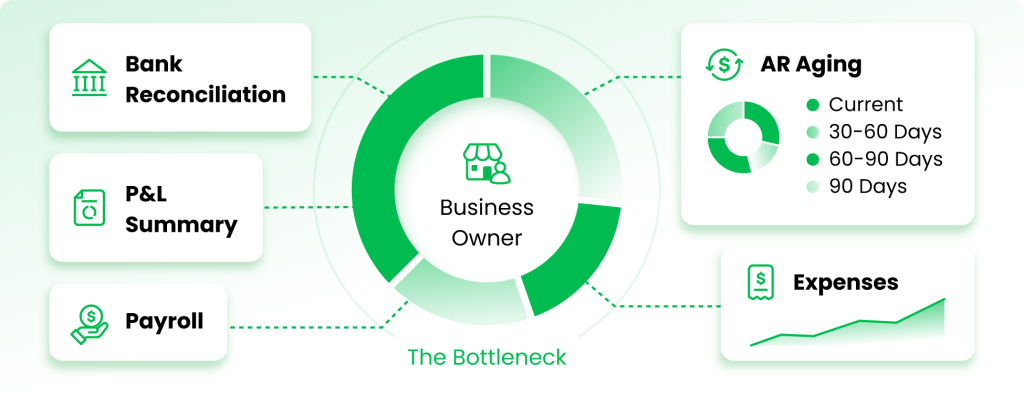
This is the stage where the benefits of outsourcing bookkeeping become concrete rather than theoretical. The problem isn’t that the owner is bad at the work. It’s that the work has outgrown the hours available for it, and the owner’s hours are the most expensive ones in the building.
The tell is decision deferral. You delay a hire because you’re not sure what payroll can absorb. You keep a marginal service line because nobody has isolated its margin. You guess at quarterly estimates. None of these are accounting problems. All of them are caused by one.
The Real Cost of Keeping It In-House
The instinctive fix is to hire a full-time bookkeeper. For some businesses that’s right. But the math deserves a closer look than it usually gets.
📊 The median annual wage for bookkeeping, accounting, and auditing clerks was $49,210 as of May 2024.1
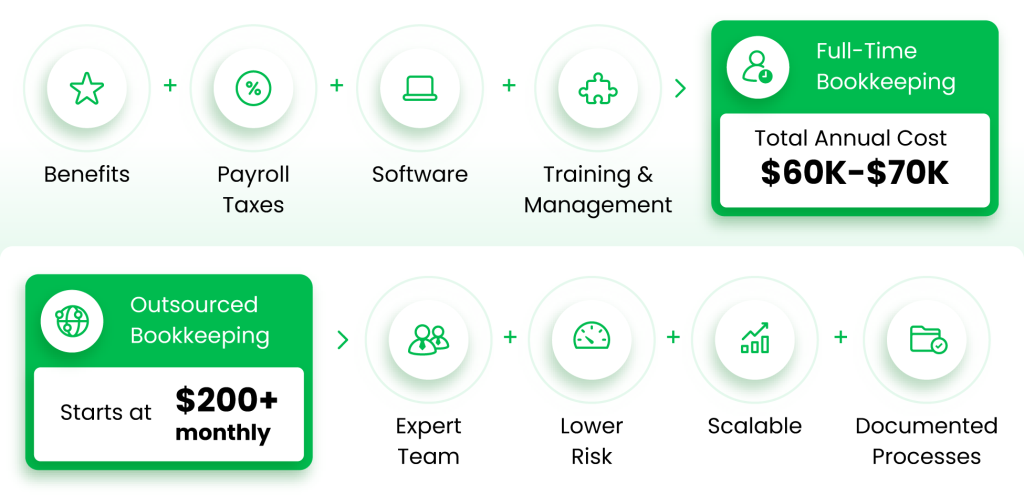
Salary is the starting point, not the total. Add payroll taxes, benefits, software seats, training, and the management time it takes to supervise a function you may not fully understand yourself. A $49K salary becomes a $60K–$70K annual commitment for a role most growing businesses can’t fill with 40 hours of real work per week.
There’s also a supply problem. The pipeline of accounting talent has been contracting for years, which means fewer candidates, longer searches, and higher offers for the same role.
📊 Accounting bachelor’s and master’s degrees awarded fell 6.6% year over year to 55,152 in the 2023–24 academic year.2
And a single in-house hire concentrates risk. One person holds the process knowledge, the vendor logins, and the reconciliation habits. When they leave, the function leaves with them. Outsourced arrangements spread that risk across a team and a documented process, with pricing that runs a fraction of the loaded cost at around $300 to $1,500 per month for most small businesses.
Where the Benefits of Outsourcing Bookkeeping Actually Show Up
Most articles list the same three benefits: save money, save time, and get expertise. All true, and all too vague to act on. Here’s where each one lands operationally.
Time comes back first. Categorization, reconciliation, and report preparation move off your desk in the first month. For owners doing their own books, that’s often 10 or more hours a month returned to the work that actually compounds.
Accuracy follows. A dedicated professional working in your file every week catches duplicate entries, miscategorized expenses, and unrecorded liabilities while they’re still small. Clean records also mean you can substantiate what’s on your tax return if the IRS ever asks. The burden of proof for deductions sits with you, not your preparer.


Then reporting quality. Outsourced bookkeeping services produce statements on a schedule, in a standard format, reviewed by someone whose only job is the books. That’s the difference between a P&L you glance at and a financial dashboard you manage from.
📊 Deloitte’s 2024 Global Outsourcing Survey found that access to skilled talent and agility have joined cost reduction as the key reasons organizations outsource.3
That survey finding matches what growing businesses actually experience. The savings are real, but they’re rarely the benefit owners talk about a year later. The benefit they talk about is knowing their numbers.
What a Reliable Monthly Close Changes
A monthly close that lands on the same date every month sounds like an accounting nicety. In practice, it separates managing cash flow from reacting to it.
Cash flow problems are rarely sudden. They build across months of slow receivables and creeping costs that current books would have surfaced early. A business that closes by the 10th sees the problem in week two. A business that closes “eventually” sees it in the bank balance.
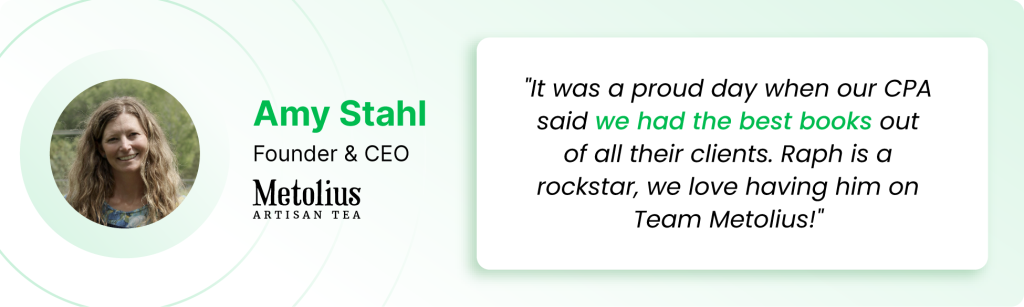
Metolius Tea — a tea importer, manufacturer, wholesaler, and retailer — had been closing books inconsistently as their channel mix expanded. After bringing on a senior outsourced accountant, the team began closing by the 10th of each month, with product-level margin reporting feeding pricing decisions.
The close discipline pays off beyond cash management. Tax season becomes a handoff instead of a cleanup project. Loan applications move faster because the statements are current. And if you ever sell the business, three years of clean monthlies is due diligence gold.
What Outsourcing Doesn’t Fix
An honest accounting of the benefits of outsourcing bookkeeping requires naming its limits, because a provider who promises everything should worry you.
It doesn’t replace judgment. A bookkeeper keeps records accurate and current. Interpreting those records — pricing, hiring, financing decisions — remains yours, ideally with input from a CPA. The SBA draws the same line: bookkeepers handle the day-to-day functions, while a CPA offers tailored advice on top of them.4
And it doesn’t remove your need to look at the numbers. The owners who get the most from outsourcing treat the monthly package as a standing meeting with their business, not a report to file away.
How to Outsource Bookkeeping for a Small Business Without Losing Visibility
The most common fear about handing off the books is losing touch with them. It’s a reasonable fear, and the provider you choose determines whether it comes true.
Ask who actually does the work. A dedicated professional who knows your business beats a rotating pool that re-learns your chart of accounts every quarter. When you hire an outsourced accountant, you should know their name.

Ask about standards and reporting. Books kept to US GAAP, the reporting standard maintained by the Financial Accounting Standards Board, will hold up in front of lenders and buyers. Advisers who work with growing businesses consistently point to timely, quality financial information as the main thing owners are missing, and the main thing to demand from a provider.5
Ask about access and security. You should retain ownership of your accounting file, see work as it happens, and know exactly who can touch your bank feeds. A defined onboarding process with a close calendar is a good signal; vagueness about either is not.
If a provider can answer those three questions specifically, you’ll end up with more visibility into your books than you had doing them yourself — because the numbers will finally be current.
Conclusion
The benefits of outsourcing bookkeeping come down to one operational shift: your financials stop being a chore that trails the business and start being a tool that steers it. The close lands on schedule. Cash flow surprises shrink. The hours you were spending in the ledger go back into the work only you can do.

The decision point is the moment stale numbers start costing you decisions: a hire delayed, a price left unexamined, a tax season that eats February. If that moment has already happened, the math on outsourcing usually isn’t close.
Want to see what the deliverable looks like? Ask for a sample monthly close package — reconciled accounts, P&L, and AR aging, delivered by the 10th.
Frequently Asked Questions (FAQs)
Is outsourcing bookkeeping worth it for a small business?
For most growing businesses, yes, and the case gets stronger as transaction volume grows. Outsourcing typically costs a fraction of a full-time hire, returns 10 or more owner-hours a month, and produces financial statements reliable enough to support lending, tax planning, and pricing decisions. The businesses that benefit least are very early-stage companies with minimal transactions, where software plus a year-end CPA review may be enough.
How much does outsourced bookkeeping cost per month?
Most small businesses pay between $300 and $1,500 per month for outsourced bookkeeping, depending on transaction volume, number of accounts, and reporting needs. That compares to roughly $60,000 or more per year all-in for a full-time in-house bookkeeper. Providers typically price by scope, so a business with two bank accounts and simple payroll sits at the low end of the range.
When should a growing business outsource bookkeeping?
The clearest trigger is when financial information stops being timely — the close slips past mid-month, reconciliations lag, or the owner is doing books on weekends. Other common triggers include a failed or departing bookkeeper hire, a lender requesting current statements, or tax season requiring weeks of cleanup. If any of those has happened in the last year, the business is past the point where outsourcing pays for itself.
What does an outsourced bookkeeper do each month?
A standard monthly engagement covers categorizing all transactions, reconciling bank and credit card accounts, maintaining AR and AP records, and delivering a financial package (typically a P&L, balance sheet, and cash flow statement) on a fixed close date. Many engagements also include payroll coordination, sales tax filings, and preparing year-end records for the CPA who files the return.
Is it safe to give an outside bookkeeper access to my accounts?
It’s safe when the provider uses proper controls: read-only bank feed access, accountant-level (not owner-level) software permissions, and no authority to move money. Reputable providers work inside your accounting file rather than their own, so you keep ownership and can see every entry. Ironically, an outside bookkeeper with defined permissions is often lower-risk than a single trusted employee with full access and no oversight.
Should I outsource bookkeeping or hire in-house?
Outsource when you need fewer than 30 hours a week of bookkeeping work, which describes most businesses under roughly $10M in revenue. Hire in-house when daily on-site financial work (job costing, inventory counts, heavy AP volume) genuinely fills a full-time role. Many businesses land on a hybrid: an outsourced bookkeeper for the monthly close and reporting, with an office manager handling day-to-day invoicing.
Do I still need a CPA if I outsource bookkeeping?
Yes. A bookkeeper and a CPA do different jobs: the bookkeeper keeps your records accurate and current through the year, while the CPA uses those records for tax strategy, filings, and higher-level advice. Outsourcing bookkeeping usually makes your CPA relationship cheaper and more useful, because the CPA receives clean books instead of billing hours to fix them.
Can AI replace a bookkeeper?
AI can automate repetitive accounting tasks — transaction categorization, invoice processing, and parts of reconciliation — but it doesn’t replace experienced professionals for oversight, error investigation, compliance judgment, and financial interpretation. Most growing businesses get the best result from a bookkeeper who uses AI tools to compress the transactional work and spends the saved time on review and reporting quality.
How do I hand off my books without losing visibility?
Keep ownership of your accounting software file, grant the provider access rather than migrating into their system, and agree on a fixed monthly close date with a defined deliverable package. Ask for a named, dedicated bookkeeper and a monthly review call for the first quarter. Owners who follow that structure typically report better visibility after outsourcing than before, because reports arrive on schedule instead of when someone finds time.
Let FullStaff Handle Your Bookkeeping
If your close date keeps slipping and your evenings keep disappearing into the ledger, that’s the problem we staff for. See a sample monthly close package — reconciled accounts, P&L, and AR aging — delivered by the 10th.
Since 2012, FullStaff has provided dedicated, degree-qualified accounting professionals to growing businesses that need reliable books without the cost of a full-time hire.
- Bank and credit card reconciliation
- Monthly close on a fixed schedule
- P&L statements and financial reporting you can act on
Here’s how it works: complete a short kickoff form, meet with us to walk through your books and needs, and get matched with a dedicated accounting professional — not a rotating resource.
References:
- Bookkeeping, Accounting, and Auditing Clerks
- The accounting graduate pipeline: Where do things stand?
- Global outsourcing survey 2024
- SBA — Manage Your Finances
- CO— by U.S. Chamber of Commerce — How to Decide Whether to Outsource Accounting Services