

A small business can run for years on bank-balance accounting. Money comes in, bills get paid, and the owner checks the account before any big decision. It works surprisingly well until the business grows faster than the time available to manage the books.
Then the cracks begin to show. Receivables go unchecked, monthly closes get skipped, and cash flow becomes harder to predict.
That’s where online bookkeeping services for small business come in. According to the Federal Reserve Banks’ Small Business Credit Survey, 51% of small employer firms reported uneven cash flow as a financial challenge, while 56% struggled to pay operating expenses.1 Here’s what these services include, what they cost, and what to look for in a provider.
What Online Bookkeeping Actually Covers
| Records and categorizes every transaction in cloud accounting software you own, such as QuickBooks Online or Xero |
| Reconciles bank and credit card accounts every month, so the books match reality |
| Tracks accounts receivable and accounts payable, including an AR aging report that shows who owes you and for how long |
| Delivers a monthly close with a P&L, balance sheet, and cash flow statement on a predictable date |
| Keeps recordkeeping compliant, from receipts to payroll records |
| Flags issues a spreadsheet won’t, like miscategorized owner draws vs. salary or expense lines drifting upward |
| Charges a flat monthly fee instead of a salary with payroll taxes and benefits |
None of this is complicated. The challenge is consistency, not complexity.
Why Bank-Balance Accounting Stops Working
A bank balance answers one question: what’s in the account right this minute. It says nothing about the invoice that’s 47 days old, the credit card charges nobody has categorized since March, or whether last quarter was actually profitable. Revenue can climb while margins quietly erode, and the balance won’t tell you.
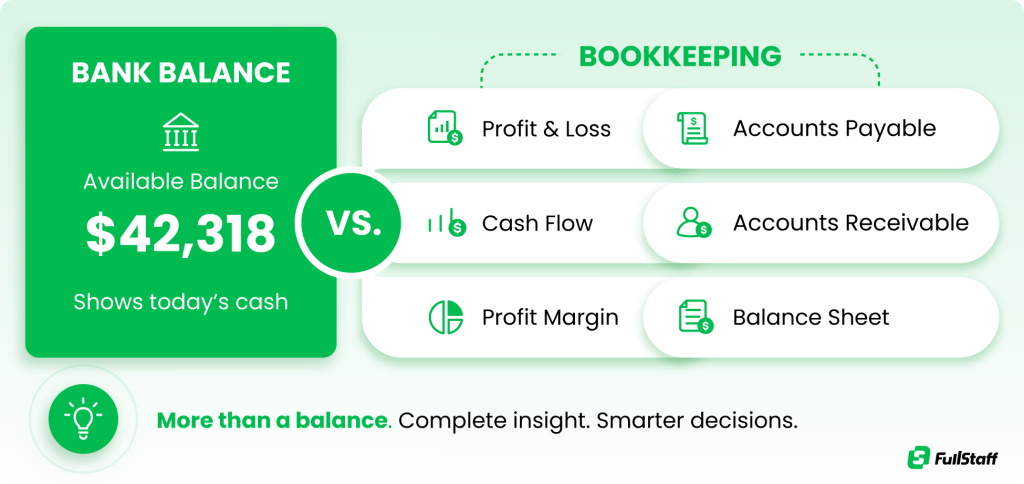
That visibility gap gets expensive as a business grows. Pricing decisions get made on instinct. Slow-paying customers keep getting work because nobody is watching accounts receivable. Tax season becomes an archaeology project.
This is the point where many small businesses realize they need more than a bank balance. They need timely financial records that show where money is coming from, where it’s going, and how the business is actually performing.
What Online Bookkeeping Services for Small Business Handle Month to Month
The process is simpler than many business owners expect. You connect your business bank and credit card accounts to cloud accounting software, and receipts, bills, and other financial documents flow in digitally instead of piling up in a shoebox.
A remote bookkeeper then categorizes transactions, reconciles accounts, and keeps your books current week by week instead of quarter by quarter. Virtual bookkeeping firms typically charge a flat monthly fee, making costs more predictable.2
Accurate bookkeeping also helps businesses meet recordkeeping requirements. The IRS expects records that allow you to monitor business performance, prepare financial statements, and support your tax returns, with employment tax records generally kept for at least four years.3
The SBA recommends keeping a close eye on accounts receivable, accounts payable, available cash, bank reconciliations, and payroll.4 For many small businesses, an online bookkeeping service takes ownership of these ongoing financial tasks.
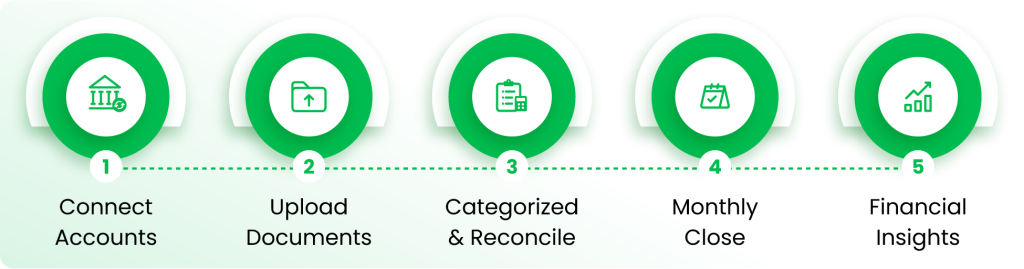
What a real monthly close includes
A close isn’t a report; it’s a checkpoint. Every account reconciled, every transaction categorized, AR and AP reviewed, and a P&L, balance sheet, and cash flow statement delivered by a fixed date each month. Done consistently, it becomes the financial dashboard the business runs on.
The Hours Problem in Owner-Kept Books
Owners who keep their own books pay twice. Once in evenings and weekends, and again in the decisions that wait while the books fall behind. An owner who can’t see job-level or product-level margin until months later is steering on delay.
The self-reported numbers back up how much owners dislike this work, and how much time it eats.


📊 40% of small business owners say bookkeeping and taxes are the worst part of owning a business, and 40% spend 80+ hours a year dealing with them.5
The relevant math isn’t the bookkeeper’s rate. It’s what an owner-hour is worth when it’s spent on sales, hiring, or operations instead of transaction categorization. For most businesses past roughly $500K in revenue, that comparison stops being close.
When Hiring In-House Doesn’t Pencil Out
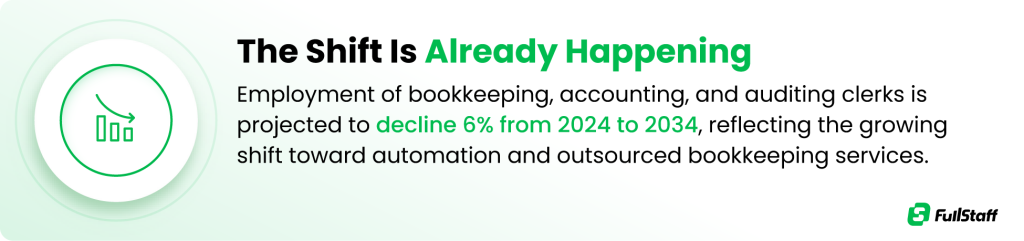
The traditional answer was to hire a bookkeeper. That answer is getting harder to execute. The labor market for bookkeeping and accounting staff is tightening from both ends: experienced clerks are retiring, and fewer people are entering the profession behind them. Accounting degrees fell 6.6% in the most recent academic year measured, though enrollment is finally recovering.6
Add payroll taxes, benefits, software, and recruiting, and the fully loaded cost of one in-house hire lands well above $60K, for a role most small businesses can’t fill full time. This is why many owners outsource bookkeeping for small business operations instead: you get the function without carrying the headcount, often through a dedicated virtual accountant rather than a rotating pool.
What Bookkeeping Services for Small Business Cost, and What Drives the Price
Pricing is the first thing owners ask about and the least standardized thing in the industry. The honest answer is a range.
📊 Virtual bookkeeping services typically run on flat monthly subscriptions between $300 and $1,500 per month, against a median bookkeeper rate of nearly $24 per hour.7
Where you land in that range depends on a few drivers:
| Monthly transaction volume across all accounts |
| Number of bank, credit card, and loan accounts to reconcile |
| Whether AR, AP, or payroll support is included or just categorization and reconciliation |
| Catch-up work, if the books are months behind |
| Reporting depth, from a basic P&L to margin reporting by product or job |
Notice what’s missing from that list: revenue. The cost of online bookkeeping services for small business depends on the amount and complexity of the work, not how much the business earns. A larger business with clean books may pay less than a smaller one with messy records. The real comparison is the cost of outsourcing versus hiring in-house.
How to Vet a Provider Before Handing Over the Books
The difference between a good provider and a bad one doesn’t show up during the sales call. It shows up a few months later. Ask who will manage your books, who owns the accounting software file (it should always be you), when the monthly close is completed, whether the work follows US GAAP, and how bank access is secured.
Also ask about onboarding. A structured process that includes setup, cleanup, and a consistent monthly workflow is usually a sign of a reliable provider. The best online bookkeeping services for small business should answer these questions clearly and confidently.

Conclusion
Online bookkeeping services for small business come down to a simple trade: a predictable monthly fee for accurate books and financial reports you can trust. The most important things to look for are a guaranteed monthly close, transparent pricing, and a provider that clearly explains who manages your books and how the process works.
Before committing, ask to see a sample monthly close package, including reconciled accounts, a profit and loss statement, and a balance sheet. It’s one of the easiest ways to evaluate the quality of a provider’s work.
Frequently Asked Questions (FAQs)
How much do bookkeeping services cost for a small business?
Typical virtual bookkeeping subscriptions run $300 to $1,500 per month, with entry-level plans starting around $200 and complex, high-volume books running higher. The price is driven by transaction volume, the number of accounts to reconcile, and whether AR, AP, or payroll support is included, not by your revenue.
What is the difference between a bookkeeper and an accountant?
A bookkeeper records and organizes daily financial transactions (categorization, reconciliation, invoicing) while an accountant interprets those records for tax strategy, compliance, and higher-level financial planning. Bookkeeping is built on double-entry recording, where every transaction generates two entries, and it produces the clean data an accountant or CPA works from.
Is it worth outsourcing bookkeeping for a small business?
For most businesses past roughly $500K in revenue, yes: the owner’s time is worth more in sales and operations than in transaction categorization, and an outsourced service costs a fraction of a fully loaded in-house salary. The main exception is a very early business with minimal transactions, where software plus a few hours a month is often enough.
How does online bookkeeping work if the bookkeeper is remote?
Your bank and credit card accounts connect to cloud accounting software through secure, read-only feeds, and documents like receipts and bills are uploaded digitally. The bookkeeper works inside that shared file, so you can see the books in real time, and communication happens over email, chat, or scheduled calls.
Is online bookkeeping safe?
Yes, when it’s set up correctly: reputable providers use bank-level, read-only account connections, never ask for your banking login, and work in software where you control user permissions. The practical security checklist is short: read-only access, two-factor authentication, and your ownership of the accounting file.
Can AI replace a bookkeeper?
AI handles a growing share of the transactional layer, including categorization suggestions, receipt matching, and bank feed imports, but it doesn’t replace human judgment on reconciliation exceptions, accrual decisions, compliance questions, or what the numbers mean for the business. In practice, AI compresses the routine work while an experienced bookkeeper or accountant reviews, corrects, and interprets it.
When should a small business outsource its bookkeeping?
The reliable triggers are: books that run more than a month behind, an owner spending several hours a week on financial admin, a bookkeeper’s departure, or a growth stage where inventory, payroll, or multiple accounts have outgrown the current setup. Any one of these usually costs more in delayed decisions than a service costs in fees.
What is included in a monthly close?
A complete monthly close includes reconciling every bank, credit card, and loan account, categorizing all transactions, reviewing AR and AP, and delivering a profit and loss statement, balance sheet, and cash flow statement by a fixed date. The close is what turns raw bookkeeping into numbers you can make decisions from.
How do I switch bookkeeping services without losing my records?
Confirm you own the accounting software subscription and its full history, then grant the new provider access rather than transferring ownership of anything. A competent new service will run a handover review (reconciliation status, open AR and AP, chart of accounts) before taking over the monthly cycle, so nothing is lost between providers.
Let FullStaff Handle Your Bookkeeping
If your books live in a spreadsheet and your close happens whenever there’s time, you’re making decisions on last quarter’s information. That’s the gap a dedicated remote bookkeeper closes.
Since 2012, FullStaff has provided dedicated virtual accountants and bookkeepers: degreed professionals working to US GAAP standards, assigned to your business rather than rotated across a pool. For small businesses, that typically covers:
- Bank and credit card reconciliation
- A consistent monthly close, delivered on a committed date
- P&L, balance sheet, and cash flow reporting you can act on
- AR aging and AP tracking, so collections and bills don’t drift
Here’s how it works: complete a short kickoff form, meet with our team about your books and software, and get matched with a dedicated accounting professional who learns your business.
References:
- 2025 Report on Employer Firms: Findings from the 2024 Small Business Credit Survey
- BILL — What Is Virtual Bookkeeping and How It Works
- Internal Revenue Service — Recordkeeping for Small Businesses
- U.S. Small Business Administration — Manage Your Finances
- New Infographic: The Burden of Small Business Accounting, Taxes and Payroll
- Journal of Accountancy — The Accounting Graduate Pipeline: Where Do Things Stand?
- How much does a bookkeeper cost?