

Every small business eventually outgrows its bookkeeping setup. When cash flow is unclear, reports are outdated, and month-end closes keep slipping, it’s time to find better bookkeeping support. In fact, 60% of small businesses cite ineffective cash flow management as a major challenge.1
The problem usually isn’t effort, it’s choosing the wrong fit. The right provider should deliver accurate books, timely reports, and financial clarity, not just record transactions.
This guide explains the different options, what pricing really means, and how to choose the right bookkeeping services for small business without making an expensive mistake.
What Choosing the Right Bookkeeping Provider Actually Looks Like
| Define the work you’re handing off before you talk to anyone. Reconciliations, invoicing, payroll, and reporting are different jobs with different price tags. |
| Match the provider tier to your complexity, not your budget. A $300 subscription can’t handle inventory, multiple entities, or accrual books. |
| Demand a fixed monthly close date. “We’ll get to it” is not a close date. |
| Insist on a dedicated bookkeeper, not a rotating pool. Continuity is where accuracy comes from. |
| Price the service against the full cost of the alternative, including your own hours. |
| Verify industry experience with specific questions, not a logo wall. |
| Confirm software fit and data security before you sign, not after. |
The challenge isn’t finding a provider. It’s telling them apart.
What Staying Too Long With the Wrong Setup Costs You
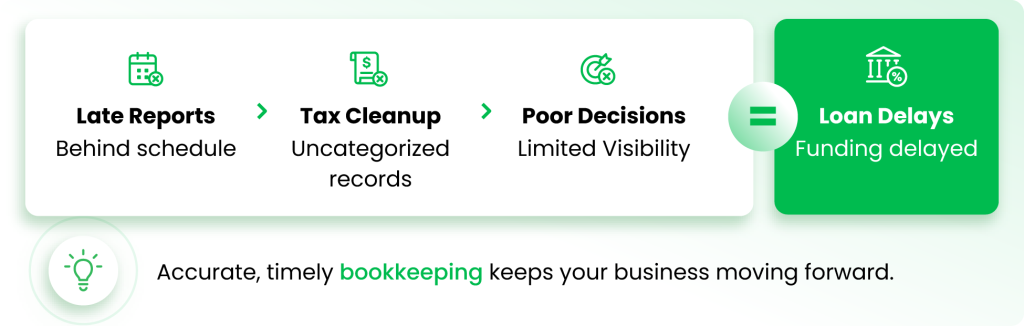
The cost of a bad bookkeeping arrangement rarely shows up as a line item. It shows up as decisions made late or not at all. If your books close six weeks after the month-end, every pricing move, hire, and equipment purchase in that window runs on guesswork.
It also shows up at tax time. When transactions sit uncategorized for months, your CPA reconstructs the year in March, bills you for the hours, and files with whatever deductions survive the reconstruction. Owners in that cycle tend to know something is off long before they can name it.
📊 Fewer than half of small business owners (48%) are confident they’re paying taxes correctly. Among owners who work with an accounting professional, that figure jumps to 69%.2
Financing is the third cost. Lenders ask for current financial statements, and “current” means reconciled through last month. Businesses evaluating bookkeeping services for small business often start the search after a loan application stalls on statements the bank won’t accept.
The Four Kinds of Provider You’re Actually Choosing Between
Every option on your shortlist falls into one of four models. The names on the websites vary. The trade-offs don’t.

The freelance bookkeeper
A solo professional handling several clients, usually hourly or on a small retainer. Good freelancers are accurate and affordable. The risk is capacity: one person, no backup, and no coverage when they’re sick, on vacation, or at their limit. If your transaction volume grows, you’re often the client that gets squeezed.
The local accounting firm
A CPA firm that offers bookkeeping alongside tax work. The credentials are real and the tax integration is convenient. But bookkeeping is rarely the firm’s priority, and the work is often pushed to junior staff and reviewed quarterly. You’re buying the firm’s brand and getting its bench.
The software-plus-service subscription
A national brand that bundles bookkeeping software with a remote team, priced as a flat monthly plan. Fast onboarding and clean dashboards. The limits appear at complexity: inventory, accrual accounting, multiple entities, or industry-specific revenue. Support is typically a queue, not a person who knows your business.
The dedicated outsourced professional
A staffing model where one named accountant works your books as their assignment, backed by a firm that handles hiring, review, and continuity. This is the model growing fastest, partly because the talent market is pushing it. Businesses that outsource bookkeeping for small business operations this way get senior-level attention at a fraction of a full-time hire.
The supply squeeze is real on the hiring side too: three-quarters of accounting firms that hired new graduates in 2024 planned to hire the same number or more in 2026 and beyond, all competing for a shrinking pool.3
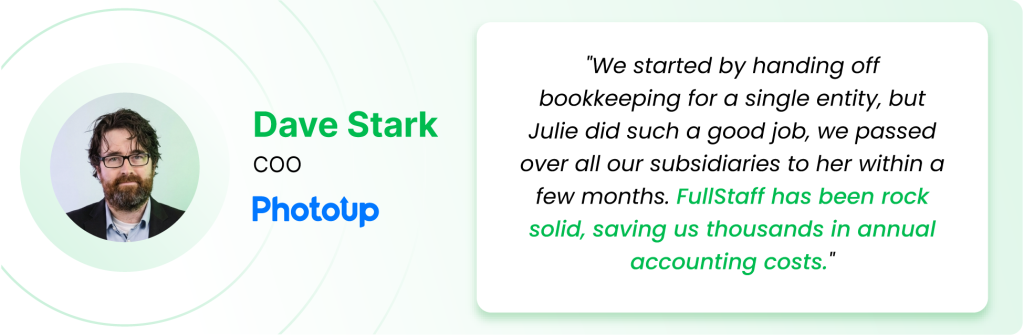
PhotoUp, a real estate photo editing company with 200+ employees, was paying five figures annually to a legacy accounting firm that still couldn’t deliver timely consolidated financials. One senior accountant took over and soon managed every subsidiary, delivering monthly US and global consolidated reports.
How to Evaluate Bookkeeping Services for Small Business
Once you know the model you need, evaluation comes down to six checks. Run all six on every finalist.
Industry experience
Ask how many clients they serve in your industry and what those clients’ books require. Vague answers here predict vague books later.
Dedicated person or pool
Ask who does the work day to day and what happens when that person leaves. “A team handles it” usually means nobody owns it.
Software fit
They should work inside your QuickBooks or Xero file, not migrate you into a proprietary system you can’t leave.
Reporting cadence
Ask for the monthly close date in writing and for a sample reporting package. A real provider hands you a P&L, balance sheet, and reconciliation summary without hesitating.
Communication expectations
Agree on response times and a channel before you sign. A monthly report with no one to explain it isn’t much better than no report.
References from businesses your size
A provider built for solopreneurs will struggle with your payroll; one built for mid-market will treat you as small.
Security belongs in this conversation too, not after onboarding. Ask how they handle bank access, whether they use read-only connections, and who inside the firm can see your data. The answers should be immediate and specific.


What Bookkeeping Should Cost, and What the Price Actually Buys
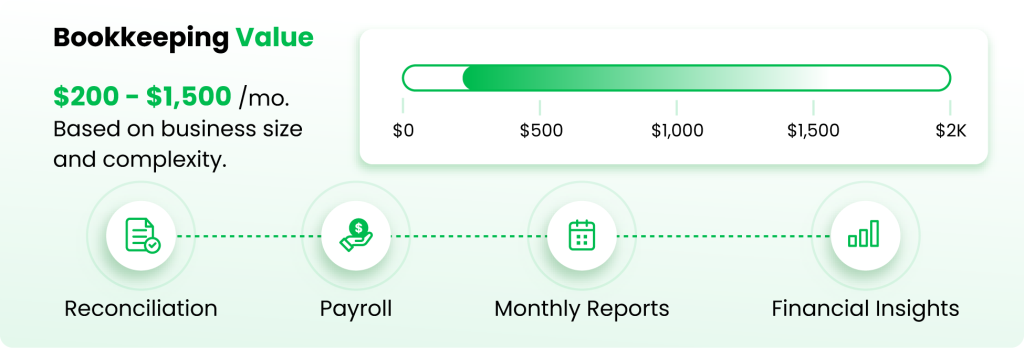
Outsourced bookkeeping is typically priced hourly, as a flat monthly fee, or per transaction. Flat monthly pricing is the most common, with costs generally ranging from $200 to $1,500 per month based on business size and complexity.
Compared to hiring in-house, outsourcing often saves money by avoiding added expenses like benefits, payroll taxes, software, and recruiting.
📊 The median annual wage for bookkeeping, accounting, and auditing clerks was $49,210 in May 2024, and employment in the occupation is projected to decline 6% through 2034.4
Comparing prices alone can be misleading. Lower-cost bookkeeping plans often include only basic transaction categorization, while services like reconciliations, payroll entries, and monthly reporting may cost extra. Look for providers that clearly itemize what’s included so you can compare the true value of each quote.
The Questions That Expose a Data-Entry Shop
Plenty of providers record transactions. Far fewer maintain books you can run a business on. A complete monthly cycle includes reconciling every bank and credit card account, reviewing AR aging, and closing to a reporting package, the same baseline the U.S. Chamber of Commerce describes for keeping records audit-ready.5
Five questions in a sales call will tell you which kind of provider you’re talking to:
| “Who exactly does my books, and can I talk to them before signing?” Hesitation here means a pool. |
| “What date each month do my books close?” A data-entry shop can’t answer, because closing isn’t part of the service. |
| “Show me a sample monthly package for a business like mine.” You want to see reconciliation reports, not just a P&L. |
| “What happens when a bank feed breaks or a balance doesn’t tie?” The right answer describes a process, not a promise. |
| “How do you handle my industry’s quirks?” Whether that’s deferred revenue, tips, or job deposits, they should ask you follow-up questions, not nod. |
Ask all five, take notes, and compare answers across finalists. The provider who asks you the most questions back is usually the one who understands the work. That’s also the fastest way to evaluate a dedicated virtual accountant against a subscription queue: one of them will want to see your chart of accounts before quoting.
Red Flags That Only Show Up After You’ve Signed
Watch the first 90 days for warning signs like books falling weeks behind, growing uncategorized expenses, frequent account manager changes, or reports without reconciliation summaries. These issues can lead to costly compliance mistakes, including payroll tax penalties.
If problems persist, switching providers is usually straightforward. Confirm access to your accounting system, export your financial records, and have the new provider perform a diagnostic review before transitioning. Month-end or year-end is typically the best time to make the change.
Conclusion
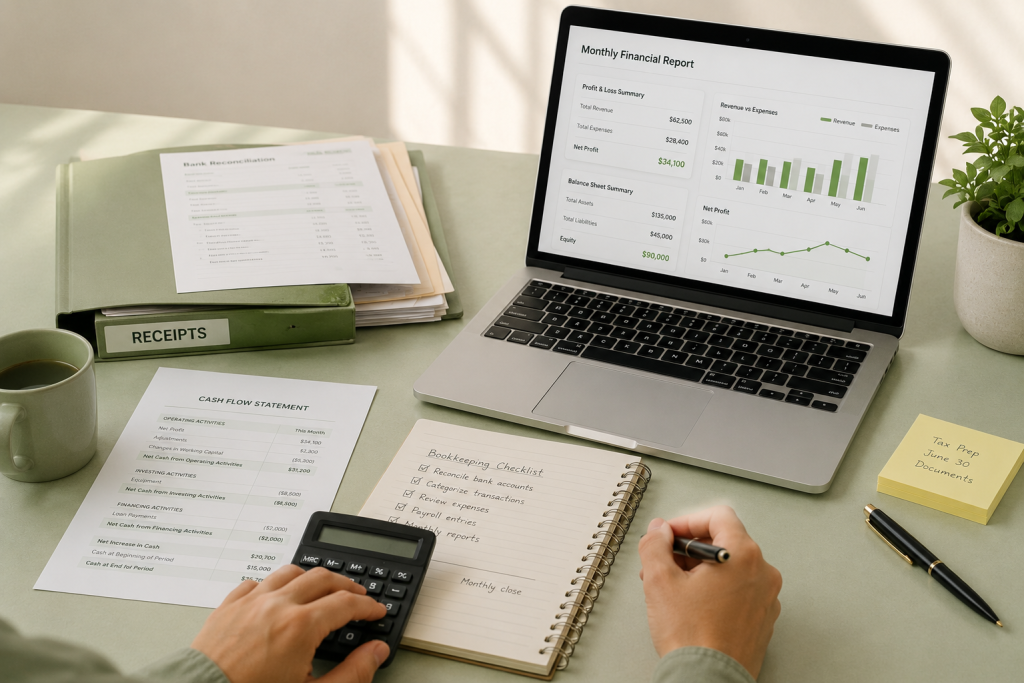
Choosing bookkeeping services for small business comes down to three decisions, made in order. Match the provider model to your complexity, because no amount of diligence fixes a tier mismatch. Verify the process, not the pitch: a written close date, a named bookkeeper, and a sample reporting package.
The owners who get this right stop thinking about their books entirely. Reports arrive on a date they can plan around, tax season is a handoff instead of a reconstruction, and the numbers support decisions instead of trailing them.
If you want to see what that looks like before committing to anything, ask each provider for a sample monthly close package with reconciled accounts, a P&L, and a balance sheet. The section below shows where to get one.
Frequently Asked Questions (FAQs)
How much do bookkeeping services cost for a small business?
Most small businesses pay between $300 and $1,500 per month for outsourced bookkeeping, with the exact figure driven by transaction volume, number of accounts, and whether payroll and invoicing are included. Hourly work typically runs $30 to $90 and suits one-time cleanups better than ongoing service. Entry-level plans usually cover categorization only, so confirm reconciliations and monthly reports are included before comparing prices.
What’s the difference between a bookkeeper and an accountant?
A bookkeeper records and organizes daily financial transactions (categorization, reconciliations, invoicing, and the monthly close), while an accountant interprets those records for tax strategy, financial analysis, and compliance decisions. Most small businesses need consistent bookkeeping year-round and accounting expertise at specific moments like tax filing or financing. Many outsourced providers now staff degreed accountants for bookkeeping work, which blurs the line in your favor.
Should I hire an in-house bookkeeper or outsource?
Outsourcing is usually the better fit until bookkeeping demands 30 or more hours a week of work that has to happen on site. An in-house bookkeeper costs $49,000 in median salary plus 25% to 30% in benefits and taxes, and one person means no coverage or review. Outsourced services deliver the same monthly close for a fraction of that, with built-in backup. In-house starts to make sense when daily operational involvement, like same-day invoicing or on-site inventory counts, is the job.
Is it safe to outsource bookkeeping?
Yes, when the provider uses read-only bank feeds, role-based access to your accounting file, and clear internal controls over who sees your data. Reputable firms never need the ability to move your money; they need visibility, not authority. Ask any provider to walk you through their access model and offboarding process before signing. A professional firm answers in specifics, and you should keep admin ownership of your own accounting file in every case.
What questions should I ask before hiring a bookkeeping service?
Ask who specifically will do your books, what date each month they close, what a sample reporting package looks like, how they handle discrepancies and broken bank feeds, and how much experience they have in your industry. The answers matter less as facts than as signals: a provider with a real process answers immediately and asks questions back. One who hesitates on the close date is selling data entry, not bookkeeping.
How do I know if my bookkeeper is doing a good job?
Good bookkeeping shows up as a consistent close date, reconciled bank and credit card accounts every month, a near-zero uncategorized expense balance, and reports you receive without asking. Spot-check by picking one month and confirming the bank statement balance matches the reconciliation report. If your CPA can prepare taxes from the books without a cleanup project, your bookkeeper is doing their job.
When should a small business hire a bookkeeping service?
The reliable trigger points are spending more than four or five hours a week on books yourself, closing more than three weeks behind, a surprise at tax time, or a financing application that requires current statements you can’t produce. Most owners hit one of these between roughly $250,000 and $500,000 in revenue, but the trigger is the symptom, not the number. If the books stopped answering questions you need weekly, the time was probably six months ago.
Can AI replace a bookkeeper?
AI now handles much of the transactional layer of bookkeeping (categorization suggestions, receipt matching, and bank feed automation), but it doesn’t replace human judgment on accruals, error investigation, compliance questions, or what the numbers mean for a decision. The practical effect is that AI makes good bookkeepers faster and cheap bookkeeping less defensible, since pure data entry is exactly the part software already does. The value of a provider now sits in review, interpretation, and accountability.
How long does it take to switch bookkeeping providers?
A standard switch takes two to four weeks: confirming your admin access to the accounting file, exporting statements and reconciliation reports, a diagnostic review by the new provider, and a cutover at month-end. Catch-up work extends the timeline if your books are behind, since most providers will clean up prior months before taking over the current one. Year-end is the cleanest switch point, but a competent firm can transition mid-year without losing history.
Let FullStaff Handle Your Bookkeeping
If your books close late, your AR aging is a mystery, and your evenings keep disappearing into QuickBooks, more effort won’t fix it. A dedicated professional whose only job is your monthly close will. Ask us for a sample close package (reconciled accounts, P&L, and balance sheet) and see the standard before you commit to anything.
Since 2012, FullStaff has matched growing businesses with dedicated, degreed accounting professionals who work to US GAAP standards: one named person on your books, not a rotating queue.
- Bank and credit card reconciliation, every account, every month
- A consistent monthly close with P&L and balance sheet reporting
- AR aging and cash flow visibility you can plan around
- Catch-up bookkeeping if your books are behind
Here’s how it works: complete a short kickoff form, meet with our team to define the scope, and get matched with your dedicated accounting professional.
References:
- PYMNTS Intelligence — 60% of Small Businesses Struggle With Cash Flow Management
- QuickBooks — 20 Small Business Financial Literacy Statistics
- AICPA — Accounting Firms Report Strong Hiring Outlook, Trends Report
- Bookkeeping, Accounting, and Auditing Clerks
- U.S. Chamber of Commerce (CO—) — Daily Accounting Checklist for Small Businesses