

Growing businesses tend to hit the same wall. Revenue is up, headcount has grown, but the finance function is still running on the same setup from two years ago — one bookkeeper, the same workflows, a month-end close that keeps getting later.
This is the moment most business owners start looking at offshore accounting. Not from a strategic playbook — from a breaking point. For many, the offshore model is how they solve it.
This piece covers what the offshore model actually involves, how the costs compare on both sides, why the Philippines has become the default talent market for U.S. businesses, and how to recognize when a company is operationally ready to make the move.
What Growing Businesses Actually Get
For anyone who wants the overview before the detail:
- Offshore accounting means hiring qualified accounting professionals in another country—most often the Philippines—to support your finance function.
- Common responsibilities include bookkeeping, AP/AR, payroll, reconciliations, financial reporting, and month-end close support.
- Offshore accountants often work in QuickBooks, Xero, NetSuite, and other platforms used by U.S. businesses.
- Dedicated offshore accounting support can start at under $1,000 per month, while comparable U.S.-based hires often cost $4,500–$6,500 monthly.
- Tax planning, compliance sign-offs, and financial advisory work typically remain with a local CPA or controller.
- Most businesses explore offshore accounting after a staff departure, growth surge, or overloaded close process.
The challenge is usually not the model itself — it’s knowing when your business is actually ready for it.


When the In-House Finance Model Stops Scaling
The signs are specific. Month-end close runs past the 10th, then the 15th. Cash flow decisions get made on guesswork. A key person leaves and the books don’t stabilize for three months. A CPA is being paid to clean up entries that should have been current all along.
These are capacity problems, not process problems. The traditional fix — another full-time hire — carries a cost structure that doesn’t pencil out for most businesses between $1M and $8M in revenue.
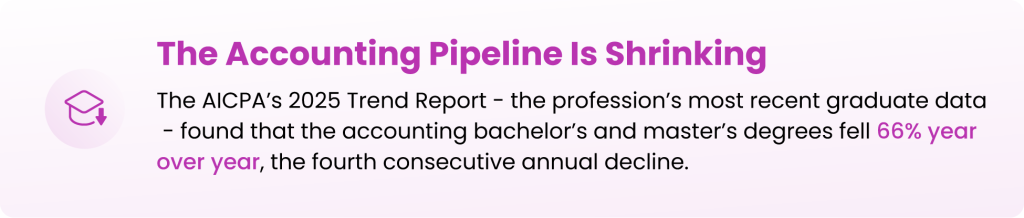
When delayed financial reporting becomes the reason you can’t make confident business decisions, the staffing model is the problem worth solving.
What the True Cost of In-House Accounting Actually Is
A $60,000 annual salary sounds manageable. The fully loaded cost of that hire rarely is.
Add payroll taxes, benefits, software, and turnover risk, and a single in-house accounting hire can push well past $100,000 per year fully loaded — the BLS puts median accountant wages at $81,680 before benefits and overhead are added.2
A U.S.-based senior accountant runs $4,500–$6,500 per month in fully loaded employment terms. A dedicated offshore equivalent — same GAAP training, same platform proficiency — can start under $1,000 per month.
See current pricing by service level for a breakdown of what that looks like.
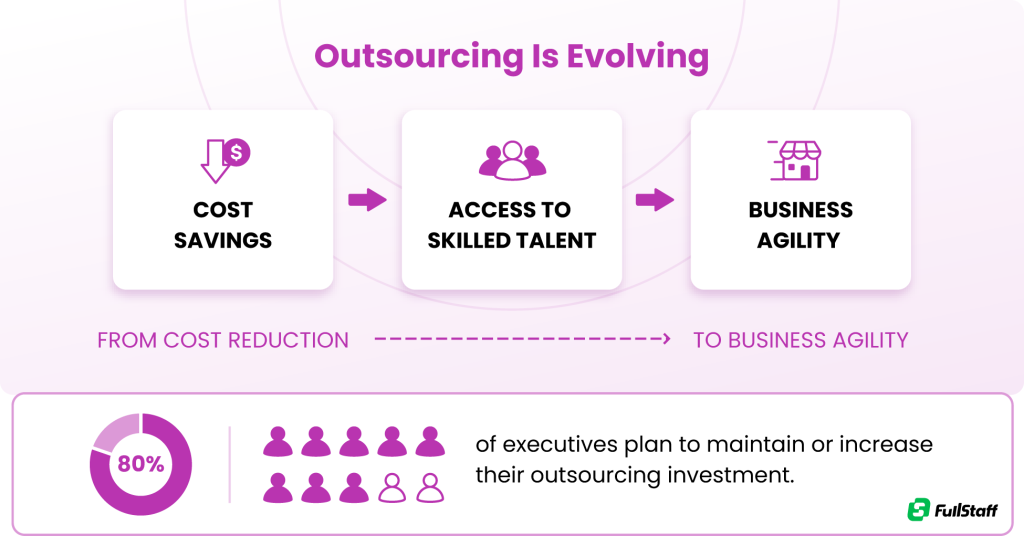
📊 Deloitte’s 2024 Global Outsourcing Survey found that 80% of executives plan to maintain or increase their outsourcing investment — with cost reduction the top driver, followed by access to specialized skills that are increasingly difficult to hire domestically. It reflects a broader shift from outsourcing as a stopgap to outsourcing as a deliberate operating model.3
The hidden cost of turnover
Replacing a bookkeeper typically costs $5,000–$15,000 and leaves a 60–90 day gap where reconciliations slip and owner time fills in. A dedicated offshore professional embedded in your systems is far less disruptive to transition.
The fully loaded cost of in-house accounting is the number most SMBs have never actually calculated — and it’s the number that changes the comparison.
What Offshore Accounting Covers — and What It Doesn’t
The offshore model works best for tasks that are recurring, rules-based, and high in volume — bookkeeping, AP/AR, payroll, reconciliations, financial statement preparation, and month-end close coordination. Most of the day-to-day finance function qualifies.
What stays in-house or with a local CPA: tax strategy and filing, compliance sign-off, and anything requiring real-time judgment. An offshore accountant supports the close — they don’t replace the CPA reviewing the return.
The right question isn’t “does this replace my accountant?” — it’s “does this free my accountant to focus on judgment work instead of transaction processing?”
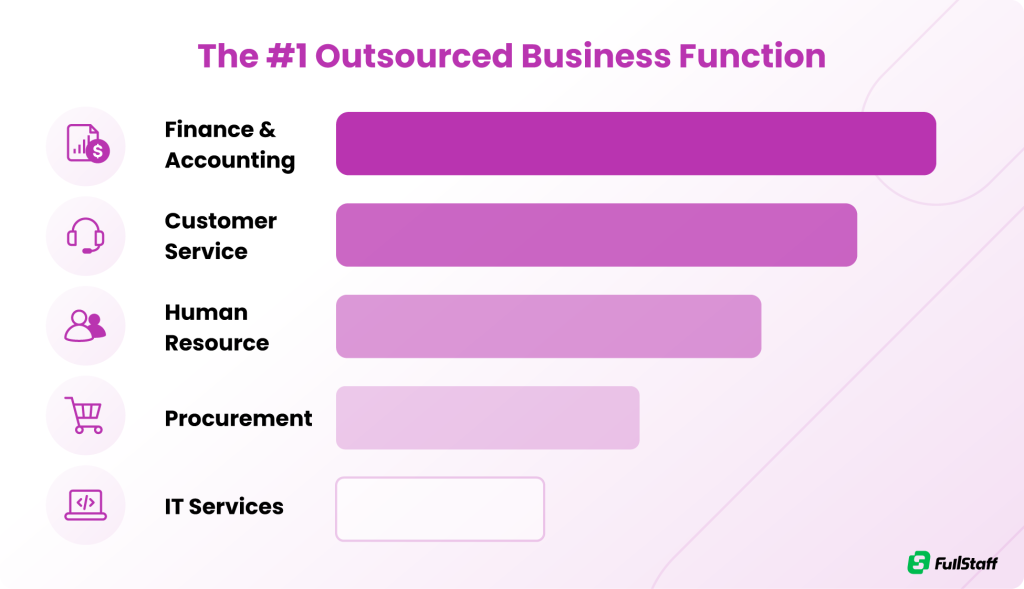
📊 Finance and accounting functions have the highest outsourcing adoption among all business service categories, according to Deloitte’s 2025 Global Business Services Survey — reflecting the maturity of the offshore model for transactional accounting work.4
The offshore model doesn’t hand off financial oversight. It makes oversight possible by keeping routine work current and accurate.
Why U.S. Businesses Rely on the Philippines for Accounting Talent

The Philippines has become the default market for U.S. companies looking to staff their accounting function offshore — and the reasons have more to do with talent than geography.
The country produces more than 150,000 accounting graduates annually, most trained on GAAP and IFRS frameworks from their first year of study.⁷ Many hold local CPA credentials and work daily in QuickBooks, Xero, NetSuite, and other platforms common in U.S. small and midsize businesses. English is an official language and the medium of instruction for business education. Professional norms align closely with U.S. workplace expectations.
This isn’t a market built around cost arbitrage — it’s a talent pipeline built around accounting proficiency for international clients.

📊 Global demand for finance and accounting outsourcing reached $64.86 billion in 2024 and is projected to hit $110.74 billion by 2030, a 9.3% annual growth rate — driven by rising domestic salary pressure and a structural shortage of qualified accounting professionals, per Grand View Research.8
The Philippines isn’t a workaround for U.S. accounting standards — it’s a talent pipeline that was built around them.
How to Know If Your Business Is Ready
The readiness question isn’t about revenue threshold — it’s about specific operational conditions. You’re likely ready if your books have been consistently late, a bookkeeper left in the past year and disrupted operations, or you’re paying your CPA to clean up entries that should have been current all along.
The transition is more straightforward than most owners expect. A good provider handles onboarding, system access, and workflow documentation before the engagement begins — the first 30 days are integration, not disruption.
Offshore accounting isn’t a cost hack — it’s a staffing decision. The savings are real, but the more durable benefit is continuity: qualified staff embedded in your systems, running your close on schedule, producing reports you can actually use. For businesses that have hit the capacity wall, it’s often the fix that makes the finance function work the way it should.
Frequently Asked Questions (FAQs)
What is offshore accounting?
Offshore accounting is the practice of hiring qualified accounting professionals in another country — most commonly the Philippines for U.S. businesses — to manage some or all of a company’s day-to-day finance function. This typically covers bookkeeping, accounts payable and receivable, payroll, reconciliations, and financial statement preparation. The offshore model is used as a capacity solution, not a replacement for financial oversight or CPA-level advisory work.
Is it legal for U.S. businesses to outsource accounting offshore?
Yes. Sending accounting work offshore is legal for U.S. businesses, provided the engagement meets applicable IRS and data privacy requirements. The 2025 IRS guidelines require that businesses provide explicit client consent for any international data transfer, maintain proper documentation under Form 8938 and FBAR requirements, and verify that their provider meets specific data handling standards.
What accounting tasks can be handled by an offshore team?
Offshore teams typically handle bookkeeping, accounts payable and receivable, bank and credit card reconciliations, payroll processing, financial statement preparation (P&L, balance sheet, cash flow statements), and month-end close coordination. More experienced staff can also manage expense reporting, budget-to-actual analysis, and financial dashboards.
How much does offshore accounting cost per month?
For U.S. businesses, dedicated offshore accounting staff can start under $1,000 per month, scaling with hours, scope, and complexity. Compare that to a U.S.-based equivalent, which costs $4,500–$6,500 per month in real employment terms once salary, benefits, payroll taxes, software, and training are factored in. Entry-level bookkeeping plans can start as low as $200 per month, with dedicated full-service accountants starting around $900 per month.
What are the risks of outsourcing accounting offshore, and how are they managed?
The primary risks are data security, communication gaps, and compliance. Data security is managed through encrypted cloud access, SOC 2-certified operating environments, NDAs, and clearly defined access controls. Communication risk is reduced by working with staff in time zones with meaningful U.S. overlap and establishing clear documentation and escalation protocols from the start.
Can offshore accountants work in the U.S. GAAP and U.S. tax standards?
Yes. Accounting professionals in the Philippines are typically trained in both GAAP and IFRS as part of their core accounting education — they’re not localizing a foreign framework to U.S. standards, they were taught those frameworks from the start. Many hold local CPA credentials and have years of experience working exclusively with U.S. clients in platforms like QuickBooks, Xero, and NetSuite.
What’s the difference between the offshore and outsourced accounting models?
While the terms are often used interchangeably, they describe different models. Outsourced accounting typically involves a firm or contractor managing your books using their own processes. Offshore staffing provides a dedicated accountant who works within your systems and workflows, learning your business over time and offering more consistent support.
How long does it take to get an offshore accounting team up and running?
For most engagements, onboarding takes two to four weeks from the initial kickoff. That period covers access provisioning for your accounting platforms, documentation of your existing workflows and chart of accounts, and the accountant’s review of your historical books to understand your current state. The first month of active work is primarily an integration phase — the accountant learns your business while maintaining current operations.
Can AI replace offshore accounting staff?
AI tools can automate specific, repetitive accounting tasks — transaction categorization, invoice matching, basic reconciliation flagging — and have meaningfully compressed the time required for high-volume, rules-based work. What AI doesn’t replace is the judgment, oversight, and interpretation that a qualified accountant provides: catching categorization errors that follow the rules but violate the logic, understanding why a reconciliation variance matters, or knowing which numbers to flag for an owner versus which to resolve internally.
Let FullStaff Handle Your Bookkeeping
If your books are consistently behind and the finance function has become a source of delay rather than clarity, adding more of the same won’t solve it.
Since 2012, FullStaff has placed dedicated offshore accounting professionals with growing businesses across the U.S. — not rotating contractors, but a single dedicated team member embedded in your systems, working to U.S. GAAP standards, with an accounting degree and fluency in the platforms you already use.
A dedicated FullStaff accountant typically covers:
- Monthly bookkeeping and transaction categorization
- Bank and credit card reconciliations
- Accounts payable and receivable management
- Payroll processing and reporting
- Month-end close coordination and financial statement preparation
- Cash flow and expense tracking
Here’s how it works: complete a short kickoff form → we schedule a brief meeting to align on your systems and workflows → your dedicated accountant starts within days.
References:
- The accounting graduate pipeline: Where do things stand?
- Accountants and Auditors
- Global Outsourcing Survey
- 2025 Deloitte’s Global Business Services (GBS) Survey
- Finance And Accounting Business Process Outsourcing Market (2026 – 2033)