

Ecommerce bookkeeping is harder than it looks. A single payout from Shopify, Amazon, or another platform can include sales, fees, returns, shipping costs, and advertising expenses—all rolled into one deposit. That means the money hitting your bank account rarely tells the full story.
Keeping accurate records means tracking revenue, expenses, inventory costs, and taxes across multiple platforms. As sales volume grows, there are more moving parts to track and manage.
In the sections below, we’ll explain why settlement reconciliation takes time, how inventory costs affect profitability, and why bookkeeping becomes more challenging as your ecommerce business grows.
What’s Involved in Ecommerce Bookkeeping?
| Each platform payout includes sales, fees, returns, and other costs that must be separated and recorded correctly. |
| Inventory costs should be recorded when products are sold, not when inventory is purchased. |
| Shopify, Amazon, and TikTok Shop all have different fees, payout schedules, and reporting systems. |
| You may still have sales tax obligations even when a marketplace collects sales tax for you. |
| Accrual accounting provides a more accurate view of profitability than cash-basis accounting. |
| Monthly closing requires matching and reviewing data from multiple sources, not just your bank account. |
| As order volume and sales channels increase, bookkeeping becomes more time-consuming and difficult to manage. |
These challenges are part of how ecommerce businesses operate and grow.
Why Marketplace Payouts Don’t Arrive as Revenue
One of the most common ecommerce bookkeeping mistakes is treating platform deposits as revenue. In reality, they aren’t the same thing.
When Amazon, Shopify, or another platform sends a payout, the deposit has already been reduced by fees, returns, shipping costs, advertising expenses, and other charges. The amount that reaches your bank account is only the net payout—not your total sales. Recording only the deposit can understate revenue and make it harder to track expenses accurately.
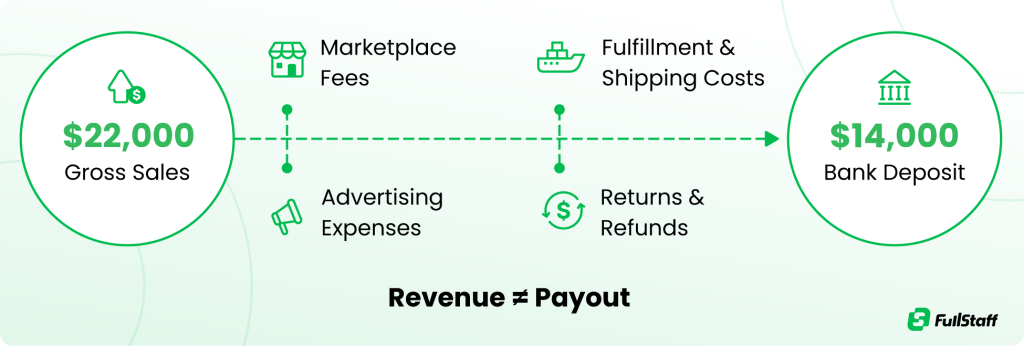
For example, a $14,000 deposit could represent $22,000 in sales after various fees and deductions. Recording the deposit as revenue would understate income and hide important business expenses.
That’s why accurate bookkeeping starts by breaking down each payout before recording it in your books.
What a settlement actually contains
A marketplace payout includes more than sales revenue. It can contain sales, platform fees, fulfillment costs, advertising expenses, returns, refunds, and inventory reimbursements. Each item should be recorded in the correct account to keep financial reports accurate.
Tools like A2X and Link My Books can automate much of this process, but the data still needs regular review to ensure everything is categorized correctly.
The calendar-boundary problem
A sale made at the end of one month may not be paid out until the next. On cash-basis books, that revenue is recorded in the wrong period, which can distort monthly financial reports.
The solution is accrual accounting, which records revenue when it is earned rather than when cash is received. This helps businesses report performance more accurately and keeps revenue in the correct reporting period.1
How Inventory Timing Distorts Gross Margin
The most common COGS error in ecommerce isn’t a miscalculation. It’s a timing mistake — and it makes the P&L unreadable in any given month.
The inventory timing problem
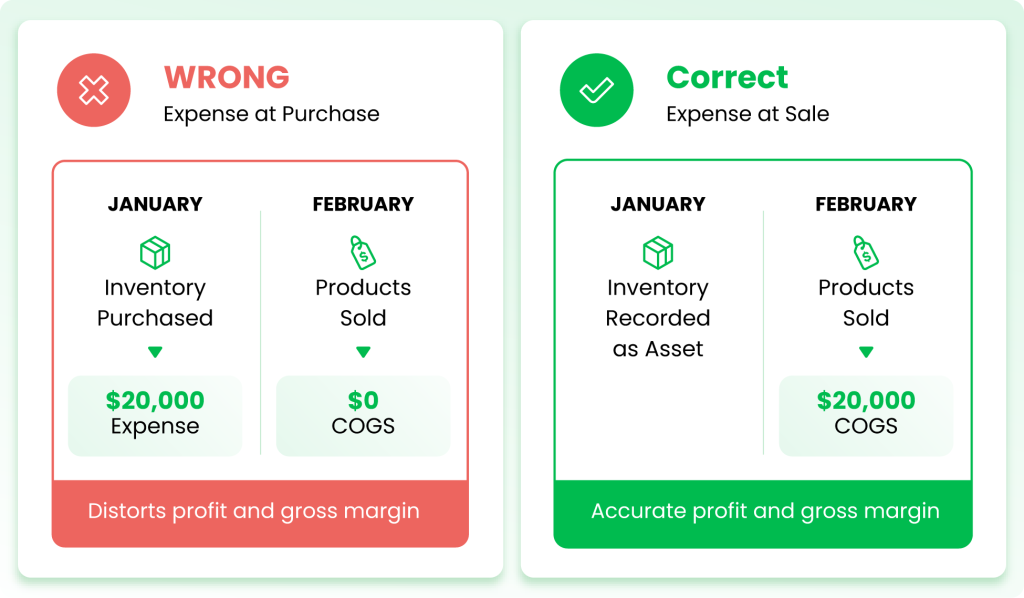
Inventory purchases should be recorded as an asset first and moved to cost of goods sold (COGS) only when the products are sold.2 However, many businesses record inventory as an expense when it is purchased.
When that happens, costs appear in the wrong month. One month may show unusually high expenses, while later months show inflated profit margins. Neither reflects the business’s actual performance.
It also affects the balance sheet. Inventory that has already been expensed no longer appears as an asset, making inventory levels look lower than they really are


Why landed cost matters
Inventory costs include more than the purchase price. Freight, import duties, customs fees, and other shipping costs should also be included.
When these costs are overlooked, products appear more profitable than they really are. That can lead to inaccurate margins and poor pricing decisions.
📊 Accurate inventory costing is essential because inventory values directly affect cost of goods sold (COGS), gross profit, and financial reporting.3
What Changes When You Add a Second Sales Channel
Adding a second sales channel doesn’t just increase sales—it also adds another layer of bookkeeping. Each platform has its own payout system, fees, reports, and reconciliation requirements.
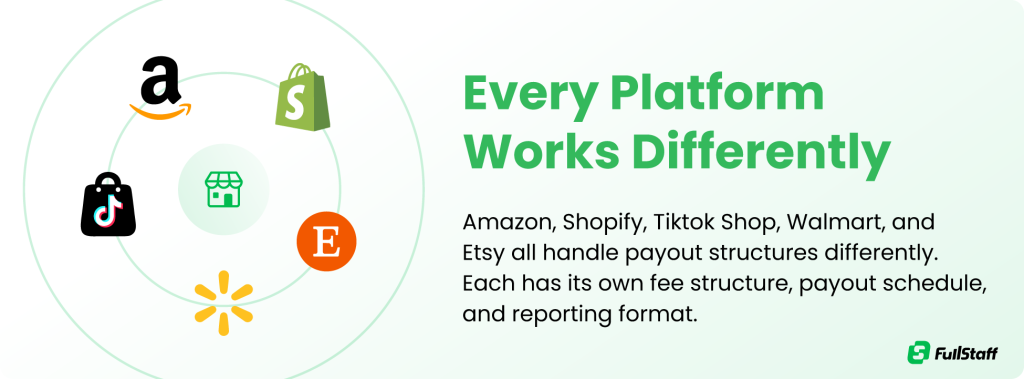
As a result, every new sales channel requires its own reconciliation process. Instead of managing one set of records, you’re managing multiple systems that all need to be accurately reflected in the same books.
Payout schedules rarely match
Different platforms release funds on different schedules. Amazon, Shopify, Stripe, Klarna, and other payment providers each have their own payout timelines.
This means monthly closing often requires reconciling multiple platforms, payout reports, and bank deposits at the same time. As more channels are added, keeping everything aligned becomes more challenging.
The challenge isn’t just transaction volume—it’s keeping data from multiple platforms accurate, organized, and in sync.
Why Sales Tax Tracking Gets Harder as Revenue Grows
Most ecommerce businesses know sales tax becomes more complicated as they grow. What many don’t realize is that sales tax tracking needs ongoing attention—not just a year-end review.
Economic nexus rules can change
Many states require businesses to collect and remit sales tax once they exceed certain sales thresholds. These thresholds vary by state and can change over time.
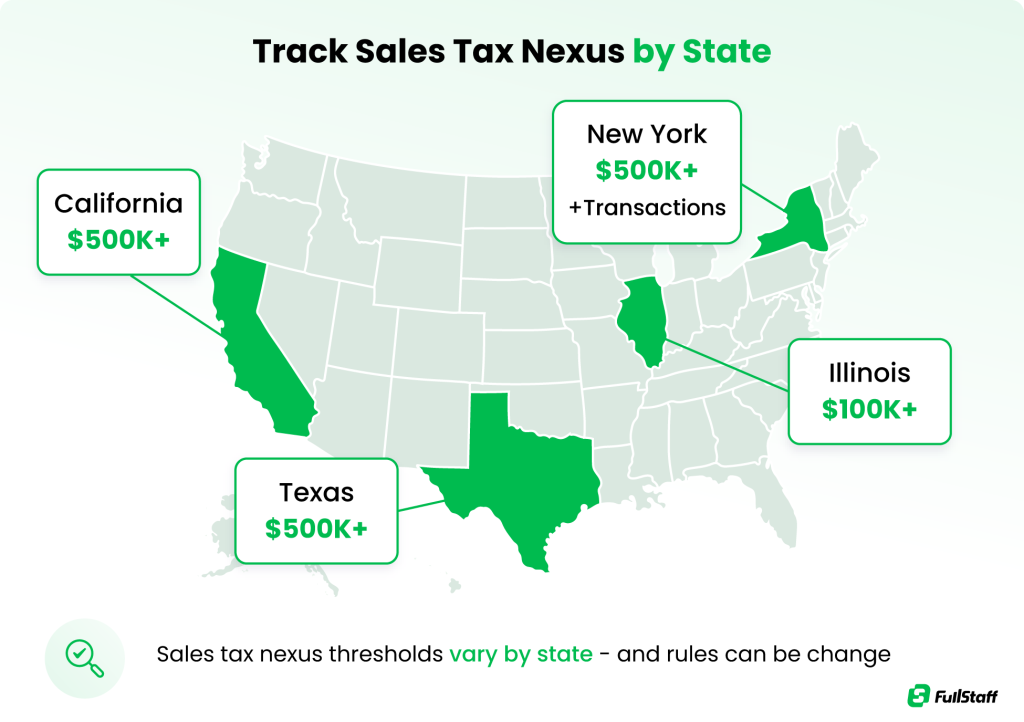
For example, most states use a revenue threshold of $100,000, while California and Texas use $500,000. New York applies a dual threshold based on both revenue and transaction volume. Recent rule changes have also removed transaction-count requirements in some states, making revenue alone enough to trigger nexus.
Marketplace collection doesn’t solve everything
Marketplaces like Amazon often collect and remit sales tax on behalf of sellers, while platforms like Shopify generally do not. Businesses selling through multiple channels may still need to track sales by state and monitor nexus thresholds.
Regular bookkeeping helps identify potential sales tax obligations early, reducing the risk of penalties and compliance issues.
📊 Post-Wayfair, 45 states have enacted economic nexus rules. Illinois removed its transaction-count threshold in January 2026 — revenue alone now triggers nexus exposure, raising the stakes for multi-channel sellers with growing interstate sales.4
Why Bookkeeping for Ecommerce Takes Longer to Close Each Month
Closing the books for an ecommerce business involves more than matching bank transactions. It requires reconciling marketplace payouts, tracking inventory costs, reviewing sales tax obligations, and producing accurate financial reports.
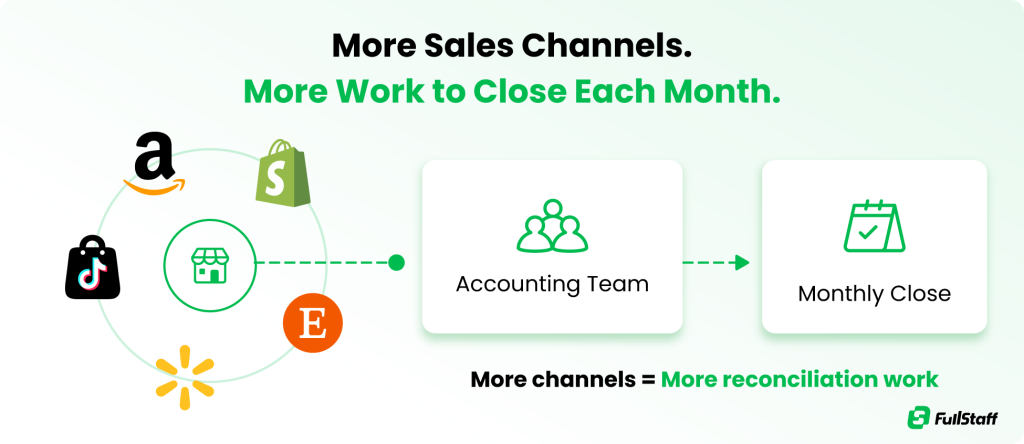
Complexity grows with each sales channel
The challenge isn’t just transaction volume. Each sales channel adds its own payout schedules, fees, reports, and reconciliation requirements.
A business selling across multiple platforms needs a more advanced bookkeeping process than a service business with the same revenue. The goal is to ensure all sales, expenses, and deposits are accurately reflected in the books.
Metolius Tea faced this challenge as it scaled. After hiring a dedicated senior accountant through FullStaff, the company closed its books by the 10th of each month and gained visibility into product-level margins for the first time.

When the close is late, decisions suffer
Pricing, inventory purchases, advertising spend, and cash flow planning all depend on accurate financial data. When reports are delayed, decisions are often made using outdated information.
📊 Around 70% of small businesses don’t have an accountant, while 21% of owners admit they don’t know enough about bookkeeping. As financial operations become more complex, keeping accurate records becomes increasingly difficult.5
From Bookkeeping to Better Decisions

As ecommerce businesses grow, bookkeeping becomes more than a recordkeeping task. Accurate financials depend on consistent processes that keep sales, inventory, marketplace settlements, and taxes aligned across every channel.
When the books are up to date, business owners can make confident decisions about pricing, inventory purchases, advertising spend, and cash flow. When they’re not, those decisions are often based on incomplete or outdated information.
If you’re ready to see what a well-run monthly close looks like, request a sample report from the FullStaff team and see how dedicated ecommerce bookkeeping can improve visibility into your business.
Frequently Asked Questions (FAQs)
Why is ecommerce bookkeeping more complex than regular business bookkeeping?
Ecommerce bookkeeping involves tracking marketplace payouts, inventory costs, returns, fees, and multiple sales channels. Unlike traditional businesses, sales and deposits often occur at different times, requiring more detailed reconciliation. It also requires accurate tracking of inventory, sales tax, and platform-specific transactions to produce reliable financial reports.
What is settlement reconciliation in ecommerce?
Settlement reconciliation is the process of breaking down a marketplace payout into its individual components, such as sales, fees, returns, refunds, and advertising costs. Recording each item correctly helps ensure accurate revenue reporting, expense tracking, and profitability analysis.
How should COGS be tracked for an ecommerce business?
COGS should be recorded when a product is sold, not when inventory is purchased. Inventory is first recorded as an asset, then moved to cost of goods sold as sales occur. For accurate margins, COGS should include the full landed cost of inventory, including purchase price, freight, and import duties.
What is economic nexus and how does it affect my ecommerce business?
Economic nexus means your business may be required to collect and remit sales tax in a state once your sales exceed that state’s threshold. As your ecommerce revenue grows across multiple states, you may become subject to sales tax obligations in more locations, making regular sales tax tracking an important part of financial management.
What’s the difference between cash-basis and accrual accounting for ecommerce sellers?
Cash-basis accounting records revenue when money is received, while accrual accounting records revenue when a sale occurs. For ecommerce businesses, accrual accounting provides a more accurate view of revenue, expenses, inventory, and profitability, especially when payouts and sales occur in different periods.
How often should I close my books if I run an ecommerce business?
Most ecommerce businesses should close their books monthly. A monthly close helps ensure revenue, expenses, inventory, and marketplace payouts are recorded accurately and provides timely financial reports for pricing, inventory, advertising, and cash flow decisions. Ideally, books should be finalized within the first few weeks of the following month.
What does a monthly bookkeeping service for ecommerce actually include?
A monthly bookkeeping service for ecommerce typically includes settlement reconciliation, inventory and COGS tracking, financial reporting, and sales tax monitoring. It should provide accurate monthly financial statements and ensure marketplace sales, fees, and expenses are properly recorded so business owners can make informed decisions.
How does adding a second sales channel affect my bookkeeping process?
Each sales channel has its own fees, payout schedules, and reporting format. Adding a second channel means tracking and reconciling another set of transactions alongside the first. As more channels are added, bookkeeping becomes more complex because all sales, fees, and deposits must be accurately recorded in the same set of financial records.
Can AI replace bookkeeping services for ecommerce?
AI can automate many bookkeeping tasks, such as categorizing transactions, processing settlement data, and identifying discrepancies. However, it cannot replace the expertise needed to interpret financial data, handle complex accounting decisions, or ensure records are accurate. For growing ecommerce businesses, AI works best as a tool that supports bookkeepers rather than replacing them.
When does it make sense to outsource bookkeeping for ecommerce?
It often makes sense to outsource bookkeeping when sales volume, inventory, or the number of sales channels becomes difficult to manage in-house. Signs include delayed financial reports, bookkeeping errors, inventory discrepancies, or spending too much time preparing records for tax season. Outsourcing can help ensure accurate financials while freeing up time to focus on growing the business.
Let FullStaff Handle Your Bookkeeping
Running a multi-channel ecommerce operation means your books need to do more than satisfy the IRS. They need to tell you which products are profitable, which channels are worth the fees, and whether cash flow can support the next inventory order.
Since 2012, FullStaff has provided dedicated virtual bookkeeping professionals to ecommerce businesses across the country. Each client works with a single point of contact — not a rotating service desk — and all work is performed to US GAAP standards.
Services for ecommerce businesses include:
- Settlement reconciliation across Amazon, Shopify, TikTok Shop, and other platforms
- Channel-level margin tracking and SKU-level COGS reporting
- Inventory accounting and monthly balance sheet reconciliation
- Sales tax nexus monitoring across states
Here’s how it works: complete a short kickoff form, meet with your onboarding team, and receive your dedicated bookkeeping professional.
References:
- Tax Guide for Small Business
- Accounting Periods and Methods
- Cost of Goods Sold (COGS) Explained With Methods to Calculate It
- Sales Tax Nexus for Ecommerce Sellers in 2026
- 2026 Accounting & Bookkeeping Trends: 51 Key Statistics