

Your WIP schedule says the project is on track. Your bank account says you can’t cover next week’s payroll.
That gap isn’t a billing problem or a client problem. It’s a bookkeeping problem. And it’s not random — it shows up in five specific places that most contractor bookkeeping setups never flag until the damage is done.
Construction cash flow is complex. Progress billing, retainage, change orders, and subcontractor payments can create gaps between work completed and cash received. If these aren’t tracked accurately, your reported cash position may not reflect reality.
Many contractors have bookkeeping systems in place, but books that satisfy tax requirements don’t always provide a clear picture of cash flow. The five issues below are common areas where inaccurate bookkeeping can become costly.
1. Your WIP Schedule Isn’t Being Updated — So Your Cash Flow Forecast Isn’t Either
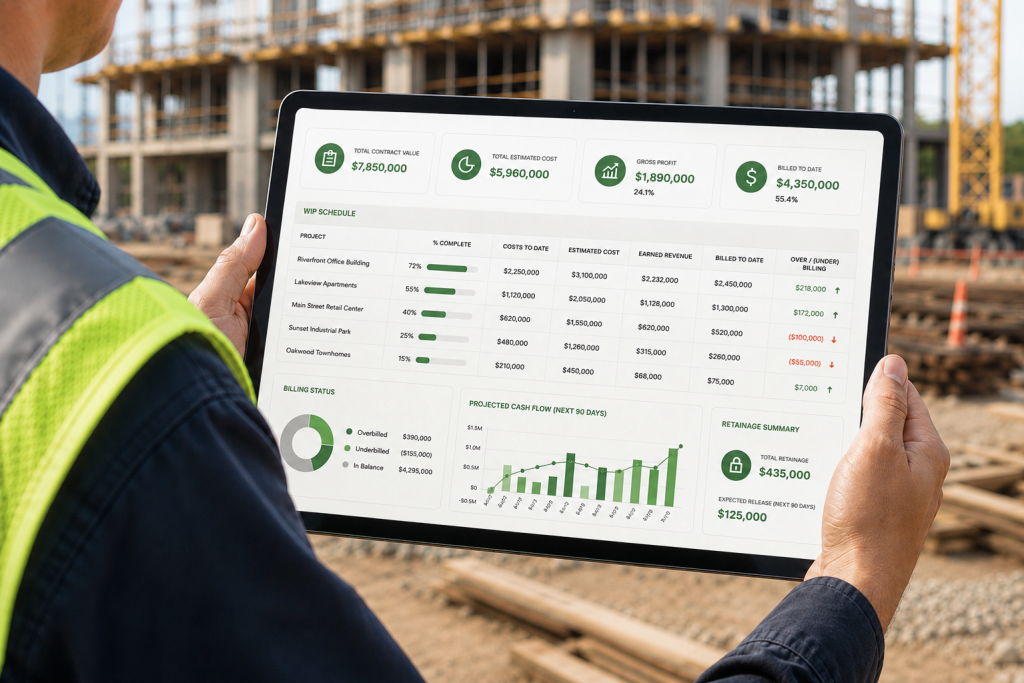
The WIP schedule is the single most important financial document in contractor bookkeeping. Not the P&L. Not the balance sheet. The WIP.
It shows how much revenue has been earned versus billed on each active project. When the report is accurate, it provides a reliable cash flow forecast. When costs and completion percentages aren’t updated regularly, billing becomes inaccurate—and so does the cash flow picture that follows.
AICPA-CIMA guidance on WIP schedules frames these reports as operational blueprints, not compliance documents 1 — a distinction most small contractors never get told. The percentage-of-completion method ties recognizable revenue to a ratio of costs incurred vs. total estimated costs.2 If the estimated costs are wrong — which they often are three months into a six-month job — the percentage is wrong, the billing is wrong, and the cash you think is coming isn’t.
The fix is simple: update WIP schedules monthly using current completion costs, not original bid estimates.
2. Retainage Is Sitting in the Wrong Line on Your Balance Sheet
Most contractors get paid 90–95% as work progresses. The remaining 5–10% — retainage — is held by the owner until project closeout. That’s standard. What isn’t standard is how most bookkeeping for construction companies handles it.
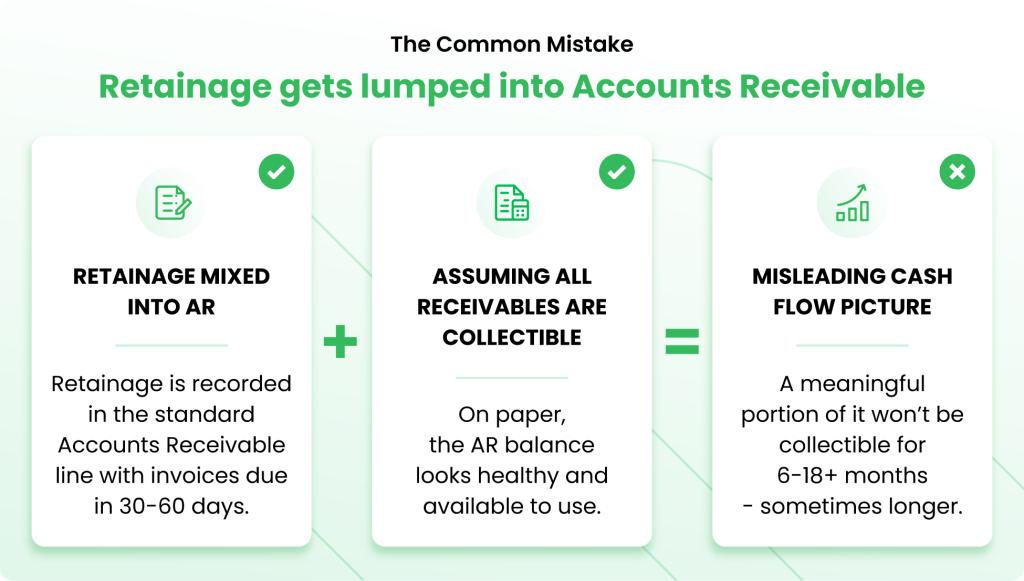
That misclassification can overstate working capital and create a misleading view of available cash. It can also raise concerns for lenders and bonding agents reviewing your financials. Retainage should be tracked separately from current receivables to provide a clearer picture of cash flow.3
On a $2M project at 10% retainage, that’s $200,000 classified as liquid when it isn’t. That number matters.
3. Over- and Under-Billing Are Distorting Your Cash Position in Opposite Directions
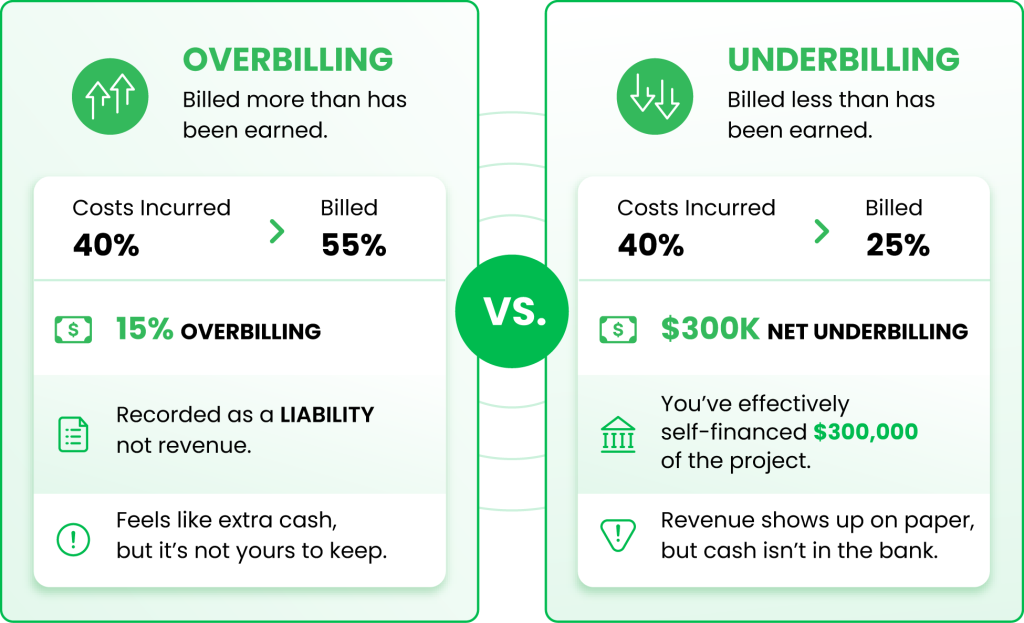
Overbilling and underbilling are two sides of the same problem. Both distort the cash position. Both show up in the WIP schedule — if the WIP schedule is being maintained.
Overbilling occurs when a contractor bills more than has been earned. For example, a project that’s 40% complete on costs but billed at 55% creates a 15% overbilling. Despite providing additional cash upfront, it must be recorded as a liability until the work is completed.
Underbilling is the quieter problem. As NetSuite explains, a contractor carrying $300,000 in net underbillings has effectively self-financed $300,000 of the owner’s project.4 Financial statements may show healthy revenue and profits, yet a lack of cash on hand can create liquidity problems.


Bonding agents review WIP schedules specifically to assess billing accuracy. Chronic underbillings raise questions about whether pay apps are being submitted on time and whether the business can fund work already in progress.
4. The Gap Between Your Billing and Collection
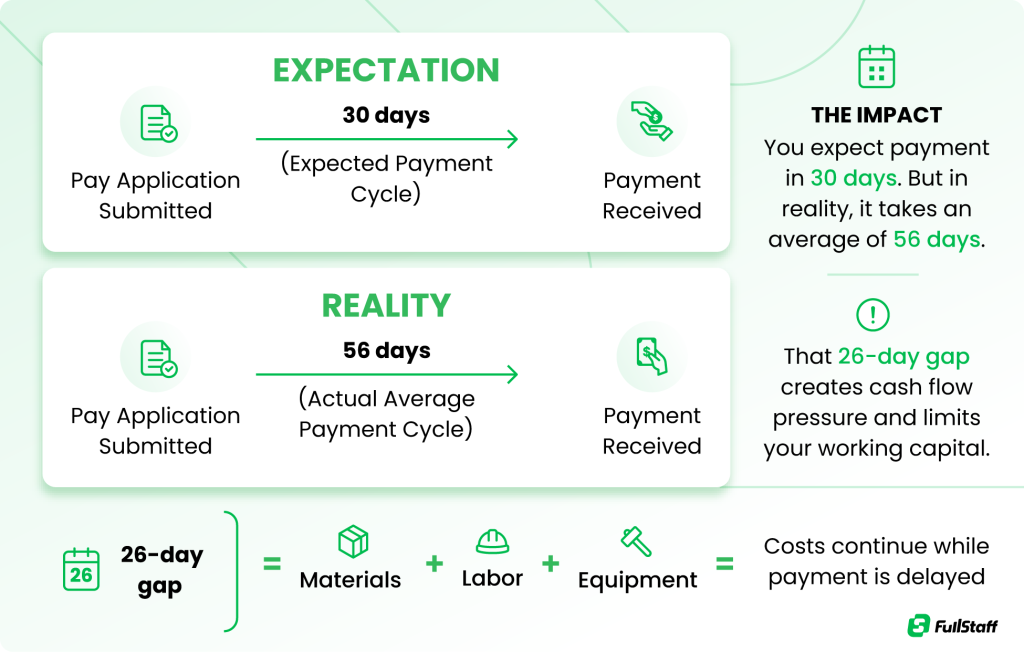
Here’s a number worth knowing: general contractors typically assume subcontractors are paid within 30 days of submitting a pay application. According to Billd’s 2025 National Subcontractor Market Report, the actual average is 56 days.5
That 26-day gap is the quiet driver behind most subcontractor working capital problems. If cash flow projections assume 30-day collection and reality delivers 56, the plan is built on numbers that will never materialize on time. Materials, labor, and equipment don’t wait.
The deeper issue is that books based on invoice dates often create overly optimistic cash flow projections. A better approach tracks expected payment dates, especially when GC payment cycles can range from 35 to 70 days or more.
Not having that data in the books means every month is a surprise.
5. Running Cash-Basis Books Leaves You Blind to Cash Flow
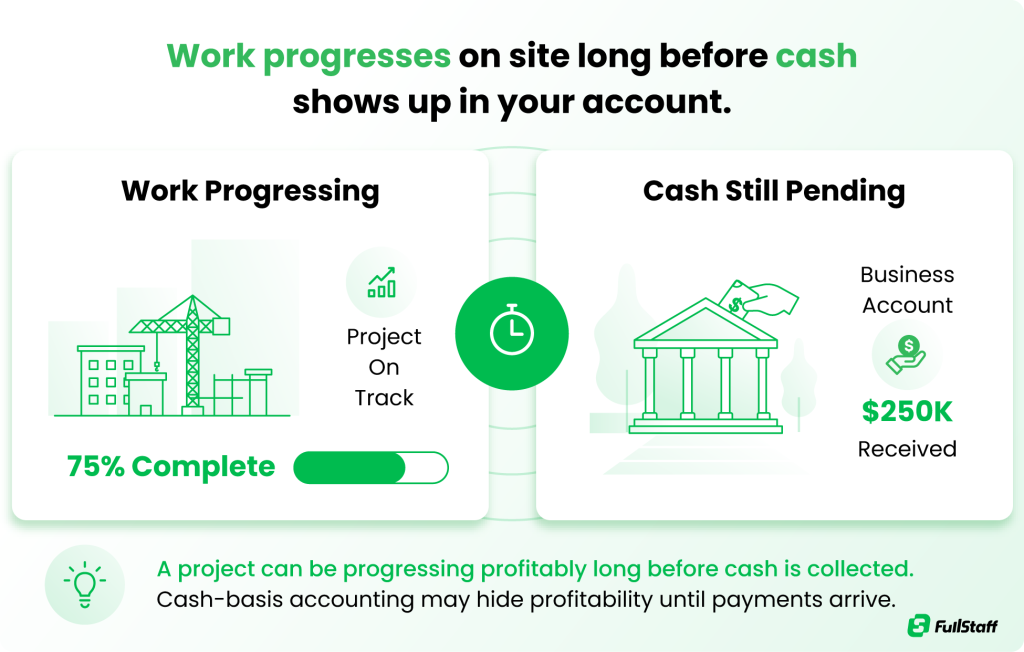
Cash-basis accounting works for many small businesses. For contractors running multi-month projects, it creates a specific blind spot: profit only becomes visible when cash arrives, not when work is earned.
The result is delayed insight into project profitability. A contractor can spend months on a $1.5M project and not know whether it made money until the final payment arrives.
Accrual-based job costing provides a project-level P&L that updates as costs are incurred and work progresses, allowing issues to be identified before the job is complete. Construction bookkeeping services built around job costing deliver real-time margin visibility, while cash-basis books primarily serve as a record of collected payments.
Getting a Clearer View of Cash Flow

Effective contractor bookkeeping helps ensure that billing, retainage, WIP reporting, payment timing, and revenue recognition are accurately tracked. When these areas are overlooked, contractors may be making decisions based on an incomplete financial picture.
The issues outlined above are common among growing construction businesses. Addressing them doesn’t necessarily require new software—it requires someone who understands construction finance running the books correctly every month.
Frequently Asked Questions (FAQs)
What is contractor bookkeeping and how does it differ from standard bookkeeping?
Contractor bookkeeping tracks finances at the project level, including job costs, progress billing, WIP schedules, and retainage. Unlike standard bookkeeping, it helps contractors monitor profitability and cash flow for individual jobs rather than viewing the business as a single financial unit.
How does a WIP schedule affect cash flow for contractors?
A WIP schedule shows how much work has been completed, earned, and billed on each active project. When updated regularly, it helps contractors identify overbillings, underbillings, and potential cash flow issues before they impact operations.
What is retainage in construction and how should it be tracked in the books?
Retainage is a portion of a payment withheld until project milestones are met or the work is completed. It should be tracked separately from regular accounts receivable to provide a more accurate picture of available cash and expected collections.
What’s the difference between overbilling and underbilling in construction?
Overbilling occurs when a contractor bills more than has been earned based on project completion, while underbilling occurs when completed work has not yet been billed. Both affect cash flow and should be monitored through accurate WIP reporting.
Why do construction companies struggle with cash flow even when they’re profitable?
Many contractors recognize revenue before they receive payment. Delays caused by billing cycles, retainage, and extended payment terms can create cash flow challenges even when projects appear profitable on financial statements.
What accounting method should contractors use—cash basis or accrual?
Many growing contractors benefit from accrual accounting because it matches revenue with project costs as work is completed. This provides better visibility into profitability and project performance than cash-basis accounting alone.
Let FullStaff Handle Your Bookkeeping
Managing construction bookkeeping takes consistency. As projects increase, so do transactions, draws, retainage tracking, change orders, and reporting requirements. Meanwhile, your team is focused on running jobs — not maintaining the books.
Since 2012, FullStaff has helped businesses maintain organized, reliable financial records through dedicated bookkeeping support. Every bookkeeper holds an accounting degree, follows US GAAP standards, and works as an assigned team member — not a rotating resource.
FullStaff can help with:
- Job-cost tracking and project reporting
- Bank and credit card reconciliation
- Transaction categorization and coding
- Accounts payable and receivable tracking
- Monthly close and reporting
- Profit and Loss statements
- Financial reporting and insights
- Catch-up bookkeeping support and more
The process is simple: Complete a quick kickoff form so the team can understand your business and workflows, meet with FullStaff to discuss your goals and reporting needs, and get matched with a dedicated accounting professional who helps organize your bookkeeping processes from day one.
References:
- WIP schedules: Blueprints for solid construction accounting
- The Percentage of Completion Method Explained
- Handling Retentions and Holdbacks: Bookkeeping for Construction Payment Terms
- What Is Underbilling in Construction?
- Cash flow problems continue to plague subcontractors: report