

A closed transaction may look straightforward on paper: commission comes in, the brokerage takes its split, and a 1099-NEC arrives at tax time. But behind every payout are expenses, fees, and compliance requirements that can quickly complicate the numbers.
From commission splits and transaction costs to trust-account reconciliation and tax planning, real estate finances involve more than tracking deposits. Without a reliable system, important details are easy to miss.
This guide explains what real estate bookkeeping should cover each month—and the common gaps that can create financial and compliance issues later.
What Real Estate Bookkeeping Actually Covers
Most real estate agents are self-employed, which means taxes aren’t automatically withheld from commission payments. Every commission check requires careful tracking to avoid surprises at tax time.

A reliable bookkeeping system helps record transaction income, track expenses, reconcile trust accounts, and maintain accurate records for quarterly taxes and annual filings.
Why commission income is harder to track than a salary
Salary income is consistent and easy to follow. Commission income, on the other hand, varies from deal to deal and often includes multiple deductions before the final payout reaches your account.
A single transaction may involve brokerage splits, referral fees, transaction coordinator costs, and other expenses. Without detailed records, it’s difficult to know how much you actually earned from each closing—or how much it cost to generate that income.
The expenses agents most commonly skip
The IRS classifies real estate agents as self-employed, making them responsible for keeping accurate records of business expenses throughout the year.1 Some of the most commonly overlooked expenses include vehicle mileage, marketing costs, software subscriptions, client gifts, and professional development.

Effective bookkeeping goes beyond matching bank transactions. It involves accurately categorizing expenses and maintaining organized records throughout the year.
Your Commission Ledger — What to Record on Every Transaction
The commission ledger is the core document in bookkeeping for real estate agents. It captures, at the transaction level, what you earned and what was deducted before you received your disbursement. It bridges the MLS close date and the deposit that eventually hits your account.
Gross commission, splits, and brokerage fees
Each transaction should record key details such as the property address, closing date, gross commission, brokerage split, net commission, and any related fees. Tracking these components provides a clearer picture of what each deal actually earns.

Without that level of detail, you may know your total income for the year but have little insight into which transactions are the most profitable or where expenses are reducing your margins.
Transaction-level costs and the 1099-NEC transaction
Your brokerage reports gross commission on the 1099-NEC, but splits and other fees must be tracked separately. That’s why it’s important to know what each commission check actually nets.
Many agents set aside a portion of every commission payment for taxes, expenses, and savings—something that’s difficult to do without accurate records.2
Why disputes happen in manually managed commission records
Informal tracking can create compounding errors over time. Research on brokerage commission operations found that manually managed commission environments generate disputes in up to 23% of transactions, often due to undocumented calculations and missing deal records.3
A structured commission ledger helps prevent those issues by clearly showing what you earned, what you spent to earn it, and what you kept. Without it, tax reporting and financial decisions may rely on estimates rather than accurate records.


Trust Accounts and Broker Compliance
For brokers managing escrow funds, real estate bookkeeping is a licensing requirement, not a best practice. Trust-account recordkeeping failures are among the most common enforcement actions in every state that publishes audit data.
What trust-account recordkeeping actually requires
Brokers are required to maintain a control journal, separate ledgers for each client or transaction, and records of all undeposited funds. Every deposit and disbursement must be documented and tied to the appropriate ledger.
The trust account balance should always reconcile to the total of all individual client ledger balances. These aren’t best practices—they’re regulatory requirements that apply across real estate jurisdictions.
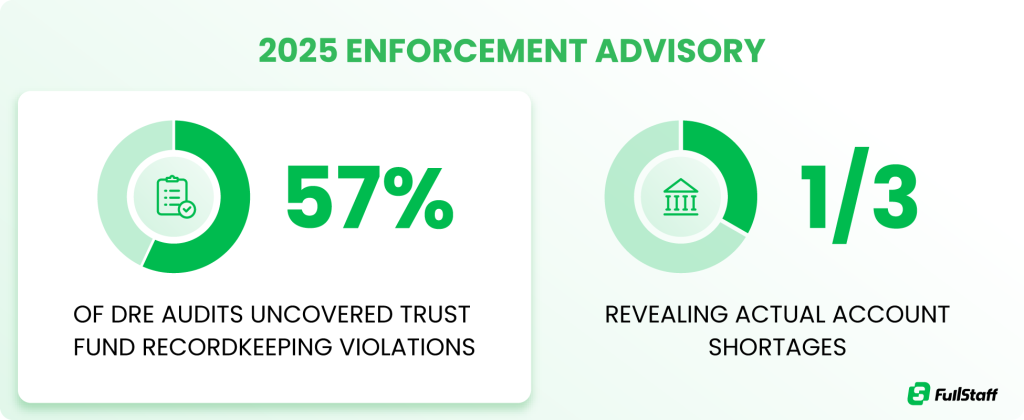
📊 The California Department of Real Estate’s 2025 enforcement advisory found that 57% of DRE audits conducted in fiscal year 2023–24 uncovered trust fund recordkeeping violations, with nearly a third revealing actual account shortages.4
Monthly reconciliation — the requirement most brokers underestimate
Monthly reconciliation means comparing the trust account bank statement, the journal, and the combined total of all client ledgers — then documenting that comparison in a written report retained on file. It must happen every month without exception.
A North Carolina Real Estate Commission case study on trust account violations identified missing ledger entries and skipped reconciliations as the primary patterns in enforcement actions.5
Taxes on Variable Income — How the Math Works
Variable income doesn’t change the tax rules for real estate agents—it simply makes them harder to manage. Because commission payments arrive at irregular intervals, tax obligations can be less predictable throughout the year.
Agents who stay ahead of their taxes typically build a reserve system into every commission disbursement, setting aside funds before the money is spent elsewhere.
Self-employment tax and quarterly estimates
As a self-employed agent, you owe the full 15.3% self-employment tax on net business income, covering both Social Security and Medicare. That comes on top of federal and state income tax.
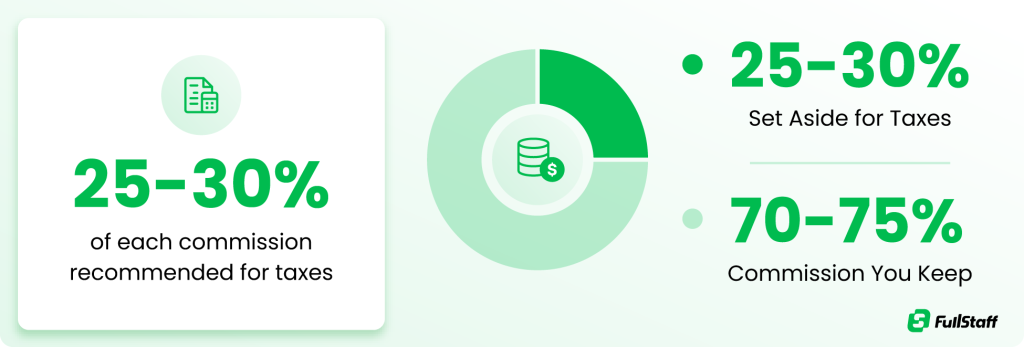
📊 A standard recommendation for agents is to set aside 25–30% of each commission for taxes.6 That discipline is practical only if you know what each commission netted — which is a bookkeeping number, not an estimate.
Deductions agents routinely miss
On Schedule C, the tax form used by self-employed agents, expenses such as vehicle use, home office costs, professional dues, license fees, and the deductible portion of self-employment taxes may be deductible.
These deductions require documentation. The better your records, the easier it is to capture eligible deductions and support them if needed.
Signs Your Current System Has Run Out of Road
Most agents start with a simple setup: a business bank account, a credit card, and a spreadsheet. That may work at first, but as transaction volume grows, so does the risk of missed details and reporting gaps.
As your business becomes more complex, manual tracking can make it harder to monitor income, expenses, taxes, and profitability with confidence.

The visibility gap between revenue and profit
Knowing your gross commissions isn’t the same as knowing your profit. If you can’t quickly determine what remained after brokerage fees, marketing costs, and taxes, there’s a visibility gap in your finances.
Many agents discover this during tax season, when records are spread across multiple systems or are missing altogether.
What a clean monthly close looks like
A clean monthly close includes recording all commission transactions, categorizing and reconciling expenses, reviewing tax obligations, and maintaining an up-to-date profit and loss statement.
For brokers, it also includes reconciling trust accounts before the next month begins. More than a tax requirement, monthly bookkeeping provides the financial visibility needed to make informed business decisions.
Frequently Asked Questions (FAQs)
What records should a real estate agent keep for taxes?
Self-employed agents should keep receipts, invoices, mileage logs, and records supporting home office deductions, as bank statements alone are not sufficient documentation. Most tax records should be retained for at least three years, while records for vehicles, equipment, and other depreciable assets may need to be kept longer.
How do I track commission income as an independent contractor?
Track each transaction separately, including the property address, closing date, gross commission, brokerage split, fees, and net commission received. Detailed records make tax reporting easier and provide a clearer view of profitability.
What is escrow reconciliation and why does it matter?
Escrow reconciliation is the process of verifying that trust account balances match the corresponding client ledger balances. Regular reconciliation helps maintain accurate records and supports compliance requirements.
How often should a broker reconcile their trust account?
Trust accounts should be reconciled at least monthly by comparing bank balances, transaction journals, and individual client ledgers. Keeping reconciliations current helps prevent discrepancies from going unnoticed.
When does a real estate agent need a dedicated bookkeeper?
A dedicated bookkeeper may be needed when transaction volume grows, records begin falling behind, or financial reporting becomes difficult to manage. For brokers, trust-account compliance often makes professional bookkeeping support beneficial sooner.
Let FullStaff Handle Your Real Estate Bookkeeping
Managing real estate bookkeeping takes consistency. As your transaction volume grows, so do the commission entries, trust account reconciliations, and reporting requirements that come with it. Meanwhile, you’re focused on clients and closings — not maintaining the books.
Since 2012, FullStaff has helped businesses maintain organized, reliable financial records through dedicated bookkeeping support. Every bookkeeper holds an accounting degree, follows US GAAP standards, and works as an assigned team member — not a rotating resource.
FullStaff can help with:
- Commission ledger recording and reconciliation
- Trust account recordkeeping and monthly reconciliation
- Bank and credit card reconciliation
- Transaction categorization and expense coding
- Accounts payable and receivable tracking
- Monthly close and financial reporting
- Profit and Loss statements
- 1099-NEC preparation support
- Catch-up bookkeeping and more
The process is simple: complete a quick kickoff form so the team can understand your business and workflows, meet with FullStaff to discuss your goals and reporting needs, and get matched with a dedicated accounting professional who helps organize your bookkeeping processes from day one.
References:
- Licensed real estate agents – Real estate tax tips
- Agent Finances
- 10 best real estate commission management software in USA to streamline payouts & compliance (2026)
- Most Common Enforcement Violations Advisory | California DRE
- Multiple Trust Account Violations — Case Study | NCREC
- How much should I set aside for taxes as a real estate agent?