

Small business bookkeeping is usually built for one purpose: tax compliance. The books satisfy the CPA each April — but whether they tell you anything useful about the business the other eleven months is a different question.
U.S. Bank research, widely cited by SCORE, links poor cash flow visibility to 82% of small business failures.1 Most of those businesses weren’t unprofitable. They just ran out of clarity before they ran out of options.
Here are five signs it’s time to outsource bookkeeping — listed in roughly the order they show up.
Sign 1: The Books Have Become a Second Job

A 2024 Intuit QuickBooks survey found small businesses spend an average of 25 hours a week on manual data entry and reconciliation alone — before billing, expense tracking, or tax prep.2 If your transaction volume is growing or your books are behind, that number climbs.
Once you’re spending more than five hours a week on bookkeeping, it’s no longer a background task. It’s taking time away from sales, operations, and other revenue-generating work.
Outsourced bookkeeping comes with a predictable monthly cost. Doing it yourself carries a hidden cost that grows every week. If bookkeeping keeps interrupting your schedule, outsourcing often makes financial sense even before you factor in mistakes or missed opportunities.
Sign 2: You Can’t Close the Month on Time
A monthly close isn’t just an accounting task—it’s how you know whether the business actually made money. When financials are delayed, decisions about pricing, hiring, and spending are based on outdated information.

Current financials also matter when applying for financing. The Federal Reserve’s 2025 Small Business Credit Survey found that 22% of applicants were fully denied.3 Consistent, accurate books help ensure you’re prepared when funding opportunities arise.
Sign 3: Your Cash Position Is Always a Guess
Most owners know what came in last month. Fewer know what’s actually available after payables, receivables, and upcoming expenses. That’s where cash flow issues begin.
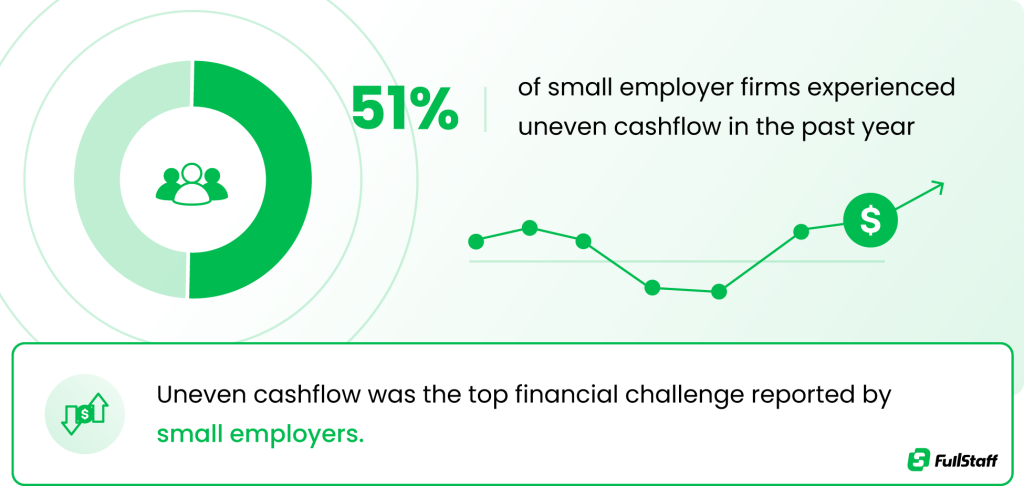
A 2025 SMB compass report found that 51% of small employer firms experienced uneven cash flow during the previous year.4 In many cases, the issue isn’t a lack of revenue—it’s a lack of visibility into the numbers.
An effective outsource bookkeeping provides a clear view of cash on hand, outstanding invoices, upcoming bills, and projected cash position. With current financial data, business owners can make decisions based on facts rather than estimates.
Sign 4: Your Business Has Outgrown Your Current Setup
As businesses grow, financial reporting becomes more complex. New locations, product lines, or entities often create demands that a basic bookkeeping setup wasn’t designed to handle.
Metolius Tea experienced this challenge after reaching seven-figure revenue. By adding a dedicated senior accountant through FullStaff, they shortened their monthly close process and gained access to reliable product-level margin reporting. Their CPA later described their records as the best-kept books in the firm.
When you start needing consolidated reporting, inter-company reconciliations, or entity-level financial statements, it’s often a sign that additional accounting capacity is needed to support continued growth.


Sign 5: Tax Season Brings Surprises — or Dread
A tax surprise is rarely just a tax bill. It’s often a sign that bookkeeping issues went unnoticed for months. Small businesses paid more than $4.5 billion in IRS penalties in a recent year, and bookkeeping errors account for a significant share of those avoidable costs.5
The fix isn’t a better CPA at year-end. It’s a monthly bookkeeping function that catches problems in real time rather than surfacing them in April. If you dread tax season, the underlying problem is twelve months upstream.
Moving Beyond DIY Bookkeeping

The five signs aren’t isolated problems. They tend to show up together — the delayed close, the cash guessing, the tax surprise, the Tuesday-night reconciling all arriving at once. They don’t mean you’ve done something wrong. They mean the business has outgrown what a part-time or DIY setup was built to handle.
Partnering with an outsource bookkeeping provider at this stage isn’t about replacing the people you trust. It’s about adding the capacity your operation needs to keep up. Clean books close on the 10th. Cash flow is a number, not a guess. Tax season becomes a review, not a scramble.
Frequently Asked Questions (FAQs)
What does it cost to outsource bookkeeping for a small business?
Outsourced bookkeeping typically costs between $300 and $1,200 per month, depending on transaction volume and complexity. Simple businesses usually fall on the lower end, while multi-entity operations or inventory-heavy companies pay more. Compared to a full-time in-house bookkeeper, which can cost $55,000–$85,000 annually plus benefits, outsourcing is often the more cost-effective option for small businesses.
What’s the difference between a bookkeeper and an accountant — and which do I need?
A bookkeeper manages daily financial tasks such as transaction recording, reconciliations, payroll, and monthly reporting, while an accountant or CPA handles taxes, compliance, audits, and financial strategy. Most businesses benefit from both, using a bookkeeper to maintain accurate records and a CPA for higher-level financial and tax work.
How do I hand off my books without losing months of history?
Most outsourced bookkeepers begin with a review of your existing records, identify any cleanup needs, and work directly within your current accounting software. Your historical data remains intact because the files stay in your system; only the responsibility for managing and maintaining them changes.
Can I outsource bookkeeping if I already have someone handling payroll or taxes?
Yes. Bookkeeping, payroll, and tax preparation are separate functions and are often handled by different providers. An outsourced bookkeeper works alongside your payroll processor and CPA by ensuring financial records are accurate, reconciled, and ready for tax filing.
What happens to my current bookkeeping software when I outsource?
In most cases, your software remains the same. Outsourced bookkeepers typically work within platforms like QuickBooks Online or Xero, allowing you to retain ownership and access to your financial data. If you’re using spreadsheets or desktop software, transitioning to a cloud-based platform may be recommended during onboarding.
How quickly can an outsourced bookkeeper get up to speed on my business?
Most outsourced bookkeepers become fully operational within a few weeks. The first month is usually focused on reviewing records and completing any cleanup work, while ongoing monthly processes are established by the second month. More complex businesses may require a slightly longer onboarding period.
Let FullStaff Handle Your Bookkeeping
If you’re running a business in the $500K–$5M range and the books are a recurring problem — delayed close, guessed cash position, or a tax season that always brings surprises — the setup isn’t working. It’s not a discipline issue. It’s a capacity issue.
Since 2012, FullStaff has matched small and mid-size business owners with dedicated virtual accountants and bookkeepers — professionals with accounting degrees working to US GAAP standards. Not a rotating team. Not a shared inbox. One person who learns your books and stays.
For general small business clients, that work typically includes:
- Bank and credit card reconciliation
- Monthly close and financial statements
- Accounts payable and receivable management
- P&L statements and cash flow reporting
- Payroll entry and reconciliation
Here’s how it works: complete a short kickoff form to describe your business and what’s currently not working. We’ll schedule a brief call to confirm scope and match you with the right person. From there, your dedicated bookkeeper takes over the monthly work.
References:
- The #1 Reason Small Businesses Fail – And How to Avoid It
- Business Solutions Survey: Intuit QuickBooks business solutions report 2024
- 2026 Report on Employer Firms
- Small Business Cash Flow Report 2025: Key B2B Trends
- Four common tax errors that can be costly for small businesses