

A P&L that’s three weeks behind is a familiar problem for growing businesses. Payroll errors go unnoticed until they’re posted. Revenue numbers exist, but profit margins are estimates, and cash position depends on which invoices someone remembers to track.
As businesses grow, accounting demands often exceed internal resources. Eventually, it’s harder for one team to keep up.
Offshore accounting services help close that gap by adding trained, dedicated accounting professionals to existing workflows—without the overhead of hiring additional in-house staff. The finance and accounting outsourcing market is growing at nearly 8% annually, reflecting the increasing number of businesses making this shift.1
What You Can Actually Hand Off
| Transaction-level bookkeeping: daily entries, categorization, journal entries |
| Bank and credit card reconciliation across all accounts |
| Accounts payable: vendor invoices, payment scheduling, aging reports |
| Accounts receivable: customer invoicing, collections follow-up, AR aging |
| Payroll processing: calculations, tax withholdings, benefits tracking |
| Month-end close support and financial reporting packages (P&L, balance sheet, cash flow) |
| Year-end prep: expense coding, 1099 tracking, documentation for your CPA |
The challenge isn’t finding tasks to hand off. It’s deciding which ones to start with.
When Financial Admin Starts Costing You More Than It Should
Business owners don’t usually decide to do their own bookkeeping. They just never stop.
Revenue grows, transaction volume climbs, and the finance function absorbs more work without anyone formally expanding the team. As a result, reporting falls behind, and important business decisions are delayed because the numbers aren’t ready.
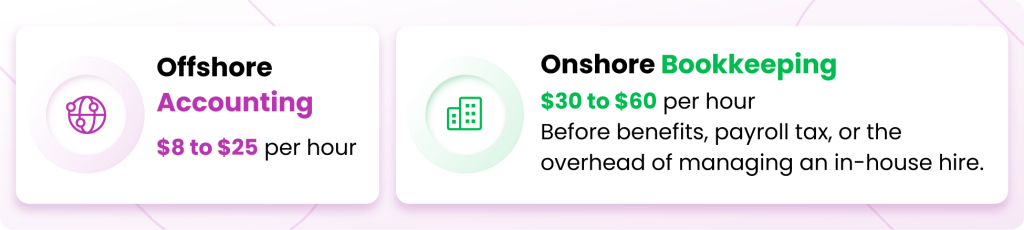
The arithmetic is straightforward. The more important question is what the business could accomplish with the time it recovers. Companies that delay this decision don’t just spend more—they operate on financial data that’s weeks behind. If the current accounting process can’t keep up, offshore bookkeeping support can help close the gap.
The First Tasks to Delegate Through Offshore Accounting Services
The best place to start is the transactional layer: work that’s high-volume, process-driven, and doesn’t require local regulatory judgment.
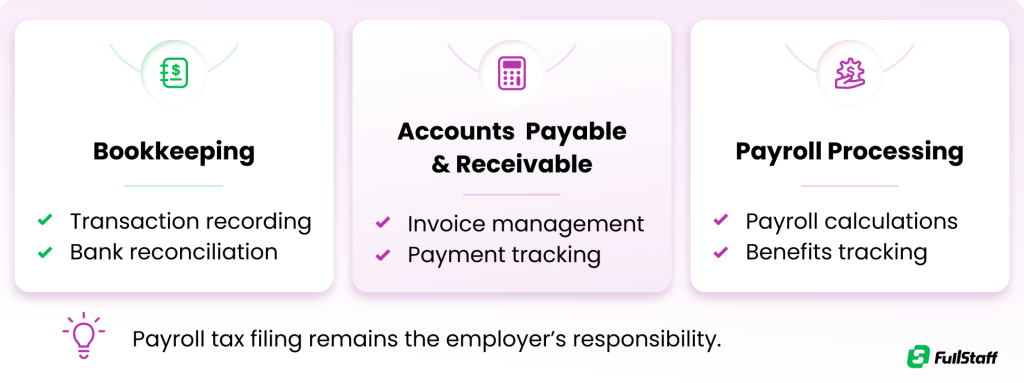
This is where the fastest return lives, and where the handoff is lowest-risk.
Transaction bookkeeping and bank reconciliation
Daily entry coding and bank reconciliation are the foundation of everything else in your close process. Your offshore accountant works inside your existing software (QuickBooks, Xero, or NetSuite), categorizing transactions, posting journal entries, and reconciling all accounts each month.
This is typically the largest time sink in any SMB finance function. Clearing it frees your team for higher-judgment work.
Accounts payable and accounts receivable
Vendor invoice processing, payment scheduling, and AP aging reports are all transferable. On the receivables side, offshore teams handle invoice generation, collections follow-up, and AR aging summaries.
These functions are time-consuming but rule-based. Your offshore accountant follows the process you define. You retain approval authority on payments and write-offs.
Payroll processing
Offshore teams handle salary calculations, tax withholdings, benefits tracking, and year-end payroll reporting.
One important distinction: payroll processing is delegatable. Payroll tax filing is not. The IRS is clear that employers retain tax liability even when processing is handled by a third party.3 Your CPA handles the filings.


What You Can Add as the Relationship Matures
Once your offshore team knows your chart of accounts, understands your reporting cadence, and has worked through a full close cycle with you, the scope expands.
The typical window is 60 to 120 days. By then, the team has enough context to take on work that requires judgment about your business, not just accounting rules in general.
Month-end close and financial reporting
Your offshore accountant can own the monthly close package: P&L statement, balance sheet, cash flow statement, AR and AP aging. Delivered by the 10th of each month.
This is where the value shifts from time savings to decision quality. A consistent close means growth decisions are based on last month’s actual numbers, not numbers from two or three months ago.
Expense management and year-end prep
Receipt coding, expense report review, vendor payment tracking, and 1099 documentation all transfer cleanly to an offshore team. Your CPA takes over at the filing stage.

What Stays With Your CPA or In-House Team
Offshore accounting handles the preparation. Your CPA handles the judgment.
Tax filing stays local. Always. That includes income tax returns, payroll tax filings, sales tax submissions, and any work requiring a licensed signature.
Regulatory compliance decisions, advisory conversations about business structure, and anything requiring client-facing interpretation stay with your onshore team.
The offshore model works because it’s built on a clear division: the offshore team produces clean, well-organized financials; your CPA reviews, interprets, and signs. Trying to offshore the wrong side of that line creates compliance risk, not cost savings.
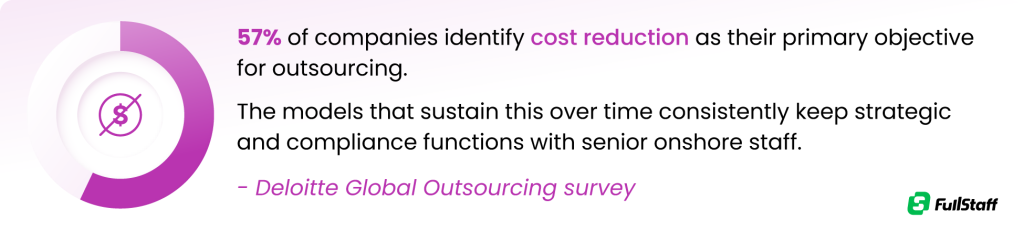
A majority of companies outsource primarily to reduce costs. The arrangements that hold up long-term are the ones that keep advisory and compliance work onshore while delegating execution.
Why Philippine Accountants Work Well With US-Based Businesses
The Philippines produces over 150,000 accounting graduates per year, most of whom study US GAAP and IFRS alongside Philippine accounting standards. English is an official language.

Philippine CPAs take a national licensing exam with pass rates comparable to the US. Most are already familiar with QuickBooks, Xero, and NetSuite before they’re hired.
For US-based businesses using offshore accounting services, onboarding is a conversation about your chart of accounts and your close process. Not about teaching accounting fundamentals.
To understand how the onboarding process works before committing, most providers will walk you through it in a single call.
Conclusion
Offshore accounting services work best when you treat them as a capacity decision, not a cost-cutting shortcut.

Start with the transactional layer: bookkeeping, reconciliation, AP/AR, payroll processing. Add financial reporting and close support once the team has context. Keep tax filing, compliance decisions, and advisory work with your licensed CPA.
The businesses that get the most from offshore accounting aren’t chasing the biggest cost reduction. They’re the ones that get consistent monthly close packages and make decisions from clean numbers.
If your books are running behind your business, a dedicated offshore accounting professional can close that gap, starting with the work that costs you the most time right now.
Frequently Asked Questions (FAQs)
What is offshore accounting?
Offshore accounting is the practice of hiring accountants based in another country to handle your business’s financial functions: bookkeeping, payroll, reconciliation, reporting, and related work. These professionals work remotely but operate inside your existing software, workflows, and reporting structures. The offshore team executes; your local CPA or finance lead retains oversight and handles filings.
What tasks can you delegate to an offshore accounting team?
The most common delegated tasks include daily transaction bookkeeping, bank and credit card reconciliation, accounts payable and receivable processing, payroll calculations and tracking, month-end close support, and financial reporting. Year-end prep tasks (expense coding, 1099 documentation, and financial statement organization) also transfer cleanly, with your CPA handling final filings.
How much can a small business save with offshore accounting?
After accounting for management time, communication tools, and coordination overhead, businesses working with offshore teams typically save 50 to 80 percent compared to equivalent in-house capacity. Offshore accounting professionals generally run $8 to $25 per hour; comparable onshore bookkeeping costs $30 to $60 per hour. For a business at $1 million in revenue, outsourced accounting often runs $10,000 to $15,000 per year, roughly 1 to 1.5 percent of revenue.
What’s the difference between offshore and outsourced accounting?
Offshore accounting specifically means your accounting team is based in another country. Outsourced accounting is a broader term covering any third-party firm handling your books, whether domestic or international. In practice, many outsourced accounting arrangements are offshore, particularly those based in the Philippines or India, because the cost difference between markets makes offshore staffing more sustainable at small-business scale.
Do offshore accountants know US GAAP?
Yes, with a caveat: confirm it explicitly with any provider you’re evaluating. Philippine CPAs study US GAAP as part of their standard curriculum, and many are licensed under requirements that closely mirror US standards. Most established offshore teams also have direct experience with QuickBooks, Xero, and NetSuite. Ask for documentation of their US GAAP training and examples of work produced for US-based clients.
What accounting tasks should I keep in-house?
Tax filing stays local — income tax returns, payroll tax filings, and sales tax submissions. Any work requiring a licensed CPA signature, compliance decisions tied to your jurisdiction, and financial advisory conversations about business structure should stay with your onshore team. The offshore team handles execution and preparation; the local team handles review, interpretation, and filing.
How long does it take to set up an offshore accounting team?
Most businesses are operational within 30 days. The first two weeks cover onboarding: system access, chart of accounts review, workflow documentation, and a parallel run alongside your current process. The first full close cycle is where you validate the setup before handing off fully. Expect to invest real time upfront. The return shows up in month two.
Is offshore accounting secure for sensitive financial data?
Established providers use SOC 2 compliance, NDA agreements, role-based access controls, and regular security audits to protect client data. Before sharing any financial records, ask your provider to document their data security practices and confirm who has access to your accounts. Standard due diligence, not a reason to avoid offshore accounting, but a reason to vet providers carefully.
Can AI replace offshore bookkeepers?
AI automates certain accounting tasks well: transaction categorization, receipt matching, and reconciliation flagging are areas where software handles volume reliably. But AI does not replace an experienced accountant for exception handling, judgment calls on categorization edge cases, or interpreting what the numbers mean for your business. Most offshore accounting teams already use AI tools to process high-volume work faster, while senior staff focus on review and reporting. The combination is more accurate than either alone.
Is offshore accounting a good fit for a small business?
Yes, particularly for businesses between $500K and $5M in revenue that have outgrown basic bookkeeping but aren’t ready to build a full-time internal finance team. The entry cost is low, the setup is fast, and the tasks that consume the most time (transaction coding, reconciliation, AP/AR) are exactly what offshore teams handle well. Start with one function, validate the setup, and expand from there.
Let FullStaff Handle Your Bookkeeping
If your books are three weeks behind and your close process depends on whoever has time that week, that’s a setup problem, not a people problem.
FullStaff places dedicated, degree-qualified accounting professionals with US-based businesses that have outgrown what their current setup can handle.
Since 2012, FullStaff has matched growing SMBs with experienced Philippine CPAs and accountants trained in US GAAP, fluent in English, and experienced with the tools you already use.
- Monthly bookkeeping and transaction coding
- Bank, credit card, and account reconciliation
- Accounts payable and accounts receivable management
- Payroll processing and year-end documentation support
- Month-end close packages and financial reporting
- Ongoing coordination with your US-based CPA
Here’s how it works: complete a short kickoff form, schedule a 30-minute call to walk through your current setup, and get matched with a dedicated accounting professional, not a rotating resource.
References:
- Finance And Accounting Outsourcing Market Size and Share
- Outsourced Accounting Services Cost 2026 — Infinity Globus
- Outsourcing payroll and third-party payers
- The true cost comparison: In-house vs offshore accounting team
- Global outsourcing survey