

Small business owners often assign bookkeeping to whoever has time—the owner, a part-time contractor, or an office manager filling in the gaps. This approach works early on, but it starts to break down as the business grows.
The warning signs are consistent. Reports are late. Reconciliations are skipped. No one can say with confidence what last month’s margin was.
If you’re considering whether to outsource bookkeeping for small business operations, look beyond the cost. The real question is whether your current setup can support accurate financial reporting and growth. This article explains when it’s time to outsource and what to expect from the transition.
What Outsourced Bookkeeping Actually Looks Like
| A dedicated accountant manages monthly categorization, reconciliation, and closing. |
| Receive monthly P&L, balance sheet, and cash flow reports on time. |
| Your books stay in QuickBooks, Xero, or your preferred accounting software. |
| Your bookkeeper provides updates without needing reminders. |
| A senior accountant reviews the work for accuracy. |
| Reports deliver insights, not just tax-ready records. |
| Stay informed without managing the bookkeeping yourself. |
The challenge isn’t finding someone to do the bookkeeping. It’s finding someone who produces financials you can actually run the business on.
Why DIY Bookkeeping Eventually Becomes a Decision Problem
As a business grows, bookkeeping becomes more complex. What worked in the early stages often struggles to keep up.
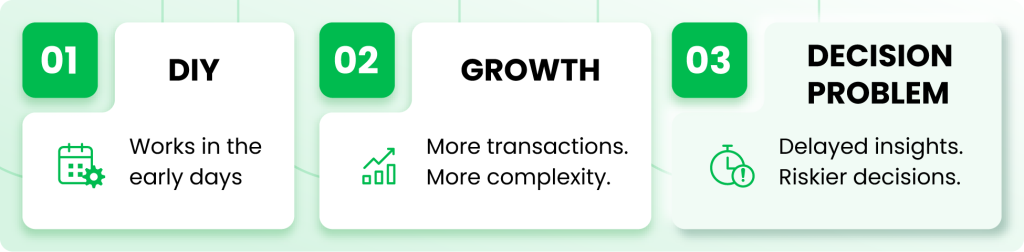
71% of small business owners still use pen and paper or spreadsheets for at least part of their financial management, increasing the risk of human error.1 The result isn’t always chaos—it’s delay: late month-end closes, aging invoices, and cash flow decisions based on outdated information.
Part-time bookkeeping can keep records up to date, but it often lacks the oversight needed to catch errors, monitor aging receivables, and close the books consistently. As the business grows, bookkeeping becomes less about data entry and more about providing accurate financial information for better decisions.
The Real Cost of Delayed or Inaccurate Financial Reporting
Delayed books don’t just slow administrative work—they lead to poor business decisions. Hiring, pricing, and vendor negotiations all become harder when financial data is outdated.
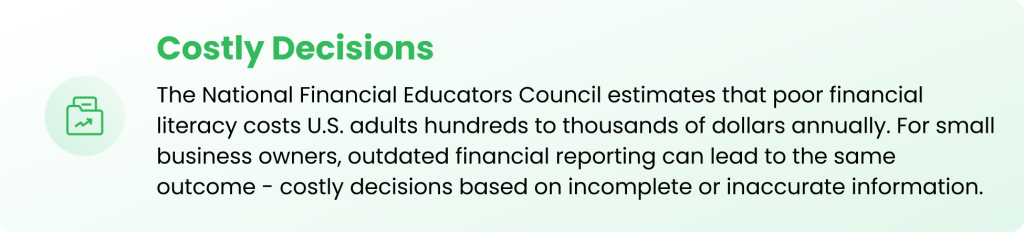
Inaccurate books also increase tax risk. Misclassified expenses and uncategorized transactions can reduce deductions, raise the likelihood of errors, and make year-end cleanup more expensive than maintaining accurate monthly bookkeeping.
Preparing to Outsource Bookkeeping
Before outsourcing, make sure your books are in a workable state. The more organized your records are, the faster your provider can get your bookkeeping up to date and deliver accurate financial reports.
Before engaging a provider:
| Use accounting software, even if the books aren’t perfect. |
| Keep business and personal accounts separate. |
| Know your approximate monthly transaction volume. |
| Identify the reports you need, such as a P&L, cash flow statement, or AR aging report. |
A reputable provider will review your existing bookkeeping process before providing a quote.


What to Look for in a Bookkeeping Provider
When you outsource bookkeeping for small business needs, look beyond pricing. A reliable provider should deliver consistent reporting, clear communication, and a structured review process.
Ask how the books are managed. Find out when monthly financial reports are delivered, whether a senior accountant reviews the work, and if the provider works within your existing accounting software instead of requiring a new platform.
Also ask what you’ll receive each month. Financial statements should be accurate, actionable, and supported by a clear process for resolving questions or correcting errors.
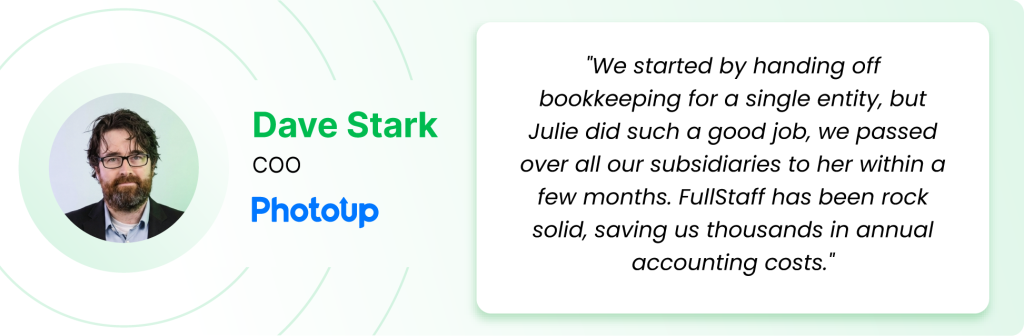
A strong bookkeeping partnership should also scale with your business. For example, PhotoUp started with one entity and one dedicated accountant before expanding to multiple subsidiaries. As the company grew, the same accounting support delivered timely U.S. and global consolidated financial statements, demonstrating the value of consistent processes from the start.
How the Transition Works in the First 90 Days
The first month after you outsource bookkeeping, operations focus on onboarding. Your provider will review your accounting system, gather financial records, and establish a consistent month-end close process.
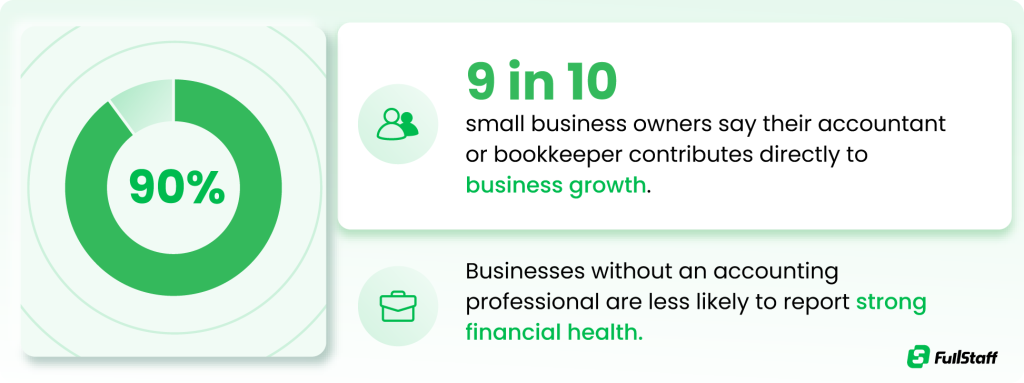
By the second month, you should begin receiving timely financial reports that accurately reflect your business. By month three, the process should feel routine, with reliable reporting that supports confident business decisions.
Pay attention to the onboarding experience. Delayed communication, unclear processes, or unexplained financial reports early on are often signs of service issues that can continue over time.
Making the Right Bookkeeping Decision
When you outsource bookkeeping for small business operations, the goal isn’t simply to delegate tasks—it’s to gain accurate, consistent financial information that supports better decisions.
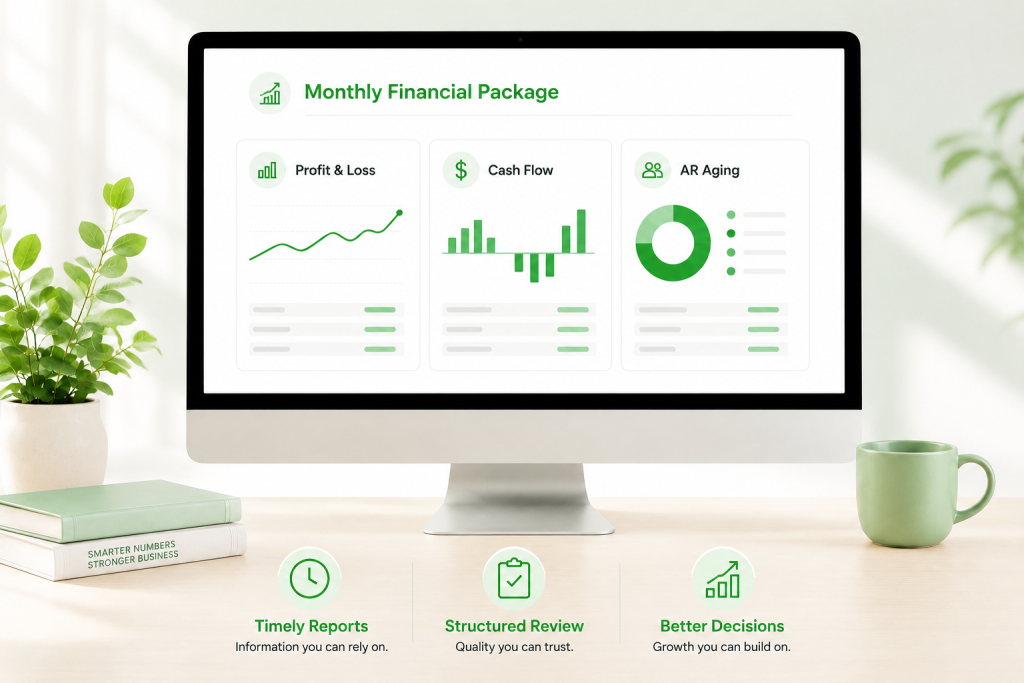
A successful transition starts with choosing the right provider: one that delivers timely financial reports, follows a structured review process, and communicates clearly throughout the engagement.
If you’d like to see what professional monthly reporting looks like, request a sample financial package below, including a P&L, cash flow statement, and AR aging report.
Frequently Asked Questions (FAQs)
How much does it cost to outsource bookkeeping for a small business?
Outsourced bookkeeping for small businesses typically ranges from $200 to $2,500 per month, depending on transaction volume, number of accounts, payroll complexity, and reporting requirements. This compares to an in-house bookkeeping hire whose total compensation — salary, benefits, payroll taxes, and overhead — often runs $45,000 to $60,000 annually for a mid-market employee.
When should a small business outsource its bookkeeping?
The clearest indicator is when the books are consistently closing late — or when the owner can’t identify the current month’s profit without going back to last quarter’s data. Other reliable signals include skipped reconciliations, AR aging that isn’t being tracked, a part-time bookkeeper stretched beyond their bandwidth, and any point where pricing, hiring, or borrowing decisions are being made without current financial data.
What’s the difference between a bookkeeper and an accountant?
A bookkeeper records and categorizes financial transactions on an ongoing basis — bank reconciliations, accounts payable and receivable, payroll entries, monthly close. An accountant interprets those records, handles tax preparation, and provides higher-level financial guidance. Most small businesses need both: a bookkeeper maintaining the books month to month and a CPA reviewing year-end financials and handling tax filings. Outsourced bookkeeping services often include a controller layer between the two — someone reviewing the bookkeeper’s work and flagging issues before they reach the CPA.¹⁰
What does an outsourced bookkeeper actually do each month?
Each month, a bookkeeper categorizes all transactions, reconciles bank and credit card accounts, processes accounts payable and receivable entries, and closes the books. The output is typically a P&L, balance sheet, and cash flow statement. Depending on scope, the work may also include payroll journal entries, loan amortization, depreciation tracking, and AR aging. A competent provider also flags anything unusual — a transaction out of pattern, a reconciliation that doesn’t tie — rather than simply recording what happened and moving on.
Can I outsource bookkeeping if I’m already using QuickBooks?
Most outsourced bookkeeping providers work directly in the client’s existing QuickBooks or Xero file. You grant access to your account, and they do the work in your software — not a proprietary platform they control. This matters for continuity: if you change providers, your books stay with you in your own account with no migration required.
What should I look for when hiring an outsourced bookkeeper?
The most important criteria are a defined close schedule, controller-level review of the work, software compatibility, and a clear description of the monthly deliverable. Ask specifically: when will I receive my financials each month, who reviews the work before it reaches me, and what happens if I have questions about a line item? Businesses that have had a bad experience with outsourced bookkeeping usually trace it back to one of three things: rotating staff with no continuity, no oversight above the data-entry level, or deliverables that arrived without explanation when something looked off.
Is outsourced bookkeeping safe — what about data security?
Reputable outsourced bookkeeping providers work through cloud-based accounting software — QuickBooks Online, Xero — with permission-based access controls. The provider gets access to the bookkeeping function; you retain full administrative control and can revoke access at any time. Before engaging a provider, ask who has access to your accounts, how access is managed when a staff member leaves, and whether they carry professional liability coverage. These are standard questions, and a credible provider will have direct answers.
What happens to my books if I switch bookkeeping providers?
If the work is being done in your own accounting software, the transition is relatively clean: revoke the outgoing provider’s access, grant access to the incoming one, and share any process documentation and open items. The main risks are timing — switching mid-month can create a gap in the close cycle — and documentation, where the incoming provider needs to reconstruct context if categorization decisions weren’t clearly recorded.
Can AI replace bookkeepers for small businesses?
AI can automate repetitive bookkeeping tasks — transaction categorization, bank feed matching, invoice processing — and accounting software platforms are increasingly building these features in. But AI doesn’t replace the judgment required for error detection, financial interpretation, exception handling, and compliance review. A transaction that looks like office supplies might be a capital expenditure. Most growing businesses use AI to compress the transactional workload and free senior staff for higher-value oversight — not to remove human accountants from the process.
How do I know if my current bookkeeping is accurate?
The quickest check is a bank reconciliation: every account should tie to your bank statement at month-end with no unexplained differences. Beyond that, run a P&L for the last quarter and ask whether the numbers reflect what you know happened in the business — large expenses categorized correctly, all revenue streams showing up, owner compensation accounted for clearly. If you can’t answer those questions from the financials, or if the person maintaining the books can’t explain any line item on request, the accuracy question has already answered itself.
Let FullStaff Handle Your Bookkeeping
Managing the books yourself — or with a part-time bookkeeper who’s already stretched — means your financial reports are always behind the decisions you’re trying to make. A dedicated accountant who closes your books on a consistent schedule changes that.
Since 2012, FullStaff has matched growing businesses with experienced, US GAAP-trained accountants based in the Philippines — not a rotating pool of contractors, but a dedicated professional who learns your business and stays with it.
Services for small businesses include:
- Bank and credit card reconciliation
- Monthly close and P&L reporting
- Cash flow statement and AR aging
- Accounts payable and receivable management
- Catch-up bookkeeping for businesses behind on their books
Here’s how it works: complete a short kickoff form, meet with our team to confirm scope and timeline, then get matched with a dedicated accountant within days.
References:
- Quarterly survey of small businesses in the US, Canada, the UK, and Australia
- 2025 Financial Illiteracy Cost Results
- Accounting professionals are key partners in the fight against inflation